Surface Engineering of MXenes for Biomedical Uses: Functionalization Strategies and Application Trends
Sehyeon Park, Hee Jeong Byun, Jae Young Lee

TL;DR
This review discusses how modifying the surface of MXenes can improve their stability and usefulness in biomedical applications like tissue engineering and biosensing.
Contribution
The paper categorizes MXene functionalization strategies and proposes design principles for next-generation biomedical platforms.
Findings
Surface engineering enhances MXene biostability and biocompatibility.
Functionalization enables MXenes to perform specific biomedical functions such as antibacterial therapy and bioimaging.
The review categorizes strategies based on mechanisms and intended biomedical functions.
Abstract
MXenes, a class of 2-dimensional transition metal carbides and nitrides, have emerged as highly versatile materials in the biomedical field because of their high electrical conductivity, hydrophilicity, large surface-area-to-mass ratio, and compositional versatility. Despite their promise, the inherent instability in physiological environments, lack of inherent biological activity, and potential toxicity remain major challenges limiting their biomedical applications. To address these issues, a wide range of surface engineering strategies have been developed, including covalent and noncovalent functionalization with various biomolecules, biomedical polymers, and nanomaterials. Specifically, the surface modification of MXene is intended to improve biostability and biocompatibility, and confer specific biological functions for applications in tissue engineering, biosensing, antibacterial…
Genes, proteins, chemicals, diseases, species, mutations and cell lines named across the full text — each resolved to its canonical identifier and authoritative record.
Click any figure to enlarge with its caption.
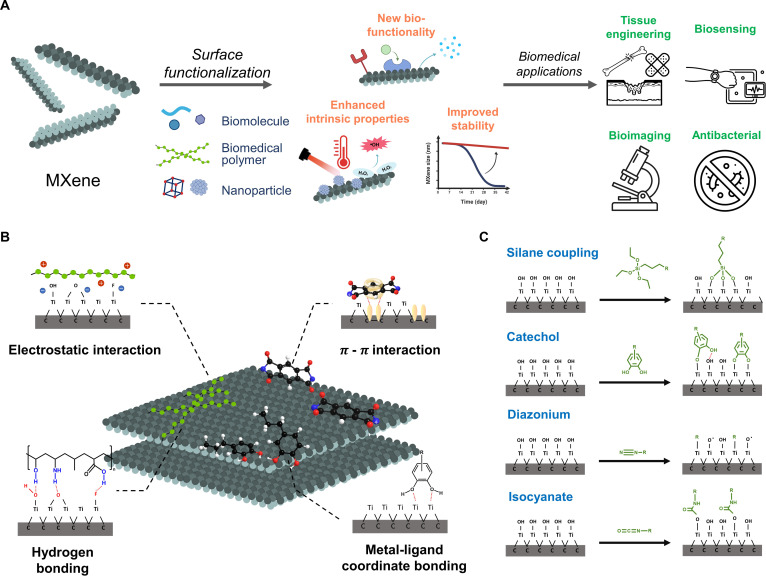 Fig. 1
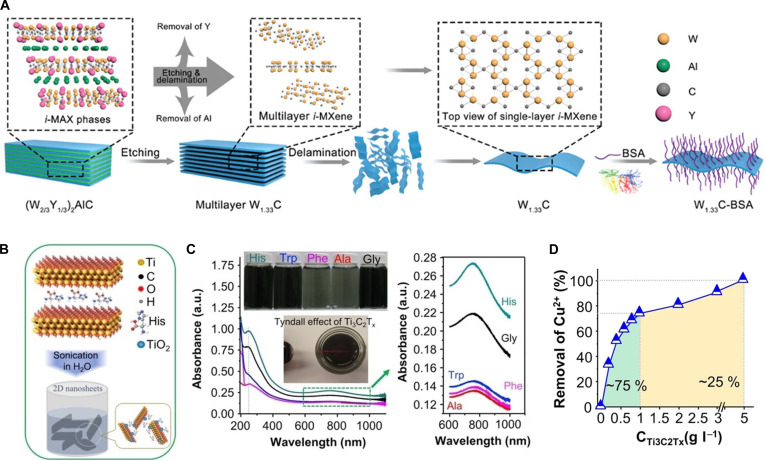 Fig. 2
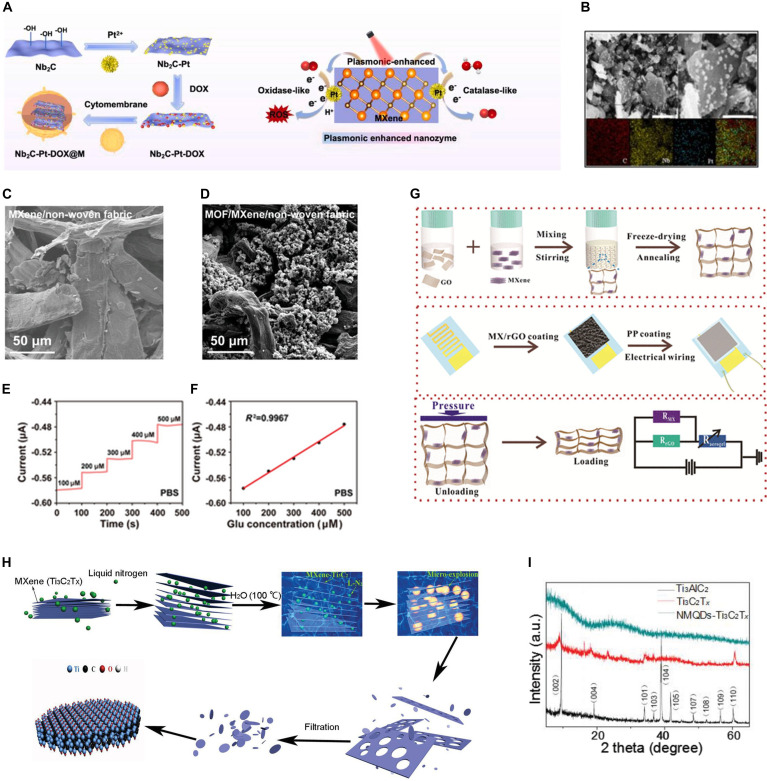 Fig. 3
| Strategy category | Functionalization technique | MXene type | Functionalization component(s) | Application | Description | Ref. |
|---|---|---|---|---|---|---|
| Noncovalent | Electrostatic interaction | Ti3C2T | Porphyrin | Oxidation resistance | Reduced MXene degradation in water | [ |
| Ti3C2 | Cationic modifier (DTAB, OTAB, DDAB) | Improvement of dispersion and stability | Uniform dispersion and strong interfacial adhesion; improved thermal stability | [ | ||
| Ti3C2 | Papain | Enzyme immobilization | Enhanced pH and thermal stability; 39.25% activity after 20 d; 50% activity after 5 reuse cycles | [ | ||
| Ti3C2T | PEI | Water desalination | Surface charge induction, high salt rejection and water permeance | [ | ||
| Nb2C | PEI | Tissue engineering | Introduction of primary amine groups; formation of Schiff base formation with aldehyde groups in the hydrogel matrix | [ | ||
| Nb2C | DOX | Drug delivery | Tumor cell death with NIR-triggered hyperthermia | [ | ||
| Ti3C2 | DOX | Drug delivery | Promoted tumor targeting and ablation | [ | ||
| Hydrogen bonding | Nb2C | PVP | Photothermal therapy | Excellent biocompatibility; degradation by myeloperoxidase | [ | |
| Nb2C | PVP | Cancer treatment, physiological stability | Improved physiological stability biocompatibility; chemodynamic therapy | [ | ||
| Ti3C2T | Ethanol, acetone, cyclohexane | Ion sieving and separation | Outstanding sub-1 nm ion rejection; selective proton–cation transport ratios | [ | ||
| KOH-treated Ti3C2T | PVA | Mechanical property reinforcement | Extensive hydrogen bonding with O-rich MXene; improved hydrogel mechanical properties | [ | ||
| Ti3C2T | PVA | Electronic skin | High stability in acidic/basic environments; high elastic modulus; pressure-sensing performance | [ | ||
| Ti3C2T | DNA | Biosensing | Nucleocapsid gene detection in saliva with low detection limit and high specificity | [ | ||
| Metal–ligand coordinate bonding | Ti3C2T | PDA | Solar absorption | High light absorption of solar spectrum at broad wavelength | [ | |
| Ti3C2T | PDA | Substrate adsorption and stability improvement | Strong substrate adhesion; hydrophobicity; enhanced adsorption capacity | [ | ||
| Ti3C2T | ADPOA | Oxidation and stability improvement | Stable colloidal dispersions in multiple organic solvents; improved oxidation resistance | [ | ||
| Ti3C2T | PDA | Mechanical and oxidative stability improvement | Tightly aligned MXene films with improved tensile strength, elongation, and conductivity; resistance to oxygen and moisture | [ | ||
| Nb2C | PDA | Tissue engineering | Hydrogel adhesion with tissue; decreased degradation | [ | ||
| π–π interaction | Ti3C2T | 6C-DQPZ | Energy storage | High reversibility; excellent retention | [ | |
| Ti3C2 | PDIsm | Photocatalysis | Facilitated π–π stacking-induced charge separation; photocatalytic oxidation | [ | ||
| - | PI | Energy storage | Enhanced electron transport; structural stability | [ | ||
| Covalent | Silane coupling | Ti3C2T | APTES, GOx, DOX, PEG | Drug delivery | Alleviation of tumor hypoxia; enhanced chemo/photothermal cancer therapy | [ |
| Ti3C2T | APTES, lipase | Enzyme immobilization | Enhanced catalytic activity; improved pH tolerance; thermal stability; reusability | [ | ||
| Ti3C2 | APTES, MNP | Drug delivery and tissue engineering | Multi-stimuli responsiveness; controllable drug release | [ | ||
| Ti3C2 | APTES, Thioketal, DOX, PDA | Drug delivery | ROS- and pH-responsive drug release | [ | ||
| Ti3C2T | APTES | Oxidation rate control | Improved stability in air | [ | ||
| Ti3C2T | APTES | Pb2+ adsorption | Interaction with lead ions; increased adsorption capacity | [ | ||
| Ti3C2 | APTES | Biosensing | Sensitive detection of carcinoembryonic antigen | [ | ||
| Ti3C2T | FAS | Hydrophobicity control | Enhanced durability; self-cleaning; liquid-repellency | [ | ||
| Ti3C2T | OTS | Hydrophobicity control | Colloidal stability in nonpolar solvents | [ | ||
| Ti3C2T | KH570 | Pb2+ adsorption | Increased specific surface area; thermostability; ion-exchange capacity | [ | ||
| Ti3C2 | PFDTMS | Hydrophobicity control | Salt-blocking in MXene membrane | [ | ||
| Ti3C2T | Polyelectrolyte brush, SPEEK, chitosan | Proton transfer membrane construction | Enhanced proton conductivity in membrane | [ | ||
| Carbodiimide coupling | V2C QD | PEG, TAT peptide, exosome | Bioimaging (PAI, MRI) and photothermal therapy | Induced gene/protein damage under NIR for tumor treatment; PAI and MRI | [ | |
| Ti3C2T | PEG | Stability and processability enhancement | Improved dispersibility; biocompatibility | [ | ||
| Ti3C2T | Serine | Biosensing | Supramolecular hydrogen bonds for self-healing | [ | ||
| Catechol conjugation | Ti3C2T | Catechol (dopamine, pyrocatechol) | Functionalization platform | Fluorescein labeling | [ | |
| Isocyanate conjugation | Ti3C2T | Dodecyl isocyanate | Hydrophobicity control | Improved nanofiller dispersion in thiourethane matrix | [ | |
| Ti3C2T | Octadecyl isocyanate | Stability enhancement | Physical stability in water | [ | ||
| Phosphonic acid conjugation | Ti3C2T | Alkylphosphonic acid | Oxidation resistance control | Hydrophobicity; long-term oxidation stability; nonpolar compatibility | [ | |
| Diazonium conjugation | Ti3C2T | Diazonium | Metal ion adsorption | Ultrafast adsorption kinetics; high maximum adsorption capacities | [ | |
| Ti3C2T | Diazonium | Energy storage | Increased capacitance; reduced impedance; stable cycling | [ |
| Functionalizing agent | MXene type | Functionalization component | Application | Description | Ref. |
|---|---|---|---|---|---|
| Biomolecule | Ti3C2T | Amino acid (His, Trp, Phe, Ala, Gly) | Oxidation stability enhancement | Prevention of MXene oxidation by modification with aliphatic amino acids | [ |
| Ti3C2 | ATP, Mn3(PO4)2 | Biosensing | Uniform nanoparticle growth; fast superoxide sensing | [ | |
| W1.33C | BSA | Bioimaging | Prolonged stability at tumor sites; enhanced in vivo CT and PA imaging | [ | |
| Ti3C2T | Gly, Leu | Inhibiting restacking | Increased interlayer spacing; improved cycling stability | [ | |
| Ti3C2T | GOx, Fe2O3 | Antibacterial application | Efficient bacterial membrane disruption; promoted ROS and Fe2+ accumulation | [ | |
| Ti3C2 | GOx | Tissue engineering | Controlled GOx release to reduce glucose and pH levels | [ | |
| Ti3C2 | Tannic acid, Fe2+/Fe3+ | Tissue engineering and antibacterial application | Catalase- and peroxidase-like activity to alleviate hypoxia | [ | |
| Ti3C2 | Hemoglobin | Biosensing | Facilitated Hb–NO2− collisions; low detection limit and broad linear range | [ | |
| Biomedical polymer | Ti3C2T | HA | Oxidation stability enhancement | Long-term oxidation resistance and structural stability in various solutions | [ |
| Ti3C2 | HA, DOX | Drug delivery; photothermal therapy | Enhanced biocompatibility; pH-responsive drug release; tumor-specific accumulation; effective tumor ablation | [ | |
| Nb2C | PVP | Photothermal therapy | Excellent biocompatibility; degradation by myeloperoxidase | [ | |
| Ti2CT | PANI, CTAB, graphene | Energy storage | Improved capacitance and cycling stability | [ | |
| Ti3C2T | PEDOT:PSS | Energy storage | Porous MXene/polymer hybrid structure; high capacitance | [ | |
| Ti3C2T | PEDOT | Energy storage | In situ polymerization of EDOT on MXene; enhanced capacitance | [ | |
| Ti3C2T | Polypyrrole | Energy storage | High volumetric capacitance; high cyclic stability | [ | |
| Ti3C2 | PDA | Tissue engineering; photothermal therapy | Redox homeostasis; reduced oxidative stress; bacterial elimination | [ | |
| Nb2C | PDA | Tissue engineering; antibacterial application | Tissue adhesion; conductivity; antioxidant effects | [ | |
| Ti3C2T | PDA | Oxidation prevention | Protection MXene from water and oxygen; aqueous MXene ink stability in water for 30 d | [ | |
| Ti3C2T | PDA | Oxidation prevention, Cr (VI) removal | Effective Cr(VI) adsorption (862.3 mg/g); long-term performance | [ | |
| Nb2C | PDA, PEI | Tissue engineering | Reduced oxidative stress; anti-inflammation; promoted myoblast maturation | [ | |
| Ti3C2 | PEG, GdW10, BSA | Photothermal therapy; bioimaging (CT, MR) | Tumor eradication without reoccurrence; dual-mode CT/MR imaging | [ | |
| Ti3C2 | PEG | Photothermal therapy; bioimaging (PA, CT) | Retarded degradation; PA/CT imaging; photothermal therapy | [ | |
| Ti2C | PEG | Photothermal therapy | High photothermal efficiency; excellent biocompatibility | [ | |
| Ti3C2 | Soybean phospholipid, DOX | Drug delivery, photothermal therapy | High drug loading; pH-responsive and NIR-triggered on-demand drug release | [ | |
| Ti3C2 | Soybean phospholipid | Photothermal therapy | Photothermal ablation of tumors after IV administration | [ | |
| Mo2C | PVA | Photothermal therapy | Fast degradability; strong NIR absorbance; photothermal efficiency | [ | |
| Ti3C2T | PVA, PDDA | Energy storage | Enhanced volumetric capacitance | [ | |
| Ti3C2 | PVP, DOX, DOXjade | Drug delivery; photothermal therapy | Photothermal effect; TfR down-regulation via iron chelation | [ | |
| Nb2C | PVP, iron oxide, CaO2, APTES | Photothermal therapy | Production of hydroxyl radicals; photothermal-radical synergy | [ | |
| Nb2C | PVP | Improving biocompatibility and physiological stability | Scavenging ROS; high catalytic activity against various ROS | [ | |
| Inorganic nanomaterial | Ti3C2T | AuNP | Antibacterial application | Antibacterial activity for | [ |
| Ti3C2T | AuNP, GOx | Biosensing | Improved electrical conductivity; efficient electrochemical transducer | [ | |
| Ti3C2 | AuNP, PEG | Photothermal therapy; bioimaging (PA, CT) | Enhanced NIR absorbance (windows I and II); improved colloidal stability; radiotherapy by enhancing tumor oxygenation | [ | |
| Ti3C2T | AuNP, PEG, DOX | Photothermal therapy; drug delivery | Dual-controlled DOX release via pH response and NIR-triggered activation at tumor sites | [ | |
| Ti3C2T | Bi2S3 | Antibacterial application | High antibacterial efficacy against | [ | |
| Ti3C2T | CuS, VEGF-mimicking peptide | Tissue engineering; antibacterial application | Accelerated infectious ischemic wound healing; angiogenesis | [ | |
| Ti3C2 | IONP, PEG, GOx | Photothermal therapy; chemodynamic therapy | Conversion of H2O2 to hydroxyl radicals; amplified photothermal and catalytic synergy for enhanced cancer treatment | [ | |
| Ti3C2 | IONP, soybean phospholipid | Bioimaging (MR) | High T2 relaxivity; high-resolution MR imaging; photothermal guidance | [ | |
| Ta4C3 | IONP, soybean phospholipid | Bioimaging (MR) | Superparamagnetic properties for T2-weighted MR imaging | [ | |
| Ta4C3 | MnO, soybean phospholipid | Bioimaging (MR, CT) | CT and T2-weighted MRI; photoacoustic imaging for tumor diagnosis | [ | |
| Ti3C2 | MnO | Bioimaging (MR) | Tumor microenvironment-responsive imaging with high contrast enhancement | [ | |
| V2C | PtNP | Photothermal therapy; chemodynamic therapy | Strong photothermal and multi-enzyme-mimic activities; treatment of drug-resistant bacterial infections | [ | |
| Nb2C | PtNP, DOX | Photothermal therapy; chemodynamic therapy; drug delivery | DOX release under hyperthermic and acidic conditions; inhibition of P-glycoprotein-mediated drug efflux | [ | |
| Ti3C2 | PtNP, PEG | Biosensing | High POD activity in the dark and under NIR irradiation | [ | |
| Ti3C2T | TiO2 | Tissue engineering; antibacterial application | Photothermal properties; antioxidant capability; conductivity; wound dressing | [ | |
| Ti3C2 | VS4 | Tissue engineering; antibacterial application | Strong chemodynamic and sonodynamic antibacterial efficacy; bone regeneration. | [ | |
| Ti3C2 | Fe-MOFs | Tissue engineering; antibacterial application | Promoted hydroxyl radical generation; improved chemodynamic therapy via hot electron transfer | [ | |
| Ti3C2 | Porphyrin-MOF | Tissue engineering; antibacterial application | ROS generation under low-intensity ultrasound; bacteria eradication; bone regeneration | [ | |
| Ti3C2T | Mn-based 1,3,5-benzenetricarboxylate-MOF | Enhancing electrical conductivity; enabling rapid ion migration | Improved bending displacement; fast response time | [ | |
| Ti3C2T | Ni3(HITP)2 | Biosensing | High-fidelity EMG signal collection and electrostimulation | [ | |
| Ti3C2T | rGO | Enhancing electrical pathway | High sensitivity; fast response time; stability over 10,000 cycles; piezoresistive sensor | [ | |
| Ti3C2T | Graphene, GOx | Biosensing | Strong electrochemical catalytic capability for glucose biosensing | [ | |
| Ti3C2T | Graphene, AuNP, GOx | Biosensing | High sensitivity for glucose sensing | [ | |
| Ti3C2T | Reduced holey graphene | Biosensing | Dopamine detection with high signal retention | [ | |
| Ti3C2 | Quantum dot transforming, TiO2 opal photonic crystal, nafion | Biosensing | High sensing stability; sensitivity and selectivity for GSH detection | [ | |
| Ti3C2 | Quantum dot transforming | Bioimaging (fluorescence) | High fluorescence; water dispersion; stable emission; good biocompatibility | [ | |
| Ti3C2T | Quantum dot transforming | Bioimaging | Stable optical properties under varying ionic strengths and pH; photostability | [ | |
| Ti3C2 | Quantum dot transforming | Bioimaging | Multiplexed imaging with size-tunable emission; photostability | [ | |
| Ti3C2T | Quantum dot transforming | Chemodynamic therapy | H2O2 decomposition to hydroxyl radicals; tumor treatment | [ | |
| Ti2N | Quantum dot transforming, soybean phospholipid | Bioimaging (PA); photothermal therapy | NIR photothermal properties with high photothermal conversion efficiency; excellent photothermal stability | [ | |
| Ti3C2 | Quantum dot transforming, Fe3+ | Biosensing; bioimaging | Fluorescence nanoprobe for intracellular GSH detection | [ | |
| Ti3C2 | Quantum dot transforming, PLL | Biosensing; bioimaging | Fluorescence turn-off–on nanosensor for sequential detection of cyt-c and trypsin | [ |
| Application area | Target tissue/analyte | MXene type | Functionalization method | Scaffold/carrier/device component(s) | Key function/outcomes | Ref. |
|---|---|---|---|---|---|---|
| Tissue engineering and regenerative medicine | Bone (in vitro) | Ti3C2T | Covalent silane coupling via GOPS | PEDOT:PSS | Combined treatment with electrical stimulation; enhanced expression of osteogenic-specific genes; promoted osteogenic differentiation | [ |
| Ti3C2T | Noncovalent hydroxyapatite | Ti-6Al-4V | Porous hydroxyapatite structure; corrosion resistance; promoted cell-spreading | [ | ||
| Ti3C2T | Noncovalent sorafenib | Silk fibroin methacrylate | NIR-induced heating and sorafenib release; bone cancer cell treatment; enhanced attachment and proliferation of osteoblasts | [ | ||
| Ti3C2T | QD transformation and noncovalent DOX | Hydroxyapatite | MXene–QDs loaded with DOX on hydroxyapatite hollow microspheres; strong fluorescence; dual responsiveness to pH and NIR | [ | ||
| Bone | Ti3C2 | Noncovalent metal NP (VS4) | None | Peroxidase-like activity; antibacterial activity; bone regeneration | [ | |
| Ti3C2 | Noncovalent porphyrin-based MOF | None | Porphyrin-based MOF; ROS generation in response to low-intensity ultrasound; antibacterial effects; promoted osteogenic differentiation | [ | ||
| Skeletal muscle | Ti3C2T | Noncovalent metal NP (MnO4) | Pluronic F127 | Conversion of ROS to O2; regulation of macrophage polarization toward the M2 phenotype; promoted myoblast proliferation and differentiation | [ | |
| Nb2C | Noncovalent polymer (PDA, PEI) | Oxidized-pullulan | Electroactive Nb2C-based hydrogel; enhanced myoblast and MSC neural differentiation; ROS scavenging; muscle tissue repair | [ | ||
| Wound healing | Ti3C2 | Noncovalent tannic acid and Fe2+/Fe3+ | Quaternary ammonium methacryloyl acylated chitosan | Peroxidase-like activity; catalase-like activity for oxygen generation; alleviation of hypoxia; promoted healing | [ | |
| Ti3C2 | Covalent silane coupling via APTES and noncovalent MnO2 | PNIPAM, alginate | PTT under NIR or AMF; AgNP release for localized antibacterial therapy | [ | ||
| Ti3C2 | Noncovalent GOx | PGA | Reduction of local glucose levels and pH; delivery into deep tissues using a microneedle patch; reduction of local ROS levels; effective wound healing | [ | ||
| Ti3C2 | Noncovalent PDA and HbO2 | Hyaluronic acid-graft-dopamine | ROS scavenging; antibacterial properties; M2 macrophage polarization; oxygen release upon photothermal stimulation | [ | ||
| Nb2C | Noncovalent PDA | Pluronic F127 aldehyde, branched poly glycerine | Antioxidant activity; reduction of oxidative stress; MRSA-infected wound healing | [ | ||
| Biosensors and wearable bioelectronics | Superoxide | Ti3C2 | Noncovalent small molecules (ATP and Mn3(PO4)2) | GCE | Rapid detection of superoxide secreted by HepG2 cells | [ |
| Glucose | Ti3C2T | Noncovalent AuNP and GOx | GCE | Enhanced electron exchange; linear detection of glucose; high sensitivity | [ | |
| Ti3C2T | Noncovalent graphene and GOx | GCE | Tunable porosity; GOx immobilization; enhanced electrochemical activity to glucose | [ | ||
| Ti3C2T | Noncovalent graphene, AuNP, and GOx | GCE | Porous film construction for GOx immobilization; enhanced electron transmission and reduced redox potential; high-sensitivity glucose detection | [ | ||
| Uric acid, glucose | Ti3C2T | Noncovalent Ni3(HITP)2 MOF | Nonwoven fabric | Low skin contact impedance; high charge storage capacity; high SNR detection of glucose and uric acid signals from sweat; effective electrostimulation for muscle theranostics | [ | |
| Nitrite | Ti3C2 | Noncovalent hemoglobin | GCE | Immobilization of hemoglobin onto MXene; mediator-free biosensor for nitrite detection | [ | |
| Dopamine | Ti3C2T | Noncovalent reduced holey graphene | GCE | Formation of MXene and holey reduced graphene composite; enhanced hydrophilicity; prevention of nonspecific adsorption; facilitated mass transport; dopamine detection | [ | |
| Pressure | Ti3C2T | Noncovalent rGO | PI interdigital electrode | Incorporation of MXene into rGO; 3D porous structure; enhanced piezoresistive performance; high sensitivity; fast response time; cycling stability | [ | |
| Ti3C2 | Noncovalent rGO | PET | rGO and MXene coating onto PET; low resistance; high sensitivity; excellent pressure linearity; fast response time; short recovery time | [ | ||
| Antibacterial activity | PTT, drug delivery | Ti3C2 | Noncovalent tannic acid and AgNP | None | AgNP formation on MXene via tannic acid-based MPN; NIR-triggered and pH-responsive AgNP release; antibacterial and anti-inflammatory effects | [ |
| PTT | Ti3C2 | Noncovalent AuNP | None | High photothermal conversion efficiency | [ | |
| Ti3C2T | Noncovalent AuNP | None | Vis-NIR light-induced antibacterial effects | [ | ||
| PTT, PDT | Ti3C2T | Noncovalent indocyanine green | None | Antibacterial effects; synergistic photothermal effect and ROS generation | [ | |
| Ti3C2T | Noncovalent Bi2S3 | None | Accelerated charge transfer under NIR irradiation; enhanced generation of ROS; antibacterial activity; photothermal effect under NIR | [ | ||
| PTT, CDT | Ti3C2 | Noncovalent Fe-based MOF | None | Photothermal heating; hot electron generation; promoted the Fenton reaction and hydroxyl radical generation; antibacterial activity; enhanced wound healing | [ | |
| V2C | Noncovalent PtNP | None | High photothermal conversion efficiency; oxidase- and peroxidase-like activity under NIR-II irradiation; promoted hydroxyl radical generation; antibacterial effect | [ | ||
| PTT, PDT, CDT | Ti3C2 | Noncovalent Fe2O3 and GOx | None | NIR-induced photothermal therapy, ROS generation, and Fe2+ release; consumption of glucose to activate AMPK in macrophages | [ | |
| Bioimaging | T2-weighted MR imaging | Ti3C2 | Noncovalent IONP and soybean phospholipid | None | High T2 relaxivity; high photothermal conversion efficiency; MR imaging; photothermal cancer therapy | [ |
| Ta4C3 | Noncovalent IONP and soybean phospholipid | None | Strong T2-weighted MR imaging contrast; high photothermal conversion efficiency; tumor ablation | [ | ||
| T1-weighted MR, CT, and photoacoustic imaging | Ta4C3 | Noncovalent MnO | None | Ta-mediated CT imaging; superior T2-weighted MR imaging; photothermal property-driven photoacoustic imaging; photothermal cancer therapy | [ | |
| T1-weighted MR and photoacoustic imaging | Ti3C2 | Noncovalent MnO | None | pH-responsive T1-weighted MRI in the mildly acidic tumor microenvironment; photoacoustic imaging; photothermal tumor ablation | [ | |
| T1-weighted MR and CT imaging | Ti3C2 | Noncovalent PEG and GdW10; covalent BSA | None | Primary amine-presenting Ti3C2 MXene; functionalization with BSA-encapsulated GdW20; dual-modal MR/CT imaging | [ | |
| Fluorescence imaging | Ti3C2 | Quantum dot transforming | None | Ti3C2 quantum dots with a width of 2–5 nm and thickness of 0.5–1.5 nm; excitation in the 340–500-nm range and emission at 460–580 nm; fluorescent imaging agents | [ | |
| Ti3C2T | Quantum dot transforming | None | Synthesis of Ti3C2T | [ |
- —National Research Foundation of Korea
- —National Research Foundation of Korea
Peer Reviews
No public reviews on file for this paper yet. If you reviewed it on a platform where reviews are public (OpenReview, ICLR, NeurIPS, ICML), you can paste yours below so the community can read it here.
Videos
No videos yet. Explain this paper in a talk, walkthrough, or lecture? Add one.
Taxonomy
TopicsMXene and MAX Phase Materials · Advanced Sensor and Energy Harvesting Materials · Graphene and Nanomaterials Applications
Introduction
MXene overview
Two-dimensional (2D) nanomaterials, such as graphene, MXene, black phosphorus nanosheets, and molybdenum disulfide, have attracted marked attention for the design and production of functional biomaterials with appropriate electrical, mechanical, optical, and magnetic properties. 2D nanomaterials have large surface areas, ultrathin structures, and diverse molecular interactions [1] that render them suitable for a wide range of biomedical applications, including drug delivery, tissue engineering, and biosensing [2–5]. MXenes were first reported by Gogotsi and colleagues in 2011, and have attracted substantial interest because of their unique structural and material properties, including hydrophilicity and electrical conductivity [6,7]. MXenes are typically synthesized by selectively etching element A from the MAX phase, a family of layered ceramics with the general formula M_n+1_AXn (n = 1 to 4), where M is an early transition metal (e.g., Mo, Nb, Cr, V, and Ti), A is a group-13 or group-14 element (e.g., Al or Si), and X is carbon and/or nitrogen. The etching process is most commonly performed using hydrofluoric acid to remove the weakly bonded A layer and introduce surface termination groups (Tx) (e.g., –OH, –O, and –F), resulting in the final formula M_n+1_XnTx. The resultant multilayered MXenes can be further delaminated into single- or few-layered nanosheets by intercalating organic molecules, such as dimethyl sulfoxide and ethanol. These MXene flakes typically exhibit enhanced dispersibility in solution and large surface areas.
MXenes possess unique electrical, structural, and interfacial properties that render them highly versatile for the fabrication of various functional materials. First, MXenes, which present atomically thin 2D layers with expanded interlayer spacing and a high specific surface area, provide a wide distribution of accessible active sites, enhancing their ability to interact with diverse ions and molecules in biological systems. Moreover, their inherent metallic conductivity and high electron mobility can be finely modulated by selecting M and X elements and/or engineering the surface termination groups [8]. For example, Mo-containing MXenes (e.g., Mo_2_TiC_2_Tx and Mo_2_Ti_2_C_3_Tx) exhibit semiconducting behavior (an increase in resistivity upon cooling). Surface termination is a key determinant of the electronic states of MXenes. MXene terminated with –O retains its metallic conductivity, whereas –OH termination induces the opening of a bandgap, endowing it with semiconducting characteristics [9]. On the other hand, the surface terminal groups of MXenes contribute primarily to their hydrophilicity and chemical reactivity, which further influence molecular interactions with various substances and allow for subsequent functionalization. Owing to their high surface reactivities and conductivities, MXenes are recognized as promising candidates for bioelectrodes and biosensor applications [10,11]. MXenes have also been integrated into tissue engineering scaffolds because their conductive properties, photothermal properties, reactive oxygen species (ROS)-related activity, and surface functionality are beneficial for influencing cellular behaviors, controlling drug release kinetics, and modulating biological responses for advanced tissue engineering scaffold design [12,13]. Colloidal stability, particularly in aqueous environments, is a prerequisite for solution-based processing and biomedical applications [14,15].
Motivation of MXene functionalization
Although MXenes have shown promising characteristics for use in various biological systems, their functions in physiological environments often require further optimization for specific applications. Surface functionalization has been recognized as a key strategy for enhancing performance, including stability, biocompatibility, and functionality. For example, MXenes can be endowed with specific functionalities (e.g., therapeutic efficacy or biosensing ability) by tailoring their surfaces with biologically relevant molecules, polymers, or nanomaterials.
One of the most critical limitations of MXenes in the biomedical field is their instability, because they are susceptible to oxidation under ambient and aqueous conditions. For instance, Ti_3_C_2_Tx MXenes degrade rapidly upon exposure to air or water, primarily by reacting with oxygen, leading to the formation of surface oxides (e.g., anatase-phase TiO₂). These degradation reactions typically begin at the sheet edges and progress inward. This instability significantly compromises the material characteristics and long-term stability of MXenes during processing and application [13–15]. Immobilizing or coating MXene surfaces with various stabilizing agents can effectively reduce oxidation rates, possibly prolonging MXene performance under biologically relevant conditions [16–18].
Biocompatibility is a prerequisite for biomedical applications. Nonfunctionalized pristine MXenes have been reported to be associated with adverse cellular responses, including reduced cell viability and elevated ROS levels, leading to potential damage to biological functions. Surface functionalization of MXenes with biocompatible substances (e.g., biomolecules and biomedical polymers) can passivate the toxic reactive sites on MXenes and modulate biological interactions to improve cellular responses and reduce tissue damage [19,20]. Consequently, surface engineering of MXenes can promote their safe and effective integration into biological systems.
Finally, the incorporation of new properties into MXenes can enable the production of multifunctional MXene-based biomaterials for improved performance in diverse biomedical applications, such as tissue engineering, biosensing, antibacterial therapy, bioimaging, and drug delivery. For example, the immobilization of metal nanoparticles or metal–organic frameworks (MOFs) can introduce nanozyme-like catalytic activity to mitigate excessive ROS levels. The conjugation of small biomolecules or biomedical polymers to MXenes can enable the delivery of specific biological cues for specific biological interactions (e.g., targeted drug delivery and stimuli responsiveness). Therefore, functionalization is an essential strategy to substantially expand the functional scope and application potential of MXenes.
Scope and objectives
The aim of this review is to provide a comprehensive overview of the recent advances in MXene surface functionalization, particularly in biomedical applications. We explore a wide range of modification strategies and highlight how these modifications improve the physicochemical stability, biocompatibility, and application-specific functionalities. The functionalization of MXenes is categorized depending on their specific applications, including tissue engineering, biosensing, antibacterial therapies, and bioimaging (Fig. 1A). Finally, this review provides perspectives on the next generation of MXene-based biomaterials and devices.
Overview of MXene surface functionalization strategies for biomedical applications. (A) Strategies, aims, and biomedical applications of MXene functionalization. (B) Noncovalent conjugation strategies for MXene functionalization. (C) Common covalent conjugation strategies for MXene functionalization.
MXene Functionalization: Mechanisms and Techniques
During their synthesis, MXenes naturally acquire diverse hydrophilic functional groups (e.g., –OH, –F, and –O) on their surfaces, which can be further used for both noncovalent and covalent bonding with various substances. The conjugation of biomolecules, biomedical polymers, and nanomaterials introduces new functionalities and improves the stability and biocompatibility of MXene-based materials for tissue regeneration, biosensing, imaging, and other biomedical applications.
Conjugation
Noncovalent bonding strategies
The noncovalent functionalization of MXenes relies on weak intermolecular forces, such as hydrogen bonding, electrostatic interactions, π–π stacking, and metal–ligand coordinate bonding (Fig. 1B). This noncovalent functionalization approach is particularly attractive owing to the easy preparation process and preservation of the intrinsic conductivity and layered structure of MXenes [21–23].
Hydrophilic polymers [e.g., polyvinyl alcohol (PVA), polyacrylic acid (PAA), and polyethylene glycol (PEG)] are strongly adsorbed onto MXene nanosheets by forming hydrogen bonds with the surface –OH and –O groups. This modification is primarily performed to enhance colloidal and oxidation stability in aqueous media and/or provide additional functional groups for subsequent bioconjugation [24–28].
In addition, MXenes can be modified by electrostatic charge–charge interactions. The negatively charged MXene surface (zeta potential ≈ –40 mV) readily interacts with positively charged molecules [29–33]. For example, Thurakkal and Zhang [29] immobilized cationic porphyrins onto Ti_3_C_2_Tx MXene through electrostatic interactions and found that functionalized MXene exhibited 5 to 17 times lower TiO_2_ formation than bare MXene, indicative of reduced MXene degradation, demonstrating substantially improved oxidation resistance. In addition to colloidal stability, the electrostatic immobilization of functional drugs and probes onto MXenes has been extensively explored for biomedical and sensing applications [30–33]. For example, positively charged drugs (e.g., doxorubicin) can be easily adsorbed onto the surfaces of MXenes and released in response to near-infrared (NIR) irradiation, enabling effective photothermal and chemodynamic therapy for tumor ablation [34–37]. Metal–ligand coordinate bonds can be formed between catechols and transition metals (e.g., Ti or Nb) in MXenes; these bonds are generally more stable than those formed by other noncovalent interactions. Polydopamine (PDA) has been widely used for metal–ligand coordination-based functionalization of MXenes [38–43]. For instance, Zheng et al. [38] coated Nb₂C MXene surfaces with PDA under mild alkaline conditions to prevent oxidation.
MXenes can also be functionalized with aromatic molecules or conjugated polymers via π–π stacking; such MXenes are being increasingly applied as batteries and catalysts [44–46]. However, this strategy has not been extensively explored for biomedical applications.
Noncovalent strategies, including hydrogen bonding, electrostatic interactions, π–π stacking, hydrophobic interactions, and metal–ligand coordination, are simple and scalable while preserving MXene’s intrinsic properties. Hence, noncovalent functionalization strategies can be used to immobilize biomolecules and improve their colloidal stability, oxidation resistance, and functional versatility. Table 1 lists several examples of noncovalent MXene functionalization for biomedical applications.
Although such strategies are particularly attractive for biomedical applications, the relatively weak nature of the interactions between MXenes and adsorbed molecules often leads to eventual desorption under physiological conditions, potentially limiting long-term stability and controlled functionality [47,48]. Therefore, interaction strength and assembly conditions must be carefully designed and optimized.
Covalent bonding strategies
The covalent conjugation of MXenes offers more stable and specific surface modifications than noncovalent approaches. Surface termination groups, particularly hydroxyl (–OH) moieties on transition metal layers, are the primary reactive sites for covalent bonding. Among various covalent techniques, silane coupling, carbodiimide chemistry, and catechol-based immobilization have been widely employed (Fig. 1C and Table 1).
Silane functionalization is the most widely used approach. Silane derivatives, such as (3-aminopropyl) triethoxysilane (APTES) and octadecyltrichlorosilane (OTS), react with the surface hydroxyl groups on MXene to form stable M–O–Si connections. The resulting silanized MXene exhibits improved dispersibility and interfacial compatibility, and new functional groups (such as amine, thiol, and alkyl) for further MXene modification. For instance, Yang et al. [32] functionalized Ti_3_C_2_Tx MXene via APTES silanization and observed a significant shift in the zeta potential from approximately –40 to +40 mV, and further used it to synthesize electrostatic complexes with negatively charged magnetic nanoparticles. Similarly, Kumar et al. [49] introduced primary amine groups to Ti_3_C_2_ MXene using APTES for the subsequent covalent conjugation of an anti-carcinoembryonic antigen. Additionally, OTS modification introduces hydrophobicity into MXene to improve its colloidal stability in organic solvents and resistance to hydrolytic degradation [50]. Overall, silane coupling improves oxidation resistance and long-term stability; however, dense silane layers may hinder subsequent biomolecule conjugation. Carbodiimide chemistry is another widely used strategy for PEGylation and peptide conjugation. The carboxyl groups on the MXene surface are activated by 1-ethyl-3-(3-dimethylaminopropyl)carbodiimide (EDC) to form O-acylisourea intermediates, which can be further stabilized by N-hydroxysuccinimide (NHS) to yield NHS esters. Subsequently, the activated ester bonds react with amines to form stable amide bonds. For example, Cao et al. [51] functionalized V₂C quantum dot (QD) MXene with 2-arm-PEG-NH₂ using EDC/NHS chemistry and further immobilized a nucleus-targeting TAT peptide onto the PEG terminus via the same coupling reaction.
Moreover, catechol and catechol derivatives have been conjugated to MXene to introduce additional functional groups (–NH₂, –COOH, and –OH) that can serve as anchoring sites for assembly with dyes, drugs, or macromolecules. Heckler et al. [52] conjugated catechols onto MXene via dehydrative condensation and used the exposed primary amines to further immobilize a fluorescent dye (fluorescein–NHS ester) onto MXene.
Covalent functionalization strategies, including silane coupling, carbodiimide chemistry, and small-molecule conjugation, provide stable modifications that improve the dispersibility, biocompatibility, and chemical versatility of MXenes. Although these approaches enhance stability and enable multifunctionality, they may also alter surface reactivity or limit further conjugation, highlighting the need for a rational design tailored to specific biomedical applications.
Functionalization of MXene with biomedical agents
Conjugation with biomolecules
Biomolecules can be immobilized on MXene surfaces using either direct covalent or noncovalent strategies. Biomolecule immobilization often restricts conformational freedom and reduces accessibility to target ligands [53–55]. This steric hindrance can compromise molecular recognition, particularly in cases where a precise spatial orientation is critical for interactions with large target biomolecules. Biomolecule-functionalized MXenes are mostly employed not for highly specific biorecognition, but for the improvement of material characteristics, such as physicochemical stability, oxidation prevention, and introduction of new functionalities (Table 2). For example, Zhou et al. [56] noncovalently conjugated bovine serum albumin (BSA) to W_1.33_C MXenes and reported improved in vivo stability, biocompatibility, and solubility (Fig. 2A). BSA-modified MXene also exhibits strong NIR absorbance, enabling multimodal tumor imaging [computed tomography (CT) and photoacoustic (PA)] and photothermal tumor ablation. Elumalai et al. [57] functionalized Ti_3_C_2_Tx MXene flakes with various amino acids (histidine, tryptophan, phenylalanine, alanine, and glycine) via simple adsorption (Fig. 2B). They exhibited improved colloidal stability, regardless of the amino acid type. Interestingly, aromatic amino acids induced the formation of rutile-phase TiO₂@d-Ti_3_C_2_Tx hybrids, whereas aliphatic amino acids did not induce oxidation (Fig. 2C). The histidine-functionalized TiO₂@d- Ti_3_C_2_Tx hybrid could be applied for Cu^2+^ ion adsorption (Fig. 2D). Gan et al. [58] noncovalently immobilized glucose oxidase (GOx) on Ti_3_C_2_ MXene, followed by encapsulation within a poly(γ-glutamic acid)-based microneedle patch for diabetic wound healing.
(A) Preparation of W1.33C–BSA nanosheets, designed as a 2D phototherapeutic platform for multimodal, imaging-guided cancer therapy. Reproduced with permission [56]. Copyright 2021, Wiley. (B) Functionalization of Ti3C2Tx by amino acids, including histidine (His), tryptophan (Trp), phenylalanine (Phe), alanine (Ala), and glycine (Gly). (C) Representative photographs and ultraviolet–visible NIR spectra of amino acid-functionalized Ti3C2Tx MXenes dispersed in aqueous solution. (D) Cu2+ removal efficiency of His-functionalized Ti3C2Tx. Reproduced with permission [57]. Copyright 2020, Wiley.
Functionalization with biomedical polymers
The functionalization of MXenes with biomedical polymers is primarily aimed at preventing oxidation, improving physiological stability, enhancing biocompatibility, and introducing new functionalities. Various biomedical polymers, ranging from natural polymers [e.g., hyaluronic acid (HA)] and bioinspired polymers (e.g., PDA) to synthetic polymers [e.g., PEG, PVA, and polyvinylpyrrolidone (PVP)], have been widely employed (Table 2) [24,25,27,35,39–43,59–67].
As natural and bioinspired polymers are generally biocompatible and biologically active, MXenes modified with them will likely display biocompatible and/or bioactive characteristics [68–71]. Noncovalent functionalization of Ti_3_C_2_Tx MXene with HA provides a protective barrier that restricts oxygen and water penetration and enhances the long-term antioxidation capability. Moreover, the intrinsic ROS-scavenging properties of HA contribute to the stability of MXenes [60]. Zheng et al. [38] functionalized Nb₂C MXene with PDA to suppress rapid oxidation and subsequently grafted polyethyleneimine (PEI) via electrostatic interactions. PEI-modified MXene was crosslinked with oxidized pullulan, which exhibited ROS-scavenging and immunomodulatory properties beneficial for tissue regeneration.
Functionalization of MXenes using synthetic polymers is aimed at improving colloidal stability, preventing aggregation and oxidation, enhancing biocompatibility, and providing tunable physicochemical properties for specific biomedical applications. Compared with natural polymers, synthetic polymers offer more controlled molecular structures, tunable functional groups, and superior chemical stability. Xu et al. [34] noncovalently functionalized Ti_3_C_2_ MXene with PVP to mitigate aggregation. The resulting MXene/PVP complex was further loaded with an anticancer prodrug for cancer treatment. Zong et al. [72] synthesized multifunctional Ti_3_C_2_ MXenes by immobilizing an amino-PEG derivative and subsequently conjugating BSA-coated GdW_10_ polyoxometalate clusters using EDC/NHS chemistry. The resulting nanomaterials enabled T_1_-weighted magnetic resonance (MR) and CT imaging and photothermal tumor therapy.
MXenes have also been functionalized with conductive polymers [such as polyaniline (PANI), PEDOT:PSS, and polypyrrole]. However, only a few reports have described the direct immobilization of conductive polymers on MXene surfaces in the biomedical field. Functionalization of MXenes with conductive polymers is primarily intended to increase their electrochemical capacitances. Fu et al. [73] noncovalently immobilized PANI onto Ti_2_CTx MXene via electrostatic interactions and observed significantly enhanced electrochemical capacitance. The Ti_2_CTx@PANI hybrid was further integrated with negatively charged graphene for use as an electrode material. This electrode exhibited a high specific capacitance of 635 F·g^−1^ and excellent cyclic stability of 94.25% after 10,000 cycles at 10 A·g^−1^.
Functionalization strategies using natural, synthetic, and conductive polymers stabilize MXenes, expand their biomedical utility, and enhance their electrochemical performance. These approaches have versatile applications, ranging from drug delivery and tissue regeneration to imaging and bioelectronics.
Functionalization with inorganic nanomaterials
The functionalization of MXenes with inorganic nanomaterials has been explored to enhance their physicochemical properties and expand their applications. Specifically, in biomedical applications, hybridization aims to (i) enhance the photothermal conversion efficiency, (ii) enable multimodal bioimaging, and (iii) introduce catalytic or enzyme-mimicking activities. The representative inorganic nanomaterials used for MXene functionalization include metallic nanoparticles, metal oxides, chalcogenides, MOFs, graphene derivatives, and QDs (Table 2).
Notably, MXene–metal nanoparticle hybrids provide strong synergistic photothermal and imaging capabilities. This enhancement is achieved because metal nanoparticles, particularly in the NIR region, absorb light through surface plasmon resonance (SPR) and convert it into heat, leading to a photothermal effect. When combined with MXenes possessing intrinsic photothermal properties, this collaborative mechanism in MXene–metal nanoparticle hybrids markedly improves the overall therapeutic efficiency [74–77]. Furthermore, conjugation with metal nanoparticles enhances the bioimaging capabilities of MXenes. The strong SPR absorption and scattering of the nanoparticles amplify the PA and optical imaging signals; nanoparticles consisting of high-atomic-number atoms increase x-ray/CT contrast [78,79]. Thus, MXene–metal nanoparticle hybrids can serve as highly effective platforms for simultaneous imaging and photothermal therapy. Tang et al. [80] synthesized Ti_3_C_2_@Au nanocomposites via the in situ reduction of HAuCl_4_ on Ti_3_C_2_ MXene and achieved enhanced absorbance in the NIR-I and NIR-II windows and strong dual-modal PA/CT contrast. Similarly, Liu et al. [81] reported the in situ growth of gold nanoparticles (AuNPs) on Ti_3_C_2_Tx MXene, followed by the immobilization of doxorubicin (DOX)-linked PEG for NIR-responsive drug release and effective photothermal therapy (PTT) for tumor ablation. Tantalum carbide MXene (Ta_4_C_3_) functionalized with iron oxide nanoparticles (IONPs) demonstrated superior PTT efficiency and MR/CT imaging performance owing to synergistic magnetic contrast and Ta-based x-ray attenuation [66].
Importantly, metal nanoparticles can facilitate enzyme-like activities, such as peroxidase- and oxidase-like reactions, because they provide active sites that catalyze chemical reactions with various substrates, while their conjugation with MXenes improves electron transfer efficiency [82–84]. Li et al. [85] developed Ti_3_C_2_Tx-Bi_2_S_3_ nanorod hybrids, in which Bi_2_S_3_ generated electron–hole pairs in response to NIR irradiation and efficiently transferred the photogenerated electrons to the MXene, resulting in the production of superoxide (•O₂^−^) and hydroxyl radicals (•OH). They demonstrated the potent antibacterial performance of these nanorod hybrids with >99% eradication of Staphylococcus aureus and Escherichia coli within 10 min. Hao et al. [36] synthesized Nb_2_C-Pt-MXene nanozyme composites for pH- and temperature-responsive DOX release. These nanocomplexes combine NIR-II photothermal effects with catalase/oxidase-like activity, allowing for efficient oxygen supply, ROS generation, and chemotherapeutic efficacy (Fig. 3A and B).
MXene functionalized with inorganic nanomaterials. (A) Biomimetic plasmonic Nb2C–Pt–DOX assemblies (NbPD@M) and their catalytic mechanism under NIR-II irradiation. (B) Scanning electron microscopy (SEM) images and energy-dispersive x-ray spectroscopy (EDS) element mapping of NbPD@M. Reproduced with permission [36]. Copyright 2021, Elsevier. SEM images of nonwoven fabric surfaces (C) after immersion in MXene solution and (D) following in situ anchoring of conductive MOF (Ni3(HITP)2). (E) Amperometric responses of GOx/c-MOF electrode to different glucose concentrations in 0.1 M phosphate-buffered saline (PBS). (F) Linear correlation between current changes and glucose concentrations. Reproduced with permission [91]. Copyright 2023, Wiley. (G) Schematic representation of the preparation process of the MXene/rGO aerogel (top), fabrication of the MX/rGO aerogel-based pressure sensor (middle), and corresponding piezoresistive sensing mechanism (bottom). Reproduced with permission [100]. Copyright 2018, ACS. (H) Microexplosion-mediated synthesis of nonoxidized MXene quantum dots (NMQDs-Ti3C2Tx). (I) X-ray diffraction (XRD) patterns of Ti3AlC2, Ti3C2Tx, and NMQDs-Ti3C2Tx. Reproduced with permission [107]. Copyright 2020, Wiley.
MOFs are composed of metal ions coordinated to organic ligands [86]. Although their photothermal effect does not primarily arise from classical SPR as in metallic nanoparticles, certain MOFs or MOF composites exhibit efficient light-to-heat conversion. The immobilization of MOFs on MXenes can further enhance electron transfer efficiency [87]. Moreover, their porous architecture with tunable biodegradability, large surface area, and versatile cargo-loading capacity contributes to enzyme-like activities and utilities in biomedical applications [88–90]. Lin et al. [91] combined a porous conductive MOF, Ni_3_(HITP)2, and Ti_3_C_2_ MXene to construct a biosensing electrode capable of detecting sweat metabolites (i.e., uric acid and glucose) with high sensitivity and offering stable electromyogram recordings (Fig. 3C to F). The inherent porosity of Ni_3_(HITP)2 provided abundant active sites, enabling high electrochemical sensitivity and selectivity toward the target analytes, whereas the high conductivity and large electroactive surface area of both MXene and MOF reduced the skin contact impedance and enhanced the charge storage capacity. Wang et al. [92] designed a Ti_3_C_2_-Zr MOF hybrid incorporating a porphyrin sonosensitizer to generate ROS in response to ultrasound (US) stimulation for sonodynamic antibacterial therapy during osteomyelitis treatment.
Graphene is a 2D carbon nanomaterial with high electrical conductivity, large surface area, and high mechanical strength; however, it often suffers from aggregation and poor stability in physiological environments [93–95]. Graphene has been hybridized with MXenes to mitigate these drawbacks by combining the conductivity and flexibility of graphene with the hydrophilicity, surface functionality, and redox activity of MXenes. Various MXene–graphene hybrids have been developed to enhance electrochemical performance, improve enzyme/drug loading, and achieve superior sensitivity for biosensing and bioelectronic applications. The porous 3D network structures improve enzyme and drug loading efficiency, piezoresistive sensitivity, and electrochemical properties [96–98]. Gu et al. [99] fabricated a Ti_3_C_2_Tx MXene–graphene hybrid glucose biosensor. Their MXene–graphene electrodes exhibited significantly improved sensitivity and reliability with stable GOx immobilization. Ma et al. [100] developed a Ti_3_C_2_Tx MXene–reduced graphene oxide (rGO) composite pressure sensor that demonstrated superior piezoresistive performance compared with rGO alone (Fig. 3G).
QDs possess unique size-dependent optical and electronic properties such as strong fluorescence, high photostability, and tunable emission spectra. When MXenes are transformed into QDs, they acquire strong and stable fluorescence while retaining their intrinsic characteristics, such as conductivity, surface functionality, and photothermal properties. MXene–QDs therefore enable multimodal bioimaging, sensitive biosensing, drug delivery, and synergistic photothermal and catalytic therapies [101–105]. Zhou et al. [106] synthesized uniform Ti_3_C_2_Tx MXene–QD (4 to 10 nm) with stable fluorescence (Fig. 3H and I). Li et al. [107] synthesized nonoxidized MXene–QDs that exhibited potent catalytic activity to convert hydrogen peroxide (H₂O₂) to toxic hydroxyl radicals (•OH) and suppress tumor growth in vitro. Shao et al. [108] synthesized Ti₂N MXene–QDs (approximately 5 nm) coated with soybean phospholipids for PA imaging-guided PTT under NIR-I/II irradiation. Luo et al. [109] synthesized primary amine-rich Ti_3_C_2_ MXene–QDs via a hydrothermal reaction in the presence of ethylenediamine. These hybrids could coordinate Fe^3+^ ions and exhibit glutathione (GSH)-responsive fluorescence recovery as a selective biosensor.
Functionalization of inorganic nanomaterials, including metallic nanoparticles, MOFs, graphene, and QDs, provides MXenes with enhanced imaging, therapeutic, sensing, and catalytic capabilities. By leveraging the synergistic interactions between MXenes and inorganic domains, these hybrids enable multifunctional biomedical platforms with promising applications in cancer therapy, antibacterial treatment, biosensing, and bioelectronics.
Applications of Functionalized MXene
Tissue engineering scaffolds and regenerative medicine
The unique characteristics of MXenes, such as their electrical conductivity, diverse molecular interactions, and intrinsic ROS-scavenging capabilities, make them attractive materials in tissue engineering and regenerative medicine. Their electrical properties are particularly beneficial for electroactive tissues such as nerves and muscles, in which electrical cues play critical roles in the proliferation, differentiation, and functional maturation of various types of cells. Pristine or minimally processed MXene nanosheets have been widely used in various composite scaffolds (e.g., hydrogels and fibers) [110,111]. Although most studies to date have focused on pristine MXenes, functionalized MXenes modified with nanoparticles, biomedical polymers, or biomolecules remain relatively underexplored in the field of tissue engineering. Most current applications in tissue regeneration have focused on wound healing and bone regeneration, with relatively few studies conducted on other tissue types (Table 3).
In addition to their conductive properties, functionalized MXenes exhibit photothermal and catalytic properties that enable stimuli-responsive therapeutic applications. Their photothermal activity has been exploited for light-triggered drug release and the photothermal ablation of bacteria and cancer cells. On the other hand, hybridization with inorganic nanoparticles introduces enzyme-mimicking catalytic activity to facilitate tissue regeneration. Yang et al. [32] developed a stimuli-responsive antibacterial hydrogel. They covalently conjugated APTES to Ti_3_C_2_ MXene and immobilized MnO₂ nanoparticles (MNPs@MXene) via electrostatic interactions and embedded MNPs@MXene and silver nanoparticles (AgNPs) in a thermo-responsive poly(N-isopropylacrylamide)/alginate hydrogel. Under NIR irradiation or an alternating magnetic field, localized heating of MNPs@MXene induced hydrogel shrinkage and triggered AgNP release on demand at diabetic wound sites. Zheng et al. [112] modified Ti_3_C_2_Tx MXene through in situ MnO_2_ formation, followed by poly-l-lysine coating and crosslinking with aldehyde-functionalized Pluronic F127. The hydrogel scaffold effectively scavenged excessive ROS, promoted macrophage polarization toward an anti-inflammatory phenotype, and enhanced myoblast proliferation and differentiation. Wang et al*.* [92] reported Ti_3_C_2_ MXene functionalized with a porphyrin-based MOF for bone regeneration. The MOF@MXene hybrid generated ROS and sonocurrents upon US stimulation and accelerated osteogenesis at infected bone defect sites.
The surface engineering strategies employed in these tissue engineering applications offer distinct advantages but also present inherent limitations. Covalent and noncovalent functionalization using biomedical polymers markedly improves the interfacial compatibility between the MXenes and biological tissues. However, a primary challenge is the potential reduction in the intrinsic electrical conductivity of MXenes when they are extensively encapsulated by insulating organic layers, which may diminish the efficacy of electrical cues for electroactive cells [113,114]. The stability of functionalized MXenes within the physiological environment is a critical consideration for the design of tissue engineering scaffolds. While functionalization strategies often serve the purpose of providing a protective barrier against rapid hydrolytic oxidation, maintaining the scaffold’s functional properties (e.g., conductivity and mechanical strength) throughout the entire tissue remodeling process remains challenging [115]. The metabolic fate of the degradation products also remains a concern. The accumulation of transition metal ions (e.g., Ti and V) during scaffold resorption necessitates dose optimization to avoid localized toxicity [116,117]. Notably, as most degradation studies have focused on Ti-containing MXenes, in-depth studies with other MXene compositions will be necessary to clearly understand the degradation mechanisms, kinetics, and toxicities.
Biosensing and bioelectronic applications
MXene-based biosensors have been developed to detect clinically relevant biomarkers, including glucose (diabetes management), superoxide (oxidative stress evaluation), and nitrite (inflammation monitoring). Effective biosensing requires high reactivity toward target analytes and efficient signal transduction. To achieve selective and sensitive detection, MXene surfaces are frequently modified with enzymes (e.g., GOx) or catalytically active nanomaterials for analyte-specific recognition and signal generation (Table 3). For example, Rakhi et al. [118] noncovalently immobilized GOx onto Ti_3_C_2_Tx MXene and further formed AuNPs to enhance the electron transfer efficiency. The resulting MXene-based glassy carbon electrode demonstrated a wide linear detection range (0.1 to 18 mM), high sensitivity (4.2 μA·mM^−1^·cm^−2^), and low detection limit (5.9 μM) of glucose. Zhang et al. [119] developed an electrode composed of Ti_3_C_2_Tx MXene and reduced holey graphene for dopamine detection. Pristine MXene exhibits a low sensing capability owing to its low stability and insufficient number of active sites. In contrast, MXene combined with reduced holey graphene provided a porous, interconnected network that supported electrostatic interactions and mass transport. This composite electrode successfully detected dopamine over the range of 0.2 to 125 μM, with a low detection limit of 0.044 μM.
In addition to biochemical sensing, MXenes have been employed in bioelectronic devices such as motion-sensing pressure and strain sensors. MXene/graphene-based composites are particularly attractive because their 3D porous architectures can enhance piezoresistive properties [120–122]. Ma et al. [100] reported a hybrid MXene/rGO aerogel prepared by freeze-drying and annealing. The composite material exhibited a rich porous structure and excellent piezoresistive behavior. The sensor exhibited high sensitivity (22.56 kPa^−1^), rapid response (<200 ms), and long-term durability over 10,000 cycles.
A primary limitation in biosensing is interfacial fouling, in which nonspecific protein adsorption can mask active sites and reduce sensitivity over time [123,124]. In practical bioelectronic applications, sensors may suffer from signal hysteresis and baseline drift caused by mechanical fatigue and fluctuating contact resistance between conductive components, including MXene sheets [125]. Maintaining long-term electrochemical stability remains a critical hurdle, as MXene nanosheets are highly susceptible to oxidative degradation when exposed to physiological environments or sweat. Such oxidation shifts the baseline resistance and compromises the reliability of diagnostic data [126]. While MXene flakes are generally considered biocompatible, the leaching of fragments into the skin or circulatory system poses a potential risk, as the released fragments could trigger localized inflammation or oxidative stress in surrounding tissues. Therefore, ensuring strong interfacial bonding within the hybrid complex is essential to prevent material shedding and to maintain the functional fidelity of the bioelectronic device [117,127].
Antibacterial applications
MXenes exhibit intrinsic antibacterial activity originating from their photothermal, photodynamic, and structural properties. Their hydrophilic surfaces promote bacterial adhesion, whereas their sharp nanosheet edges physically disrupt bacterial membranes, leading to membrane damage and cell lysis [128,129]. In addition, under NIR irradiation, MXenes generate localized heat that causes bacterial membrane rupture [130–132]. Photoexcited electrons and holes on MXene surfaces can react with oxygen or water to produce ROS, which in turn oxidize bacterial membranes and cell walls. However, due to their narrow bandgap and rapid electron–hole recombination, pristine MXenes often show limited ROS generation and modest antibacterial efficacy [133]. To address these issues, MXenes have been functionalized with metal nanoparticles or MOFs for enhancing the photothermal conversion efficiency or introducing enzyme-like catalytic activity (Table 3). For example, Zhou et al. [134] constructed a tannic acid–Fe^3+^ metal–polyphenol network (MPN) on MXene, followed by the in situ formation of AgNP. This hybrid exhibited synergistic antibacterial effects through NIR-triggered AgNP release and pH-responsive MPN degradation, resulting in enhanced Ag^+^ delivery and effective bacterial eradication. Similarly, He et al. [135] immobilized Pt nanoparticles (PtNPs) on V_2_C MXene via in situ synthesis. The MXene@PtNP composite showed a markedly enhanced photothermal conversion efficiency (from 29.4% to 59.6%) and oxidase- and peroxidase-like catalytic activities under NIR-II irradiation. This catalytic–thermal synergy enabled the effective elimination of methicillin-resistant S. aureus and promoted tissue regeneration in infected corneal injury models.
Notably, the control of photoexcited carriers involves a fundamental technical trade-off. For example, while the rapid electron-hole recombination inherent in MXenes is highly beneficial for generating heat, it substantially hinders the generation of radicals that require carrier separation [85]. Achieving an optimal balance between these 2 competing pathways remains a challenge. Additionally, photochemotherapy (CDT)-based strategies often require specific microenvironmental conditions (e.g., acidic pH or presence of H_2_O_2_), which may limit their efficacy in neutral physiological conditions [136,137]. A major consideration in this application is the photostability of the MXene substrate. Repeated or high-intensity NIR irradiation can accelerate the oxidation of MXene nanosheets into TiO_2_, which eventually diminishes their photothermal potency and catalytic activity over multiple cycles [138]. In addition, while ROS are potent antibacterial agents, excessive production can cause collateral damage to surrounding cells [132,139]. Therefore, developing on-demand or targeted strategies is highly desired. Leaching of metal ions or secondary nanomaterials can lead to localized/systemic toxicity [140]. Hence, ensuring that the therapeutic agent remains localized to the infection site is a prerequisite for the safe clinical transition of these antibacterial platforms.
Bioimaging platforms
Functionalized MXenes have been increasingly explored as bioimaging agents, with strategies broadly classified into 2 categories: (a) surface modification to enhance contrast in CT and MR imaging (MRI) and (b) transformation into QDs for optical imaging (Table 3).
In CT imaging, contrast enhancement is associated with the x-ray attenuation capability, which increases with the atomic number (Z) of the material component [141–143]. Hence, the functionalization of MXenes with high-Z elements (e.g., gold or bismuth) markedly enhances x-ray absorption and CT contrast. In MR, pristine MXenes typically display limited magnetic behavior with weak contrast. Magnetic nanoparticles such as manganese dioxide (MnO_2_) and iron oxide (Fe_3_O_4_) have been immobilized onto MXene surfaces to improve the T_1_- or T_2_-weighted contrast through the enhanced relaxation of surrounding water protons [144,145]. For example, Dai et al. [146] reported a multifunctional imaging and therapeutic platform based on Ta_4_C_3_ MXenes (Z = 73), which offered stronger x-ray attenuation than Ti-based MXenes (Z = 22). MnOx nanoparticles were immobilized in situ on the MXene, and the surface was further functionalized with soybean phospholipids to improve colloidal stability. In 4T1 tumor-bearing mice, the composite exhibited robust CT contrast due to Ta, effective T_1_-weighted MR enhancement from paramagnetic MnOx, and PA imaging capability.
MXenes can be engineered into QDs (MQDs) (typically < 10 nm), in which quantum confinement induces discrete energy levels. Fluorescence emission occurs through electron transitions between quantized states, and the emission wavelength can be tuned by controlling their size [147]. Compared with conventional organic fluorophores, MQDs offer superior photostability, tunable emission, and structural robustness; thus, they are attractive for long-term high-resolution imaging [148,149]. Zhou et al. [106] synthesized Ti_3_C_2_Tx-derived MQDs using a solvothermal method. The MQDs exhibited strong and stable fluorescence in aqueous solutions, glycol, and PVP. Notably, unlike conventional dyes, MQDs maintained their fluorescence intensity with minimal quenching, highlighting their promise as durable fluorescent probes for bioimaging.
Despite these benefits, a major technical hurdle is the trade-off between contrast ability and colloidal stability. Most functionalized MXenes with contrast agents rely on soybean phospholipid conjugation to ensure stability; however, excessive loading of contrast agents can exceed the stabilization capacity of the phospholipid layer [146,150]. Furthermore, noncovalent conjugation of phospholipid may lead to eventual loss of interfacial bonding strength [21]. The most primary concern in biosafety is the long-term accumulation of nonbiodegradable high-Z elements (e.g., Ta and Bi) within the reticuloendothelial system (RES) particularly the liver and spleen. These heavy inorganic elements lack efficient renal clearance pathways [151,152]. Therefore, long-term metabolic fate and potential chronic toxicity of these accumulated metals must be carefully evaluated to resolve the primary hurdles for clinical approval.
Conclusion and Perspective
Over the past decade, MXenes have emerged as a highly promising class of 2D nanomaterials with broad applications in biomedical engineering. Their intrinsic properties, including high conductivity, surface functionality, hydrophilicity, and tunable reactivity, make them attractive building blocks for applications in tissue engineering, drug delivery, antibacterial therapy, biosensing, and bioimaging. Surface functionalization strategies have enabled the innovative design of stable and multifunctional MXene-based platforms capable of performing complex biological functions.
To fabricate functional MXene-based biomaterials for specific biomedical requirements, surface engineering should be guided by overarching principles that balance material stability, biocompatibility, and biological functionality.
Tissue engineering: The primary objective is the creation of a bioactive interface through the functionalization of biomolecules, biomedical polymers, or other components to actively promote cellular interactions and tissue regeneration. So far, most functionalized MXenes have been focused on bone and wound regeneration; hence, their efficacy in other biological tissue environments needs to be further explored.
Biosensing and wearable bioelectronics: MXene functionalization primarily focuses on selective signal transduction by enhancing electron exchange pathways and reducing interfacial impedance through the functionalization of specific recognition elements, such as enzymes and/or conductive nanomaterials. Despite promising improvement in sensitivity, current strategies are still insufficient for ensuring long-term signal stability and preventing interference from nonspecific protein adsorption, which can compromise detection fidelity over extended periods.
Antibacterial applications: Synergistic therapeutic enhancement can be achieved by hybridizing MXenes with metal-based nanoparticles or MOFs by increasing the efficiency of PTT, photodynamic therapy (PDT), or CDT. Nevertheless, a strategic balance between carrier recombination and separation pathways is essential. While the rapid recombination in MXenes facilitates efficient photothermal conversion, it limits the ROS quantum yield for PDT and CDT. Thus, sophisticated interfacial engineering is essential to tune the electronic state for optimal therapeutic synergy.
Bioimaging platforms: Contrast and optical versatility could be amplified by incorporating high-atomic-number elements for CT/MR or transforming MXenes into QDs for fluorescence imaging. However, a persistent hurdle involves the lack of systematic evaluation regarding the NIR-II absorbance and imaging efficiency of diverse MXene compositions beyond Ti_3_C_2_ (e.g., Hf_2_C, V_4_C_3_, Cs_2_C, and Ti_4_N_3_), which is essential for deep-tissue diagnostics.
To address the aforementioned multifaceted limitations and bridge the gap toward clinical translation, a more structured framework for future development is imperative. By integrating materials science with systematic safety evaluations and scalable design, the following perspectives provide key guidelines to steer research toward next-generation MXene-based biomedical technologies
- 1.Establishing long-term clinical safety and biocompatibility: Systematic, long-term investigations in large-animal models are essential to establish the safety profile required for clinical adoption.
- 2.Advancing deep-tissue theranostics via NIR-II expansion: The NIR-II biowindow absorbance and imaging efficiency of diverse MXene compositions beyond Ti_3_C_2_ must be clearly evaluated.
- 3.Transitioning to precision chemical engineering: The development of more robust covalent conjugation techniques is necessary to ensure the structural stability and functional precision of MXene-based applications.
- 4.Standardization of scalable and high-purity manufacturing: Strategic progress in scalable synthesis and high-purity processing is fundamental for industry-scale production and regulatory approval.
In conclusion, MXenes are powerful and versatile material platforms with the potential to transform biomedical technologies. Their future success will depend on addressing current limitations through interdisciplinary collaboration across materials science, biology, and engineering. With strategic progress in functionalization, safety evaluation, and platform design, functionalized MXenes are poised to play a key role in next-generation biomedical devices and therapies.
The reference list from the paper itself. Each links out to its DOI / PubMed record.
- 1Otgonbayar Z, Yang S, Kim I-J, Oh W-C. Recent advances in two-dimensional M Xene for supercapacitor applications: Progress, challenges, and perspectives. Nano. 2023;13(5):919.10.3390/nano 13050919 PMC 1000513836903797 · doi ↗ · pubmed ↗
- 2Qiu M, Xiu Ren W, Jeong T, Won M, Young Park G, Kipkemoi Sang D, Liu L-P, Zhang H, Kim JS. Omnipotent phosphorene: A next-generation, two-dimensional nanoplatform for multidisciplinary biomedical applications. Chem Soc Rev. 2018;47(15):5588–5601.29882569 10.1039/c 8cs 00342 d · doi ↗ · pubmed ↗
- 3Hu T, Mei X, Wang Y, Weng X, Liang R, Wei M. Two-dimensional nanomaterials: Fascinating materials in biomedical field. Sci Bull. 2019;64(22):1707–1727.10.1016/j.scib.2019.09.02136659785 · doi ↗ · pubmed ↗
- 4Chen Y, Wang L, Shi J. Two-dimensional non-carbonaceous materials-enabled efficient photothermal cancer therapy. Nano Today. 2016;11(3):292–308.
- 5Soleymaniha M, Shahbazi M-A, Rafieerad AR, Maleki A, Amiri A. Promoting role of M Xene nanosheets in biomedical sciences: Therapeutic and biosensing innovations. Adv Healthc Mater. 2019;8(1):1801137.10.1002/adhm.20180113730362268 · doi ↗ · pubmed ↗
- 6Gogotsi Y, Anasori B. The rise of M Xenes. ACS Nano. 2019;13(8):8491–8494.31454866 10.1021/acsnano.9b 06394 · doi ↗ · pubmed ↗
- 7Naguib M, Kurtoglu M, Presser V, Lu J, Niu J, Heon M, Hultman L, Gogotsi Y, Barsoum MW. Two-dimensional nanocrystals: Two-dimensional nanocrystals produced by exfoliation of Ti 3Al C 2 (Adv. Mater. 37/2011). Adv Mater. 2011;23(37):4207.10.1002/adma.20110230621861270 · doi ↗ · pubmed ↗
- 8Kim H, Wang Z, Alshareef HN. M Xetronics: Electronic and photonic applications of M Xenes. Nano Energy. 2019;60:179–197.