Intrathecal Fluorescein in the Surgical Management of Spontaneous Cerebrospinal Fluid Leaks: A Case Report
Sara Costa, Simão Bessa, João Almeida, Telma Feliciano, João Lino

TL;DR
This case report describes using intrathecal fluorescein to locate and repair a hard-to-find cerebrospinal fluid leak in a patient, showing it can be a safe and helpful tool during surgery.
Contribution
The paper demonstrates the safe use of low-dose intrathecal fluorescein to identify and confirm repair of a spontaneous CSF leak during endoscopic surgery.
Findings
Intrathecal fluorescein successfully localized a dural defect during surgery that was not clearly visible on imaging.
The technique enabled targeted repair with no adverse effects from the fluorescein.
Despite successful initial repair, new rhinorrhea developed, highlighting the need for close monitoring and multidisciplinary care.
Abstract
Spontaneous cerebrospinal fluid (CSF) rhinorrhea can be difficult to localize because skull base defects may be small, multifocal, or inconspicuous on imaging. Intrathecal fluorescein has been used as an adjunct to improve intraoperative identification of CSF leaks during endoscopic repair. We report the case of a 27-year-old obese woman with a two-week history of right-sided clear rhinorrhea and orthostatic headache. Biochemical analysis of the nasal discharge was consistent with CSF. Computed tomography suggested skull base vulnerability but did not clearly identify the leak site. Low-dose, diluted intrathecal fluorescein was administered via lumbar puncture with slow injection prior to endoscopic endonasal surgery. Intraoperatively, vivid fluorescence precisely localized a dural defect at the right posterior ethmoidal roof, enabling targeted repair with a vascularized nasoseptal flap…
Genes, proteins, chemicals, diseases, species, mutations and cell lines named across the full text — each resolved to its canonical identifier and authoritative record.
Click any figure to enlarge with its caption.
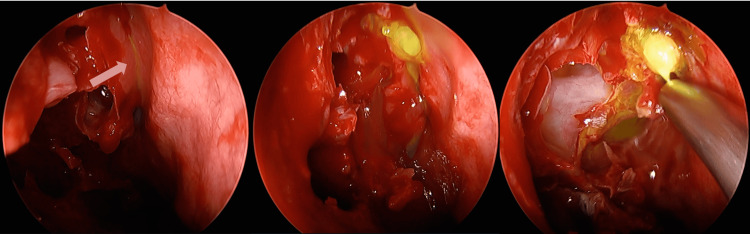 Figure 1
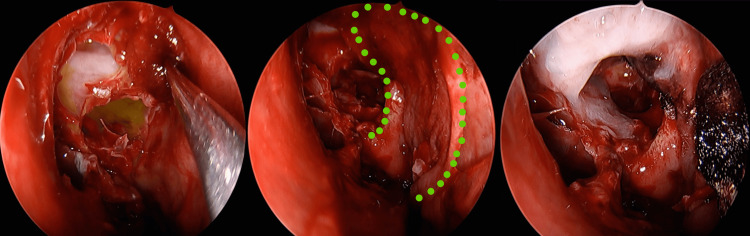 Figure 2
Peer Reviews
No public reviews on file for this paper yet. If you reviewed it on a platform where reviews are public (OpenReview, ICLR, NeurIPS, ICML), you can paste yours below so the community can read it here.
Videos
No videos yet. Explain this paper in a talk, walkthrough, or lecture? Add one.
Taxonomy
TopicsHead and Neck Surgical Oncology · Cerebrospinal fluid and hydrocephalus · Neurosurgical Procedures and Complications
Introduction
Cerebrospinal fluid (CSF) leak is a potentially serious condition owing to the risk of meningitis or neurological injury [1]. Endoscopic endonasal surgery is currently the treatment of choice, as it provides direct, minimally invasive access to the skull base [1,2]. Prompt diagnosis and precise localization of the skull base defect are essential to ensure a successful surgical repair. However, this is particularly challenging in cases of spontaneous CSF leaks, in which defects are often small, multifocal, or radiologically inconspicuous [3]. In this setting, intrathecal fluorescein has been described as a valuable adjunct for enhancing intraoperative identification and localization of CSF leaks during endoscopic endonasal repair [4-7].
Case presentation
We report the case of a 27-year-old obese woman who presented to the emergency department with a two-week history of right-sided clear rhinorrhea associated with orthostatic headache. There was no history of prior head trauma or surgery. Biochemical analysis of the nasal discharge revealed elevated glucose and protein levels, compatible with CSF. Computed tomography of the paranasal sinuses revealed a low ethmoid roof and thinning of the cribriform plate, but failed to accurately identify the site of the leak.
Given the clinical suspicion of a spontaneous CSF fistula, the patient was scheduled for endoscopic endonasal repair, preceded by adjunctive intrathecal fluorescein administration. Under sterile conditions and following lumbar puncture, a low dose of 5% fluorescein diluted in autologous CSF was administered intrathecally using a slow and controlled injection. Intraoperatively, vivid green fluorescent leakage was observed at the level of the right posterior ethmoidal roof, allowing precise localization of the dural defect (Figure 1).
Endoscopic endonasal view demonstrating green fluorescent CSF leakage at the level of the right posterior ethmoidal roof following intrathecal fluorescein administration
Reconstruction was performed using a vascularized nasoseptal flap pedicled on the posterior nasal septal artery, reinforced with oxidized regenerated cellulose and fibrin glue (Figure 2). After the repair, no residual fluorescence or active leakage was observed endoscopically.
Endoscopic endonasal view after skull base reconstruction with a vascularized nasoseptal flap, showing absence of residual fluorescence and no evidence of persistent CSF leak
No neurological symptoms, seizures, or systemic adverse effects related to fluorescein administration were observed. The postoperative progress revealed no ipsilateral recurrence. However, on the first postoperative day, the patient developed new-onset contralateral rhinorrhea. The case was discussed in a multidisciplinary setting, and the patient underwent re-operation by the Neurosurgery team, using an external approach via craniotomy and a pericranial flap for repair.
Discussion
CSF leaks most commonly arise from craniofacial trauma, followed by iatrogenic causes, predominantly after sinonasal procedures [1,2]. Spontaneous CSF leaks are less frequent and are often associated with elevated intracranial pressure or idiopathic intracranial hypertension [1,3]. In these cases, skull base defects are frequently subtle and may evade detection on conventional imaging modalities, rendering precise localization of the leakage site challenging in a subset of patients.
Intrathecal fluorescein enhances contrast between CSF and surrounding tissues, facilitating precise localization of the defect and enabling real-time verification of repair integrity [4-7]. This intraoperative confirmation may reduce recurrence rates and the need for revision surgery. In the present case, fluorescein proved particularly useful given the inconclusive imaging findings and the suspected spontaneous etiology.
Historically, concerns regarding neurotoxicity limited the widespread use of intrathecal fluorescein. Reported complications, including seizures and neurological deficits, were primarily associated with excessive doses, inadequate dilution, or rapid administration. More recent evidence supports the safety of intrathecal fluorescein when low doses are used, diluted appropriately, injected slowly, and accompanied by close perioperative monitoring [5,8].
Conclusions
This case underscores the clinical value of intrathecal fluorescein as an adjunct in the endoscopic repair of spontaneous CSF leaks. Careful patient selection and strict adherence to established safety protocols (low doses, appropriate dilution, slow injection, and close monitoring) are essential to optimize outcomes while minimizing potential risks. Although this approach was effective in managing the initial CSF leak site, the occurrence of new-onset contralateral leakage postoperatively illustrates the inherent complexity of these cases and emphasizes the need for meticulous clinical surveillance and a multidisciplinary management strategy.
The reference list from the paper itself. Each links out to its DOI / PubMed record.
- 1Cerebrospinal fluid leak Stat Pearls [Internet] Hall WA Schaurich CG Rout P Treasure Island (FL)Stat Pearls Publishing 2025 https://www.ncbi.nlm.nih.gov/books/NBK 538157/
- 2Endoscopic management of cerebrospinal fluid rhinorrhea Laryngoscope Mc Mains KC Gross CW Kountakis SE 1833183711420041545478110.1097/00005537-200410000-00029 · doi ↗ · pubmed ↗
- 3Spontaneous cerebrospinal fluid leaks in the anterior skull base secondary to idiopathic intracranial hypertension Eur Arch Otorhinolaryngol Martínez-Capoccioni G Serramito-García R Martín-Bailón M 2175218127420172817599110.1007/s 00405-017-4455-5 · doi ↗ · pubmed ↗
- 4The efficacy and safety of intrathecal fluorescein in endoscopic cerebrospinal fluid leak repair - a systematic review Auris Nasus Larynx Jolly K Gupta KK Muzaffar J Ahmed SK 9129204920223539315310.1016/j.anl.2022.03.014 · doi ↗ · pubmed ↗
- 5Rapid intrathecal fluorescein injection during cerebrospinal fluid leak repair is safe and effective Laryngoscope Mackie H Eide JG Yassin-Kassab A 2696270113520254011073010.1002/lary.32135 · doi ↗ · pubmed ↗
- 6Intrathecal fluorescein in endoscopic skull base surgery Otolaryngol Head Neck Surg Tabaee A Placantonakis DG Schwartz TH Anand VK 31632013720071766626310.1016/j.otohns.2006.11.012 · doi ↗ · pubmed ↗
- 7The clinical applications of intrathecal fluorescein in cerebrospinal fluid leak repair Radiol Case Rep Aljubran HJ Alzamil MF Alnasser AA Bashammakh MM Alfaleh MA Almomen A 496749742020254070349410.1016/j.radcr.2025.06.035PMC 12284674 · doi ↗ · pubmed ↗
- 8Safe intrathecal fluorescein use for identification of cerebrospinal fluid leaks: case-report and perioperative algorithm description Rev Esp Anestesiol Reanim Rodríguez-Navarro MÁ Díaz-Alejo C Padilla-Del Rey ML Alcaraz AB González-Pérez P Benítez M 5335366420172839071210.1016/j.redar.2017.03.003 · doi ↗ · pubmed ↗