Proposal of Limosilactobacillus secundus sp. nov., Limosilactobacillus reuteri subsp. pararodentium subsp. nov., Limosilactobacillus reuteri subsp. peregrinus subsp. nov. and Limosilactobacillus reuteri subsp. simiae subsp. nov., isolated from the gastrointestinal tract of vertebrate hosts
Xinyu Guo, Yi Yang, Justina Su Zhang, Peipei Zhang, Jens Walter, Michael G. Gänzle, Fuyong Li

TL;DR
This paper proposes new species and subspecies of Limosilactobacillus bacteria found in the guts of vertebrates, improving our understanding of their genetic diversity and host adaptations.
Contribution
The paper introduces a novel species and three novel subspecies of Limosilactobacillus based on phylogenomic analysis of gut isolates.
Findings
Four new lineages of Limosilactobacillus reuteri were identified from rodent and primate gut samples.
Genetic divergence was confirmed using average nucleotide identity and digital DNA–DNA hybridization.
The new taxonomic framework enhances understanding of host adaptations in Limosilactobacillus.
Abstract
A core genome-based phylogenomic analysis of representative strains of the species Limosilactobacillus reuteri identified eight lineages that differ from the six previously described L. reuteri subspecies. Four of them are represented by isolates obtained from intestinal digesta or faeces of rodents and primates, including strains LR77T and LR80 (lineage X), mlc3T and LR92 (lineage VIII), LR51T and LR88 (lineage VII) and LR66T and LR52 (lineage IX). Analyses of pairwise average nucleotide identity and digital DNA–DNA hybridization values further support their genetic divergence from existing L. reuteri subspecies. These findings suggest the classification of these four lineages as one novel species of Limosilactobacillus and three new subspecies of L. reuteri. Therefore, we propose the novel species Limosilactobacillus secundus sp. nov. (type strain LR77T=DSM 113335T=LMG 32469T) and the…
Genes, proteins, chemicals, diseases, species, mutations and cell lines named across the full text — each resolved to its canonical identifier and authoritative record.
Click any figure to enlarge with its caption.
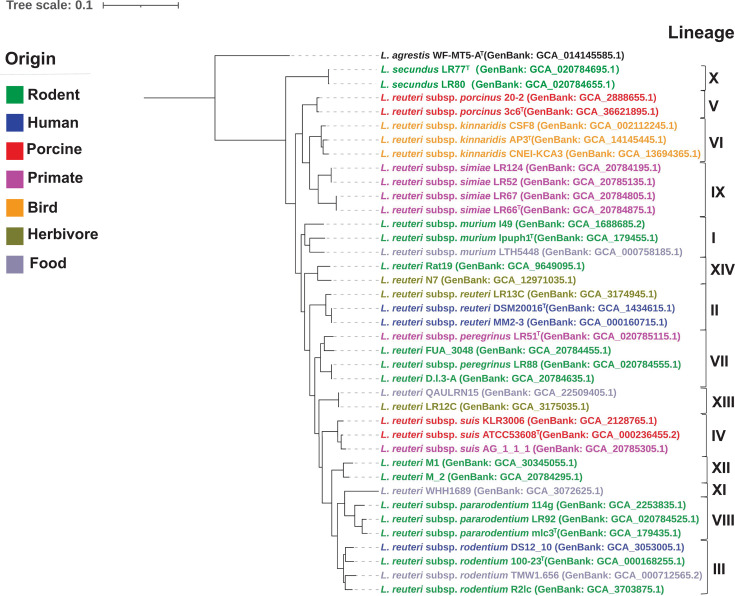 Fig. 1
| Strain name | LR77T | LR80 | mlc3T | LR92 | LR51T | LR88 | LR66T | LR52 |
| Source of isolation | Striped field mouse ( | Striped field mouse ( | Mouse | Marmota | Black howler monkey | Red-rumped agouti ( | Common patas monkey ( | Black howler monkey ( |
| GenBank ID | GCA_020784695.1 | GCA_020784665.1 | GCA_000179435.1 | GCA_020784525.1 | GCA_020785115.1 | GCA_020784555.1 | GCA_020784875.1 | GCA_020785135.1 |
| Genome size (bp) | 2,014,409 | 2,130,452 | 2,018,627 | 2,087,278 | 2,099,280 | 2,190,901 | 2,162,028 | 2,199,526 |
| Coverage (×) | >500 | >500 | 20 | >500 | >500 | >500 | >500 | >500 |
| G+C content (mol%) | 38.4 | 38.4 | 38.5 | 38.6 | 38.6 | 38.6 | 38.5 | 38.4 |
| No. of contigs | 46 | 64 | 126 | 139 | 118 | 94 | 122 | 80 |
| N50 (bp) | 124,921 | 133,090 | 53,518 | 60,880 | 108,559 | 121,258 | 80,397 | 133,800 |
| Total genes | 1,954 | 2,118 | 2,042 | 2,165 | 2,013 | 2,160 | 2,086 | 2,156 |
| No. of CDS* | 1,873 | 2,036 | 1,886 | 2,066 | 1,921 | 2,068 | 1,993 | 2,071 |
| Strain | ||||||||
|---|---|---|---|---|---|---|---|---|
| LR77T | LR80 | LR92 | mlc3T | LR51T | LR88 | LR66T | LR52 | |
|
| ||||||||
| LR77T | — | |||||||
| LR80 | 99.7 | — | ||||||
| LR92 | 93.3 | 93.2 | — | |||||
| mlc3T | 93.3 | 93.3 | 98.9 | — | ||||
| LR51T | 94.0 | 93.9 | 95.3 | 95.3 | — | |||
| LR88 | 93.9 | 93.8 | 95.3 | 95.4 | 97.6 | — | ||
| LR66T | 94.4 | 94.3 | 94.6 | 94.6 | 96.0 | 95.8 | — | |
| LR52 | 94.2 | 94.0 | 94.3 | 94.4 | 95.4 | 95.5 | 96.8 | — |
|
| ||||||||
| 3c6T | 94.4 | 94.5 | 94.7 | 94.6 | 95.8 | 95.7 | 96.1 | 96.2 |
|
| ||||||||
| AP3T | 93.8 | 93.9 | 94.5 | 94.1 | 95.3 | 95.1 | 96.3 | 96.7 |
|
| ||||||||
| ATCC 53608T | 93.7 | 93.5 | 95.8 | 95.4 | 96.5 | 95.9 | 95.5 | 95.1 |
|
| ||||||||
| lpuph1T | 94.2 | 94.2 | 95.0 | 94.8 | 95.8 | 96.0 | 95.9 | 95.8 |
|
| ||||||||
| 10023T | 93.7 | 93.6 | 96.1 | 96.1 | 95.9 | 95.8 | 94.9 | 94.8 |
|
| ||||||||
| DSM 20016T | 94.4 | 94.5 | 95.6 | 95.7 | 96.6 | 96.6 | 96.1 | 95.8 |
|
| ||||||||
| BG-AF3-AT | 92.4 | 92.3 | 94.6 | 94.3 | 93.4 | 93.1 | 93.4 | 93.2 |
|
| ||||||||
| WF-MT5-AT | 90.3 | 90.3 | 90.8 | 90.8 | 90.6 | 90.5 | 90.6 | 90.5 |
| Strain | ||||||||
|---|---|---|---|---|---|---|---|---|
| LR77T | LR80 | LR92 | mlc3T | LR51T | LR88 | LR66T | LR52 | |
|
| ||||||||
| LR77T | — | |||||||
| LR80 | 99.0 | — | ||||||
| LR92 | 52.5 | 52.0 | — | |||||
| mlc3T | 52.2 | 51.9 | 91.6 | — | ||||
| LR51T | 55.5 | 55.2 | 63.2 | 63.3 | — | |||
| LR88 | 55.5 | 55.4 | 63.2 | 63.7 | 79.1 | — | ||
| LR66T | 57.5 | 57.2 | 58.9 | 58.6 | 67.2 | 65.8 | — | |
| LR52 | 57.3 | 56.9 | 58.5 | 58.3 | 63.9 | 63.6 | 72.6 | — |
|
| ||||||||
| 3c6T | 57.9 | 58.1 | 59.8 | 59.3 | 66.1 | 65.6 | 69.5 | 69.3 |
|
| ||||||||
| AP3T | 55.5 | 55.5 | 59.5 | 56.8 | 64.2 | 61.3 | 69.6 | 73.8 |
|
| ||||||||
| ATCC 53608T | 54.2 | 54.1 | 67.2 | 64.6 | 71.3 | 67.1 | 64.2 | 62.2 |
|
| ||||||||
| lpuph1T | 56.9 | 56.8 | 60.3 | 59.9 | 66.2 | 68.5 | 66.1 | 65.9 |
|
| ||||||||
| 100-23T | 54.0 | 53.8 | 68.8 | 69.1 | 66.2 | 65.8 | 60.4 | 60.3 |
|
| ||||||||
| DSM 20016T | 58.1 | 57.9 | 65.0 | 65.7 | 72.5 | 72.8 | 68.1 | 66.7 |
|
| ||||||||
| BG-AF3-AT | 48.7 | 48.6 | 59.0 | 58.3 | 52.5 | 51.0 | 52.7 | 52.0 |
|
| ||||||||
| WF-MT5-AT | 42.0 | 41.7 | 43.0 | 42.6 | 42.8 | 42.8 | 43.0 | 42.7 |
| Substrate* | ||||||||||||||
|---|---|---|---|---|---|---|---|---|---|---|---|---|---|---|
| LR77T | LR80 | AP3T† | 3 c6T† | lpuph1T† | DSM 20016T | ATCC 53608T† | 100-23T† | LR92 | mlc3T | LR51T | LR88 | LR66T | LR52 | |
| Galactose | ||||||||||||||
| Glucose | ||||||||||||||
| Fructose | ||||||||||||||
| Maltose | ||||||||||||||
| Sucrose | ||||||||||||||
| Lactose | ||||||||||||||
| Melibiose | ||||||||||||||
| Raffinose | ||||||||||||||
| Starch | ||||||||||||||
| K-Gluconate | ||||||||||||||
- —http://dx.doi.org/10.13039/501100001804 Canada Research Chairs
- —http://dx.doi.org/10.13039/501100000038 Natural Sciences and Engineering Research Council of Canada
- —http://dx.doi.org/10.13039/501100001809 National Natural Science Foundation of China
- —http://dx.doi.org/10.13039/501100012226 Fundamental Research Funds for the Central Universities
- —National Undergraduate Innovation and Entrepreneurship Training Program
Peer Reviews
No public reviews on file for this paper yet. If you reviewed it on a platform where reviews are public (OpenReview, ICLR, NeurIPS, ICML), you can paste yours below so the community can read it here.
Videos
No videos yet. Explain this paper in a talk, walkthrough, or lecture? Add one.
Taxonomy
TopicsGenomics and Phylogenetic Studies · Bacillus and Francisella bacterial research · Probiotics and Fermented Foods
Introduction
Limosilactobacillus reuteri serves as a model organism to study the ecology and evolution of host-associated lactobacilli. The ability of L. reuteri to thrive in diverse host species underscores its evolutionary versatility [12], which is further supported by the finding that this species has an open pangenome [34]. Analyses of the phylogeny of strains of L. reuteri, their gene content, their source of isolation and their ability to colonize mice identified ten lineages with distinct genomic, metabolic and ecological features [4]. Of these lineages, six are validly published as subspecies of L. reuteri [5]. The host specificity of strains of L. reuteri has been experimentally confirmed in birds and rodents. Strains of L. reuteri subsp. kinnaridis exhibit superior ecological fitness when compared to strains from other lineages [6]. Strains of L. reuteri subsp. murium and L. reuteri subsp. rodentium and strains of lineages VII, VIII, IX and X colonize mice, while strains of other subspecies do not [46]. In addition to rodents and birds, strains of L. reuteri were also isolated from humans, captive primates and domestic animals like herbivores and swine [47]. It remains unclear whether the presence of L. reuteri in these hosts represents long-term adaptation or only temporary persistence. For example, the presence of L. reuteri in humans likely results from zoonotic transmission from domestic animals such as poultry or herbivores [4]. In addition to the ten lineages/subspecies that were characterized by ecological and metabolic studies, four additional lineages are represented by genomes but not by isolates and originate from unknown hosts [8].
The six validly published subspecies of L. reuteri share an intra-subspecies average nucleotide identity (ANI) of more than 97% and an inter-subspecies ANI of 94–97%. An intra-subspecies ANI of more than 97% was also reported for the four lineages that are represented by isolates [45] and the four lineages that are not [8]. This communication aims to define four lineages that are represented by isolates as novel species or subspecies.
Isolation and ecology
Phylogenetic analyses of 182 genomes of L. reuteri revealed ten lineages, including six lineages conforming to previously proposed subspecies and four novel lineages that cannot be assigned to the known subspecies of L. reuteri [4]. For the present study, we selected eight representative strains (i.e. LR77^T^, LR80, mlc3^T^, LR92, LR51^T^, LR88, LR66^T^ and LR52) from these four new lineages for further analyses. Strains LR77^T^ and LR80 were isolated from the jejunum of striped field mice (Apodemus agrarius) in the Vilnius area of Lithuania. Strain LR92 was isolated from a faecal sample of a Vancouver Island marmot (Marmota vancouverensis) at the Zoo in Calgary, Canada. Strains LR51^T^ and LR52 were isolated from faecal samples of black howler monkeys (Alouatta caraya), while strain LR66^T^ was isolated from a faecal sample of a patas monkey (Erythrocebus patas) at the San Francisco Zoo, California, USA. Strain LR88 was isolated from a faecal sample of a red-rumped agouti (Dasyprocta leporina) at the Valley Zoo in Edmonton, Canada, and strain mlc3^T^ was isolated from the faeces of a laboratory mouse (Mus musculus) (Table 1).
Genomic analyses
The genomes of the eight strains of the four novel lineages were obtained from RefSeq database of the National Center for Biotechnology Information (NCBI) (Table 1). In addition, representative genomes of four lineages for which genomes became available since 2023 were included [8]. The size of genomes ranges from 2.01 to 2.20 Mbp, and G+C content ranges from 38.4 to 38.6 mol% (Table 1). To determine the phylogenetic position of the four novel lineages among L. reuteri, a phylogenetic tree was constructed using 38 strains of all known lineages of L. reuteri. The genome of Limosilactobacillus agrestis WF-MT5-A^T^ was used as an outgroup. All genomes were re-annotated using Prokka with default settings [9]. Core genes, i.e., genes present in 95% of the genomes, were identified with Roary version 3.13.0 [10], and a maximum-likelihood tree was calculated from the concatenated alignment of core genes (n=899) using the GTR+G model with 1,000 bootstrap replicates using RAxML version 0.9.0 [11] (Fig. 1).
A maximum-likelihood phylogenetic tree was reconstructed using core genes identified from whole-genome sequences. The tree was inferred based on the GTR+G model with 1,000 bootstrap replicates. All branches in the phylogenetic tree exhibit higher than 80% bootstrap values. Genome sequences for type strains were obtained from the GenBank database. The 14 phylogenetic lineages of L. reuteri were numbered with Roman numerals to the right. The phylogenetic tree was visualized using iTOL [24].
Phylogenetic tree of L. reuteri displaying 14 numbered lineages, each comprising multiple strains. Colour-coding indicates organism origins from different hosts. Each bacterial strain shows subspecies classification and GenBank accession number.
The core-genome analysis identified 14 phylogenetic lineages within this species (Fig. 1). The topology of the phylogenetic tree is highly consistent with past reports on the phylogeny of lineages in L. reuteri that are based on core-genome phylogeny [458] and with a phylogenetic tree that was inferred based on the GTR+F+I+R10 model using IQ-TREE (Fig. S1, available in the online Supplementary Material) [12]. Six of these lineages (lineages I–VI) correspond to established subspecies [5], while four lineages represented by isolates (lineages VII–X) [4] and four lineages not represented by isolates (lineages XI – XIV) do not cluster with the existing six L. reuteri subspecies [8].
To further assess the genomic similarities among strains, pairwise ANI and digital DNA–DNA hybridization (dDDH) values between them were calculated using OrthoANI [13] (Table 2) and the Genome-To-Genome Distance Calculator (GGDC) with blast algorithm [14] (Table 3) . The relatedness of strains of L. reuteri was compared to other subspecies of L. reuteri and to Limosilactobacillus agrestis and Limosilactobacillus balticus, the two species that are most closely related to L. reuteri [58]. ANI values within each of the lineages ranged from 96.8 to 99.7%, and dDDH values ranged from 72.6 to 99.0%. The two strains of lineage X (LR77^T^ and LR80) exhibited ANI values of 93.2–94.5% and dDDH values of 51.9–58.1% when compared to all other lineages including the type strain of L. reuteri DSM 20016^T^. The ANI and dDDH values of the remaining three lineages (VII, VIII and IX) relative to the type strain L. reuteri subsp. reuteri DSM 20016^T^ ranged from 95.6 to 96.6% and 65.0 to 72.8%, respectively (Table 2 and Table 3). When considering the thresholds for species delineation (ANI ≥95.5%, dDDH ≥70.0%) [1517] and accounting for errors in genomic similarity calculations, the low ANI (< 95%) and dDDH (< 70%) values for lineage X support its classification as a novel species. The genomic distinctiveness of lineages VII, VIII and IX relative to existing L. reuteri subspecies supports their classification as new subspecies.
Physiology
Carbohydrate fermentation profiles (Table 4) of L. reuteri lineage VII, VIII, IX and X were analysed using the API 50 CH system and compared to literature data for the established subspecies [518]. All strains of these four lineages fermented l-arabinose, d-ribose, d-galactose, d-glucose, maltose, lactose, melibiose, sucrose and raffinose. The utilization of d-xylose, d-fructose, starch and potassium gluconate was variable. L. reuteri subsp. pararodentium did not ferment d-fructose, starch or potassium gluconate but fermented d-xylose. L. reuteri subsp. peregrinus fermented potassium gluconate, but its ability to ferment d-xylose varied between strains: specifically, strain LR51^T^ was capable of d-xylose utilization, while strain LR88 was not. L. reuteri subsp. simiae strain LR52 fermented fructose but not starch, while the opposite is true for strain LR66^T^. L. secundus utilized potassium gluconate but not d-xylose or starch. None of the strains fermented glycerol, erythritol, d-arabinose, l-xylose, d-adonitol, methyl β-xylopyranoside, d-mannose, l-sorbose, l-rhamnose, dulcitol, inositol, d-mannitol, d-sorbitol, methyl α-mannopyranoside, methyl α-d-glucopyranoside, N-acetylglucosamine, amygdalin, arbutin, aesculin, salicin, cellobiose, trehalose, inulin, melezitose, glycogen, xylitol, gentiobiose, turanose, d-lyxose, d-tagatose, d-fucose, l-fucose, l-arabitol, d-arabitol, potassium 2-ketogluconate, or potassium 5-ketogluconate. The carbohydrate fermentation patterns of L. reuteri lineage VII to X thus generally match the pattern of other strains of L. reuteri [518].
Discussion
Strains of L. reuteri and closely related species adapted to a series of vertebrate hosts. The ancestral hosts of L. reuteri are rodents (Rodentiae), and some subspecies appeared to specialize to the family Muridae [4]. Birds (class Avium) are a second host of L. reuteri subsp. kinnaridis for which host specialization has been documented experimentally [6]. The presence of L. reuteri in the intestine of humans was suggested to result from zoonotic transmission, or from consumption of L. reuteri with fermented foods [4]. The lineages of L. reuteri analysed herein all colonize mice and share the genomic traits of rodent-adapted lineages [4]. All isolates of L. reuteri lineage IX, however, were obtained from captive monkeys, which may reflect that domestication and captivity impact gut microbiota [19]. Our study, along with others [8], also identified four novel lineages of L. reuteri that are not represented by isolates. These novel lineages indicate that the diversity of L. reuteri and other gut commensals is far from being represented by current isolates or genomes, in part because wild animals remain under-represented as an isolation source. A value of 70% dDDH, corresponding to ANI values of about 95–95.5%, is widely accepted as the threshold for delineation of novel bacterial species, but a corresponding threshold value for delineation of bacterial subspecies has not been established [2021]. For Lactobacillaceae, inter-subspecies dDDH and ANI values range from less than 70 and 96%, respectively, to more than 80 and 97%, respectively [22]. Subspecies of L. reuteri were previously described based on the phylogenetic position, the gene content of the genomes and lineage-specific host adaptation. These analyses also described four lineages that are not assigned to validly published subspecies [45].
Proposal of one novel species and three novel subspecies within L. reuteri
According to the core-genome-based phylogenetic analyses, carbohydrate fermentation patterns and experimental evidence of biofilm formation in the forestomach of germ-free mice between the phylogenetic lineages [4], we propose that the four novel distinct phylogenetic lineages of L. reuteri reported previously and in the present study represent one novel species and three novel subspecies. We propose the following names: Limosilactobacillus secundus sp. nov. (type strain LR77^T^=DSM 113335^T^=LMG 32469^T^), L. reuteri subsp. pararodentium subsp. nov. (type strain mlc3^T^=DSM 113337^T^=LMG 32470^T^), L. reuteri subsp. peregrinus subsp. nov. (type strain LR51^T^=DSM 113336^T^=LMG 32467^T^) and L. reuteri subsp. simiae subsp. nov. (type strain LR66^T^=DSM 113334^T^ = LMG 32468^T^).
Description of Limosilactobacillus secundus sp. nov.
Limosilactobacillus secundus sp. nov. (se.cun'dus. L. masc. adj. secundus, second, referring to the initial working name of the subspecies as ‘second species’).
Strains of L. secundus in this study were isolated from the striped field mouse (A. agrarius) and share ANI values of more than 99.7% with each other, 94.4–94.5% to the type strain of L. reuteri subsp. reuteri DSM200016 and 92.4% or less to other species of the genus Limosilactobacillus (Table 2) . Acid is produced from l-arabinose, d-ribose, d-galactose, d-glucose, maltose, lactose, melibiose, sucrose, raffinose and potassium gluconate but not from d-fructose, d-mannose, methyl α-d-glucopyranoside, aesculin, glycerol, erythritol, d-arabinose, d-xylose, l-xylose, d-adonitol, methyl β-d-xylopyranoside, l-sorbose, l-rhamnose, dulcitol, inositol, d-mannitol, d-sorbitol, methyl α-d-mannopyranoside, N-acetylglucosamine, amygdalin, arbutin, salicin, cellobiose, gentiobiose, trehalose, inulin, melezitose, starch, glycogen, xylitol, turanose, d-lyxose, d-tagatose, d-fucose, l-fucose, d-arabitol, l-arabitol, potassium 2-ketogluconate or potassium 5-ketogluconate. The origin of strains (Table S1), analysis of the gene content of the subspecies [4] and determination of biofilm formation in mice [4] document that strains of this subspecies colonize rodents. The type strain, LR77^T^ (=DSM 113335^T^, =LMG 32469^T^), was isolated from a striped field mouse (A. agrarius). The GenBank accession numbers for the genome sequence and the 16S rRNA gene sequence of the type strain are GCA_020784695.1 and PV954769, respectively. The genome has a size of 2.01 Mbp and a G+C content of 38.4 mol%.
Description of Limosilactobacillus reuteri subsp. pararodentium subsp. nov.
Limosilactobacillus reuteri subsp. pararodentium (pa.ra.ro.den′ti.um. Gr. prep. para, resembling; N.L. rodentium, a subspecies epithet, N.L. gen. pl. n. pararodentium, resembling L. reuteri subsp. rodentium).
Strains of L. reuteri subsp. pararodentium were previously assigned to the subspecies L. reuteri subsp. rodentium, but analysis of strains on a larger scale, as performed in this study, demonstrates that L. reuteri subsp. pararodentium forms a monophyletic cluster (Fig. 1). Strains of this subspecies share more than 98.9% intra-subspecies ANI but less than 96.1% ANI to strains of other subspecies of L. reuteri and less than 94.6% ANI to other species of the genus Limosilactobacillus (Table 2). Strains of L. reuteri subsp. pararodentium were predominantly isolated from Muridae [4]. Acid is produced from l-arabinose, d-ribose, d-xylose, d-galactose, d-glucose, maltose, lactose, melibiose, sucrose and raffinose but not from d-fructose, d-mannose, methyl α-d-glucopyranoside, aesculin, potassium gluconate, glycerol, erythritol, d-arabinose, l-xylose, d-adonitol, methyl β-d-xylopyranoside, l-sorbose, l-rhamnose, dulcitol, inositol, d-mannitol, d-sorbitol, methyl α-d-mannopyranoside, N-acetylglucosamine, amygdalin, arbutin, salicin, cellobiose, gentiobiose, trehalose, inulin, melezitose, starch, glycogen, xylitol, turanose, d-lyxose, d-tagatose, d-fucose, l-fucose, d-arabitol, l-arabitol, potassium 2-ketogluconate or potassium 5-ketogluconate. The origin of strains of the subspecies (Table S1), the gene content of strains [4], literature data on the colonization of mice [46] and determination of biofilm formation in mice [23] demonstrate that strains of this subspecies can stably colonize rodents. The type strain, mlc3^T^ (=DSM 113337^T^, LMG 32470^T^), was isolated from a mouse (M. musculus). The GenBank accession numbers for the genome sequence and the 16S rRNA gene sequences of the type strain are GCA_000179435.1 and PV954770, respectively. The genome has a size of 2.02 Mbp and a G+C content of 38.5 mol%.
Description of Limosilactobacillus reuteri subsp. peregrinus subsp. nov.
Limosilactobacillus reuteri subsp. peregrinus [pe.re.gri.nus L. masc. n. peregrinus, pilgrim, wanderer, referring to the ability of strains of the subspecies to (temporarily) persist in phylogenetically diverse hosts].
Strains of L. reuteri subsp. peregrinus form a monophyletic cluster (Fig. 1) and share more than 97.6% intra-subspecies ANI, less than 96.6% ANI to strains of other subspecies of L. reuteri and less than 93.4% ANI to other species of the genus Limosilactobacillus (Table 2). L. reuteri subsp. peregrinus were isolated from humans, primates and rodents [4]. Acid is produced from l-arabinose, d-ribose, d-galactose, d-glucose, maltose, lactose, melibiose, sucrose, raffinose and potassium gluconate. Acid-producing pattern is variable for d-xylose, and acid is not produced from d-fructose, d-mannose, methyl α-d-glucopyranoside, aesculin, glycerol, erythritol, d-arabinose, l-xylose, d-adonitol, methyl β-d-xylopyranoside, l-sorbose, l-rhamnose, dulcitol, inositol, d-mannitol, d-sorbitol, methyl α-d-mannopyranoside, N-acetylglucosamine, amygdalin, arbutin, salicin, cellobiose, gentiobiose, trehalose, inulin, melezitose, starch, glycogen, xylitol, turanose, d-lyxose, d-tagatose, d-fucose, l-fucose, d-arabitol, l-arabitol, potassium 2-ketogluconate or potassium 5-ketogluconate. The origin of strains of the subspecies (Table S1), analysis of the gene content of strains [4] and determination of biofilm formation in mice [23] demonstrate that strains of this subspecies colonize rodents but also (temporarily) persist in other hosts. The type strain, LR51^T^ (=DSM 113336^T^, LMG 32467^T^), was isolated from a black howler monkey (A. caraya). The GenBank accession numbers for the genome sequence and the 16S rRNA gene sequences of the type strain are GCA_020785115.1 and PV954765, respectively. The genome has a size of 2.10 Mbp and a G+C content of 38.6 mol%.
Description of Limosilactobacillus reuteri subsp. simiae subsp. nov.
Limosilactobacillus reuteri subsp. simiae (si’mi.ae L. gen. n. simiae, of a monkey, referring to the origin of all known strains of the subspecies).
Strains of L. reuteri subsp. simiae form a monophyletic cluster (Fig. 1). They share more than 96.8% intra-subspecies ANI, less than 96.7% ANI to strains of other subspecies of L. reuteri and less than 93.4% ANI to other species of the genus Limosilactobacillus (Table 2). L. reuteri subsp. simiae were isolated from captive black howler monkeys and patas monkeys [4]. Acid is produced from l-arabinose, d-ribose, d-galactose, d-glucose, maltose, lactose, melibiose, sucrose, raffinose and potassium gluconate; acid production from d-fructose and starch is variable and acid is not produced from d-mannose, methyl α-d-glucopyranoside, aesculin, glycerol, erythritol, d-arabinose, d-xylose, l-xylose, d-adonitol, methyl β-d-xylopyranoside, l-sorbose, l-rhamnose, dulcitol, inositol, d-mannitol, d-sorbitol, methyl α-d-mannopyranoside, N-acetylglucosamine, amygdalin, arbutin, salicin, cellobiose, gentiobiose, trehalose, inulin, melezitose, glycogen, xylitol, turanose, d-lyxose, d-tagatose, d-fucose, l-fucose, d-arabitol, l-arabitol, potassium 2-ketogluconate or potassium 5-ketogluconate. The origin of strains of the subspecies (Table S1), analysis of the gene content of strains [4] and determination of biofilm formation in mice [23] demonstrate that strains of this subspecies colonize rodents but also (temporarily) persist in primates. The type strain, LR66^T^ (=DSM 113334^T^=LMG 32468^T^), was isolated from a patas monkey (E. patas). The GenBank accession numbers for the genome sequence and the 16S rRNA gene sequences of the type strain are GCA_020784875.1 and PV954768, respectively. The genome has a size of 2.16 Mbp and a G+C content of 38.5 mol%.
Supplementary material
10.1099/ijsem.0.007099Supplementary Material 1.
10.1099/ijsem.0.007099Uncited Supplementary Material 2.
The reference list from the paper itself. Each links out to its DOI / PubMed record.
- 1Oh PL Benson AK Peterson DA Patil PB Moriyama EN et al Diversification of the gut symbiont Lactobacillus reuteri as a result of host-driven evolution ISME J 2010437738710.1038/ismej.2009.12319924154 · doi ↗ · pubmed ↗
- 2Frese SA Benson AK Tannock GW Loach DM Kim J et al The evolution of host specialization in the vertebrate gut symbiont Lactobacillus reuteri P Lo S Genet 20117 e 100131410.1371/journal.pgen.100131421379339 PMC 3040671 · doi ↗ · pubmed ↗
- 3Rajput A Chauhan SM Mohite OS Hyun JC Ardalani O et al Pangenome analysis reveals the genetic basis for taxonomic classification of the Lactobacillaceae family Food Microbiol 202311510433410.1016/j.fm.2023.10433437567624 · doi ↗ · pubmed ↗
- 4Li F Li X Cheng CC BujdošD Tollenaar S et al A phylogenomic analysis of Limosilactobacillus reuteri reveals ancient and stable evolutionary relationships with rodents and birds and zoonotic transmission to humans BMC Biol 2023215310.1186/s 12915-023-01541-136907868 PMC 10010030 · doi ↗ · pubmed ↗
- 5Li F Cheng CC Zheng J Liu J Quevedo RM et al Limosilactobacillus balticus sp. nov., Limosilactobacillus agrestis sp. nov., Limosilactobacillus albertensis sp. nov., Limosilactobacillus rudii sp. nov. and Limosilactobacillus fastidiosus sp. nov., five novel Limosilactobacillus species isolated from the vertebrate gastrointestinal tract, and proposal of six subspecies of Limosilactobacillus reuteri adapted to the gastrointestinal tract of specific vertebrate hosts Int J Syst Evol Microbiol 20217100464410 · doi ↗ · pubmed ↗
- 6Duar RM Frese SA Lin XB Fernando SC Burkey TE et al Experimental evaluation of host adaptation of Lactobacillus reuteri to different vertebrate species Appl Environ Microbiol 201783 e 00132-1710.1128/AEM.00132-1728389535 PMC 5452824 · doi ↗ · pubmed ↗
- 7Yu J Zhao J Song Y Zhang J Yu Z et al Comparative genomics of the herbivore gut symbiont Lactobacillus reuteri reveals genetic diversity and lifestyle adaptation Front Microbiol 20189115110.3389/fmicb.2018.0115129915568 PMC 5994480 · doi ↗ · pubmed ↗
- 8Zhang L Moran M Guan LL Walter J Gänzle MG Limosilactobacillus Vandamme P Felis G Bergey’s manual of systematics of archaea and bacteria Hoboken, New Jersey John Wiley & Sons 202510.1002/9781118960608 · doi ↗