Research note: Transient behavioral effects of feed restriction in a white feathered laying hen pullet strain - Assessment of frustration and locomotor energy expenditure
Ana K. Rentsch, Sachin Gautamadasa, Charlene Hanlon, Grégoy Y. Bédécarrats

TL;DR
Feed restriction in young hens increases abnormal pecking and aggression, but does not affect locomotor energy expenditure.
Contribution
The study identifies specific behavioral effects of feed restriction in layer pullets, offering insights for research and welfare considerations.
Findings
Feed restriction increased abnormal pecking at 16, 17, and 18 weeks.
Aggression increased during puberty in ad libitum and early-photostimulated pullets.
Restricted feeding had no effect on vertical locomotion energy expenditure.
Abstract
Quantitative feed restriction is used to effectively manipulate layer pullet growth trajectories in research and rarely in commercial practice. In this study, we asked whether this intervention impairs pullet welfare or affects locomotor energy expenditure. Pullets were raised in furnished floor pens in a split-plot design: Two ages at photostimulation (18 weeks: early-PS vs 20 weeks: late-PS) with two feeding regimens each (ad libitum: AL vs 20%-restricted: R) between 12 and 21 weeks. Home pen video recordings were annotated for four behavioral categories: abnormal pecking, aggression, high-energy aerial locomotion, and low-energy locomotion via ramps. Feed restriction increased abnormal pecking behavior at 16, 17, and 18 weeks (P = 0.0002). Aggression increased during puberty, which occurred sooner for AL and early-PS than R and late-PS pullets, then decreased (P = 0.016). In R…
Genes, proteins, chemicals, diseases, species, mutations and cell lines named across the full text — each resolved to its canonical identifier and authoritative record.
Click any figure to enlarge with its caption.
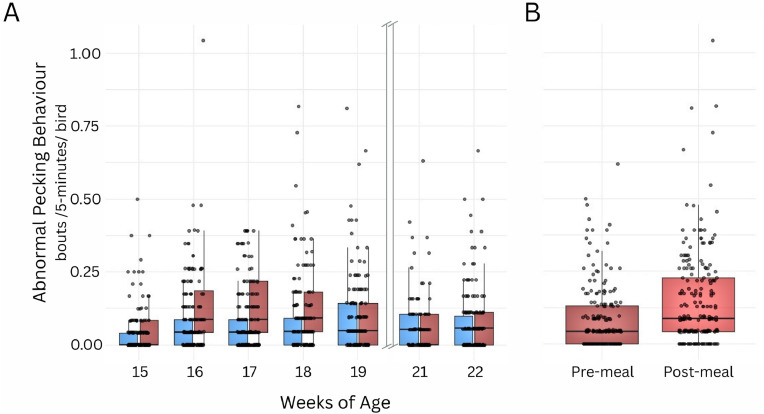 Figure 1
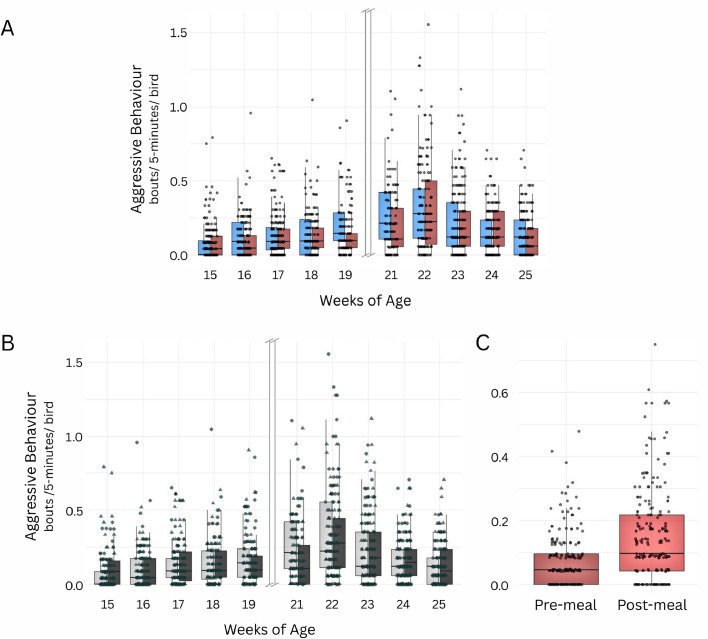 Figure 2
Peer Reviews
No public reviews on file for this paper yet. If you reviewed it on a platform where reviews are public (OpenReview, ICLR, NeurIPS, ICML), you can paste yours below so the community can read it here.
Videos
No videos yet. Explain this paper in a talk, walkthrough, or lecture? Add one.
Taxonomy
TopicsAnimal Behavior and Welfare Studies · Animal Nutrition and Physiology · Rabbits: Nutrition, Reproduction, Health