Analytical interpretation of hemodynamic data in patients with intracardiac shunts: Role of mathematical modeling
Paolo Ferrero, Andrea Tonini, Giulio Valenti, Pier Paolo Bassareo, Stiljan Hoxha, Luca Dedè, Alfio Quarteroni, Konstantinos Dimopoulos

TL;DR
This paper uses a mathematical model to better understand how blood flow is affected in heart patients with specific types of shunts.
Contribution
The study introduces a lumped parameters model to analytically interpret hemodynamic changes in intracardiac shunts.
Findings
A twofold rise in pulmonary vascular resistance significantly reduces Qp/Qs in VSD and VSD+ASD models but not in isolated ASD.
In isolated ASD models, Qp/Qs reduction is linked to changes in right ventricular elastance and relaxation time.
Pulmonary vasodilators' effects in ASD patients may be influenced by ventricular stiffness.
Abstract
Shunt lesions are categorized into pre- and post-tricuspid. Although it is well recognized that these two entities have a different pathophysiology, hemodynamic variables involved are still poorly understood. This paper aims to analytically appraise shunt physiology exploiting a lumped parameters mathematical model. Circulatory system was split into arterial and venous compartments, each of them being described by resistive, capacitive and inductive components. The model was modified including communication between atria and ventricles. Predicted changes in the ratio between pulmonary blood flow and systemic blood flow (Qp/Qs), obtained by manipulating pulmonary resistances (PVR) and ventricular stiffness were computed. A twofold rise of pulmonary vascular resistance resulted in a significant reduction of Qp/Qs in the setting of isolated ventricular septal defect (VSD) and VSD…
Genes, proteins, chemicals, diseases, species, mutations and cell lines named across the full text — each resolved to its canonical identifier and authoritative record.
Click any figure to enlarge with its caption.
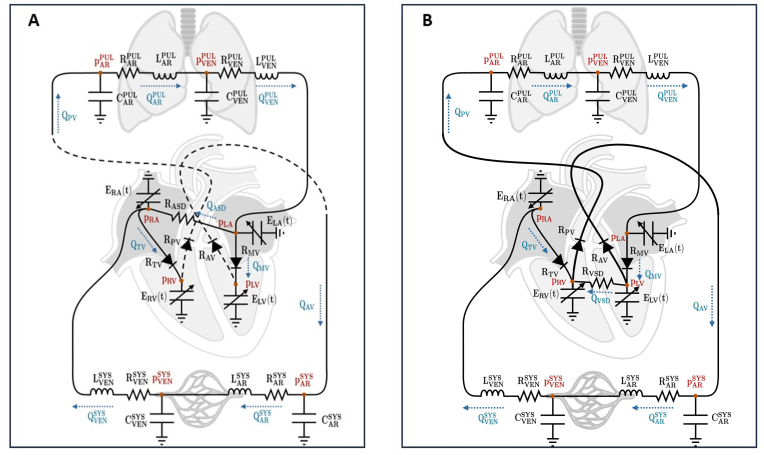 Figure 1
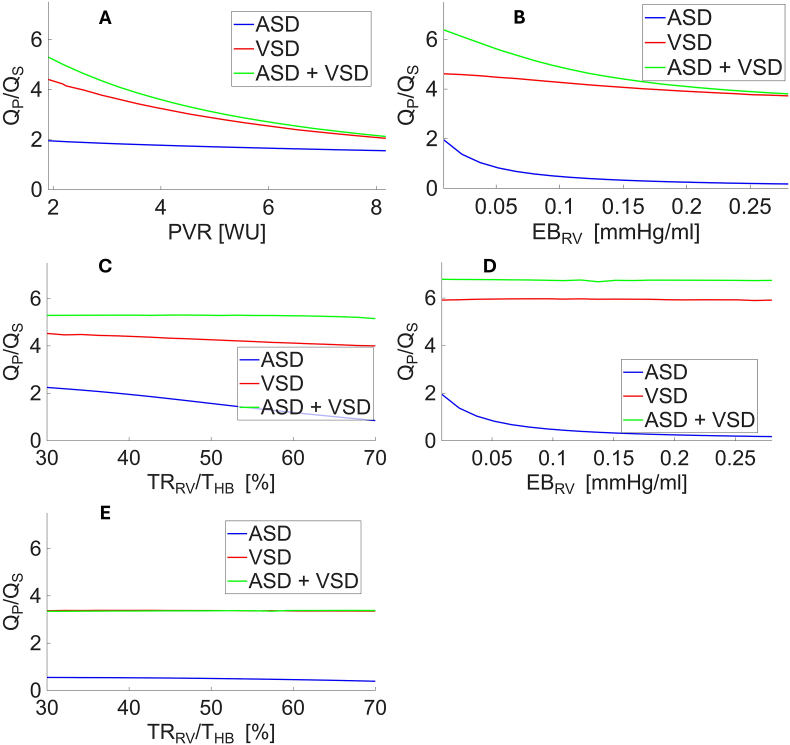 Figure 2
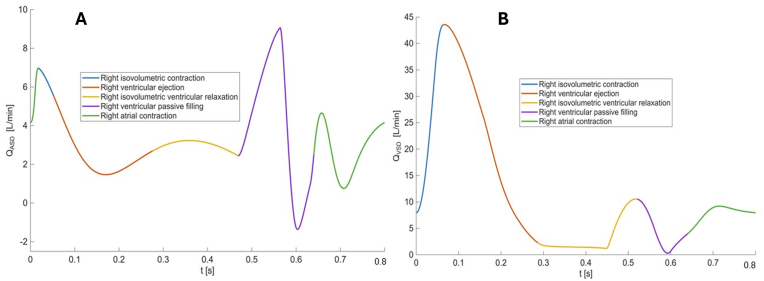 Figure 3
Peer Reviews
No public reviews on file for this paper yet. If you reviewed it on a platform where reviews are public (OpenReview, ICLR, NeurIPS, ICML), you can paste yours below so the community can read it here.
Videos
No videos yet. Explain this paper in a talk, walkthrough, or lecture? Add one.
Taxonomy
TopicsPulmonary Hypertension Research and Treatments · Cardiovascular Function and Risk Factors · Congenital Heart Disease Studies