Hydride Transfer Limits Hydrogen Evolution Efficiency With Zn Porphyrin Photocatalysts
Ouissam El Bakouri, Simon T. Clausing, Lluís Blancafort

TL;DR
This study explains why a zinc-based metalloporphyrin photocatalyst is inefficient at producing hydrogen, due to a key hydride transfer step with a high energy barrier.
Contribution
The paper identifies the hydride transfer step as the main efficiency-limiting factor in Zn porphyrin photocatalysts for hydrogen evolution.
Findings
The EPEH photocatalytic cycle is favored, but hydride transfer has a high kinetic barrier.
Hydride donation by ZnCHP4− is inefficient due to loss of aromaticity.
Hydrogen generation competes with porphyrin hydrogenation, reducing catalytic efficiency.
Abstract
We performed a computational study on the photocatalytic hydrogen evolution mechanism using a Zn‐based metalloporphyrin (ZnP), water, and a cheap sacrificial donor. Based on previous experiments, the active species is a Zn chlorin (ZnC), formed by photohydrogenation of ZnP. Our calculations favor an electron‐proton‐electron‐hydride (EPEH) photocatalytic cycle that consists of one‐electron photoreduction of ZnC followed by protonation of a bridge carbon and a second photoreduction, leading to a key ZnCHP4 − intermediate. One‐electron photoreduction increases the aromaticity of the porphyrin rings, which explains the favorable photoreduction steps. The final step is a hydride transfer from ZnCH− to a proton donor like an ammonium cation or water, resulting in hydrogen generation. Although this process is thermodynamically allowed, it has a high kinetic barrier and leads to loss of…
Genes, proteins, chemicals, diseases, species, mutations and cell lines named across the full text — each resolved to its canonical identifier and authoritative record.
Click any figure to enlarge with its caption.
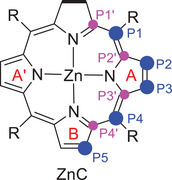 Figure 1
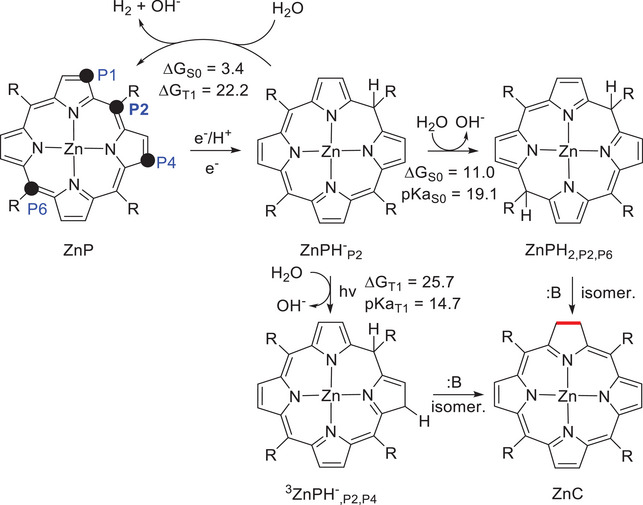 Figure 2
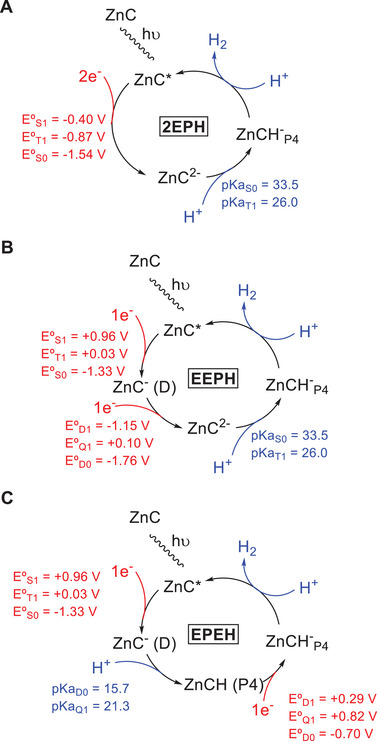 Figure 3
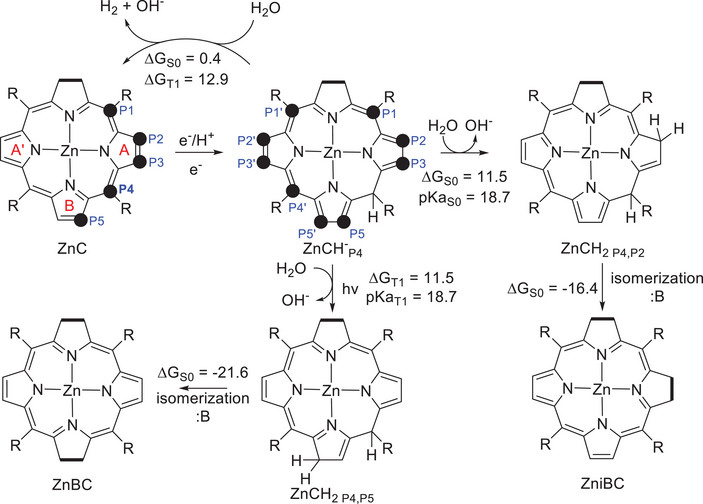 Figure 4
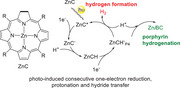 Figure 5
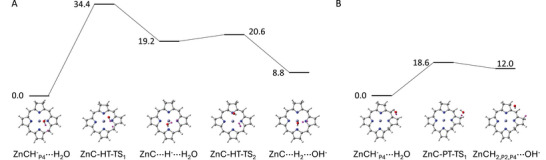 Figure 6
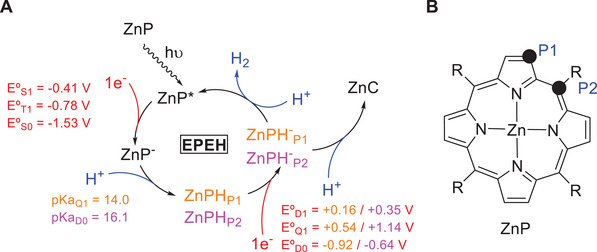 Figure 7
 Figure 8
 Figure 9
Peer Reviews
No public reviews on file for this paper yet. If you reviewed it on a platform where reviews are public (OpenReview, ICLR, NeurIPS, ICML), you can paste yours below so the community can read it here.
Videos
No videos yet. Explain this paper in a talk, walkthrough, or lecture? Add one.
Taxonomy
TopicsPorphyrin and Phthalocyanine Chemistry · Metalloenzymes and iron-sulfur proteins · Electrocatalysts for Energy Conversion