Association between electrocardiographic age and cognitive function: findings from the UK biobank and Framingham Heart Study
Bernard Ofosuhene, Huitong Ding, Heaven Y Tatere, Trevor W Vigeant, Shensheng Li, Alexander Bennett, Honghuang Lin

TL;DR
This study finds that a biological age calculated from heart scans is linked to worse cognitive performance in two large groups of people.
Contribution
The novel contribution is establishing a link between ECG-derived biological age and cognitive decline in two independent population cohorts.
Findings
Higher ECG-age compared to chronological age was associated with lower global cognitive performance in both UK Biobank and Framingham Heart Study participants.
Poorer cognitive performance was observed across multiple cognitive domains in individuals with accelerated ECG-age.
ECG-based biological age metrics may serve as low-cost digital markers for identifying individuals at risk of cognitive decline.
Abstract
Biological age derived from 12-lead electrocardiograms (ECGs) using deep learning has emerged as a promising marker of physiological ageing. However, its relationship with cognitive performance remains poorly understood. To investigate the association between ECG-derived ageing and cognitive performance in two large population-based cohorts. We analysed data from the UK Biobank (UKB) and the Framingham Heart Study (FHS). A deep learning model estimated ECG-based biological age (ECG-age) from ECG waveforms. We calculated the difference between ECG-age and chronological age (Δage), which was used to classify participants into ageing groups: accelerated ageing, normal ageing, and decelerated ageing. Cognitive performance was measured with standardized neuropsychological tests, which were grouped into six cognitive domains and a global cognitive score. Multivariable linear regression…
Genes, proteins, chemicals, diseases, species, mutations and cell lines named across the full text — each resolved to its canonical identifier and authoritative record.
Click any figure to enlarge with its caption.
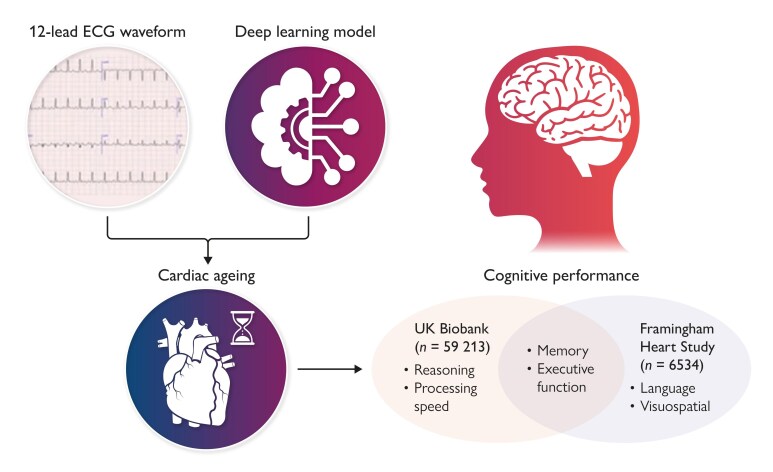 Figure 1
Peer Reviews
No public reviews on file for this paper yet. If you reviewed it on a platform where reviews are public (OpenReview, ICLR, NeurIPS, ICML), you can paste yours below so the community can read it here.
Videos
No videos yet. Explain this paper in a talk, walkthrough, or lecture? Add one.
Taxonomy
TopicsECG Monitoring and Analysis · Cardiac electrophysiology and arrhythmias · Heart Rate Variability and Autonomic Control