The magnitude and population burden of educational inequalities in adverse birth outcomes
Anton Schreuder, David van Klaveren, Richard M. K. van Dijk, Jasper V. Been, Lisa Broeders, Ageeth N. Rosman, Wessel Kraaij, Tanja A. J. Houweling

TL;DR
This study shows that lower maternal education is strongly linked to higher risks of adverse birth outcomes, with significant population health benefits possible by addressing these inequalities.
Contribution
The study quantifies the magnitude and population burden of educational inequalities in adverse birth outcomes using a large Dutch birth cohort.
Findings
Stillbirth and neonatal mortality rates were 2.94 and 2.25 times higher in the lowest education group compared to the highest.
Population attributable fractions suggest a 35% reduction in stillbirths if all mothers had the highest education level.
The middle education group contributed most to the population burden despite moderate risk increases.
Abstract
We aimed to describe the magnitude and population burden of inequality in adverse birth outcomes by maternal education (five categories). Data from 639,007 singleton births of gestational age ≥ 24 weeks or, if missing, birthweight ≥ 500 g were included from the National registry of the Netherlands, 2016–2019. One in six Dutch births had an adverse outcome. Each step down the educational ladder was associated with higher adverse outcome rates. Inequalities in stillbirth and neonatal mortality rates were large between the highest (Master’s or higher) and lowest (primary) educated groups (rate ratio [RR] = 2.94 [95%CI: 2.33–3.55] and 2.25 [1.71–2.79], respectively). Inequalities were smaller for preterm birth, small-for-gestational-age, low Apgar score, neonatal intensive care unit admission, and severe congenital anomalies (RR range = 1.32–1.77; PAF range = 13.8–17.7%). Mortality would…
Genes, proteins, chemicals, diseases, species, mutations and cell lines named across the full text — each resolved to its canonical identifier and authoritative record.
Click any figure to enlarge with its caption.
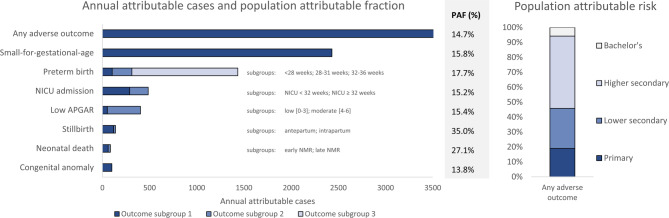 Figure 1
Peer Reviews
No public reviews on file for this paper yet. If you reviewed it on a platform where reviews are public (OpenReview, ICLR, NeurIPS, ICML), you can paste yours below so the community can read it here.
Videos
No videos yet. Explain this paper in a talk, walkthrough, or lecture? Add one.
Taxonomy
TopicsGlobal Maternal and Child Health · Maternal and Neonatal Healthcare · Health disparities and outcomes