Clinical, laboratory, and radiological features influencing admission DWI-ASPECTS in stroke patients with middle cerebral artery occlusion undergoing mechanical thrombectomy
Carmelo Tiberio Currò, Antonio Ciacciarelli, Giulia Fiume, Davide Vicari, Anna Gardin, Concetto Fabio Vecchio, Alessandra Coglitore, Mirta Longo, Giuseppe Trimarchi, Cristina Dell’Aera, Masina Cotroneo, Rosa Fortunata Musolino, Antonio Toscano, Sergio Lucio Vinci

TL;DR
This study identifies clinical and lab factors that influence a brain imaging score used to assess stroke severity in patients undergoing a specific treatment.
Contribution
The study is the first to associate aPTT and oxygen saturation with DWI-ASPECTS, identifying modifiable factors that could improve stroke outcomes.
Findings
Lower DWI-ASPECTS is associated with younger age, male sex, and higher diastolic pressure.
Oxygen saturation and aPTT are newly identified modifiable factors linked to DWI-ASPECTS.
FLAIR positivity and unknown onset time are significant predictors of lower DWI-ASPECTS.
Abstract
The Diffusion-Weighted Imaging Alberta Stroke Programme Early Computed Tomography Score (DWI-ASPECTS) is a rapid and practical score used for quantifying the extent of early ischemic changes in acute ischemic stroke. It is strongly associated with stroke prognosis. The present study aimed to identify the main clinical, laboratory, and radiological features influencing DWI-ASPECTS in stroke patients with middle cerebral artery (MCA) occlusion. This retrospective study evaluated a cohort of patients with stroke due to MCA occlusion who underwent magnetic resonance imaging before thrombectomy. Clinical, laboratory, and imaging data were collected. Univariate and multivariable analyses were performed to assess associations with DWI-ASPECTS. A total of 501 patients were selected. In the univariate analysis, a lower DWI-ASPECTS was associated with younger age, male sex, smoking, no atrial…
Genes, proteins, chemicals, diseases, species, mutations and cell lines named across the full text — each resolved to its canonical identifier and authoritative record.
Click any figure to enlarge with its caption.
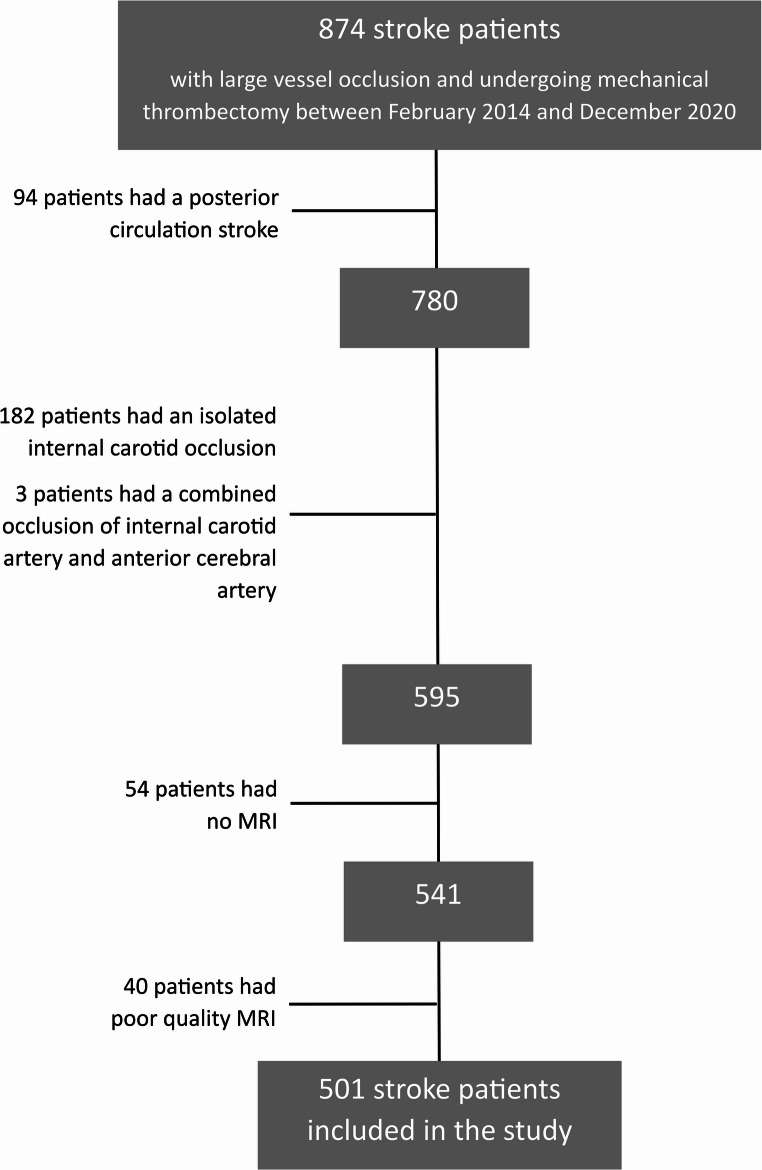 Figure 1
Peer Reviews
No public reviews on file for this paper yet. If you reviewed it on a platform where reviews are public (OpenReview, ICLR, NeurIPS, ICML), you can paste yours below so the community can read it here.
Videos
No videos yet. Explain this paper in a talk, walkthrough, or lecture? Add one.
Taxonomy
TopicsAcute Ischemic Stroke Management · Stroke Rehabilitation and Recovery · Blood Coagulation and Thrombosis Mechanisms