Statistical Accuracy of Administratively Recorded Race/Ethnicity in the Military Health System and Race/Ethnicity Ascertained via Questionnaire
Jordan McAdam, Stephanie A. Richard, Cara H. Olsen, Celia Byrne, Shawn Clausen, Amber Michel, Brian K. Agan, Robert O’Connell, Timothy H. Burgess, David R. Tribble, Simon Pollett, James D. Mancuso, Jennifer A. Rusiecki

TL;DR
This study assesses how accurately race and ethnicity data are recorded in the US Military Health System compared to self-reported data, finding significant misclassification and missing data, especially for minority groups.
Contribution
The study provides a detailed evaluation of race/ethnicity data accuracy in the MHS, highlighting disparities in data quality across different groups.
Findings
Administratively recorded data showed high accuracy for NH White and NH Black groups but lower accuracy for NH AI/AN and NH Other.
Race/ethnicity data were missing for 63% of dependent beneficiaries, with lower sensitivity but higher PPV compared to active duty/retired groups.
Misclassification and missing data may bias health disparity analyses and research in the MHS.
Abstract
Unequal disease burdens such as SARS-CoV-2 infection rates and COVID-19 outcomes across race/ethnicity groups have been reported. Misclassification of and missing race and ethnicity (race/ethnicity) data hinder efforts to identify and address health disparities in the US Military Health System (MHS); therefore, we evaluated the statistical accuracy of administratively recorded race/ethnicity data in the MHS Data Repository (MDR) through comparison to self-reported race/ethnicity collected via questionnaire in the Epidemiology, Immunology, and Clinical Characteristics of Emerging Infectious Diseases with Pandemic Potential (EPICC) cohort study. The study population included 6009 active duty/retired military (AD/R) and dependent beneficiaries (DB). Considering EPICC study responses the “gold standard,” we calculated sensitivity and positive predictive value (PPV) by race/ethnicity…
Genes, proteins, chemicals, diseases, species, mutations and cell lines named across the full text — each resolved to its canonical identifier and authoritative record.
Click any figure to enlarge with its caption.
 Figure 1
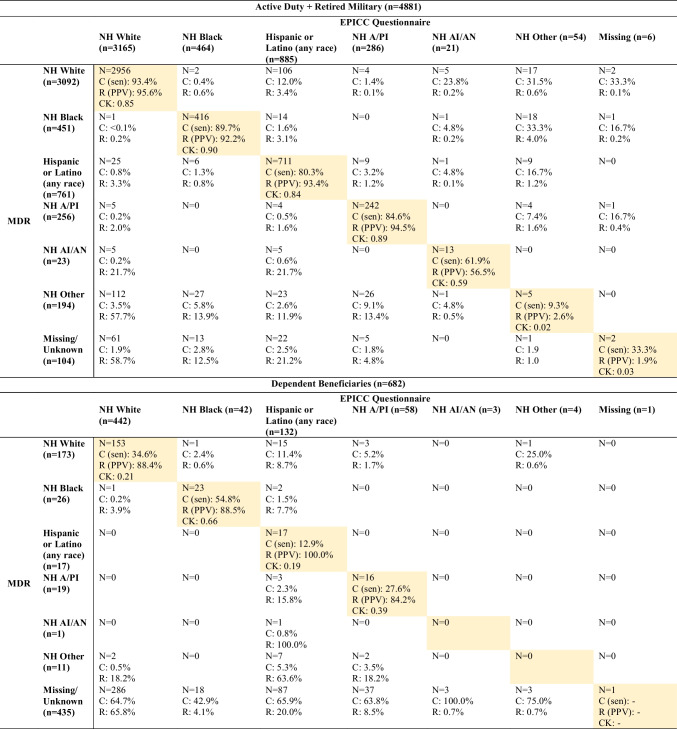 Figure 2
Peer Reviews
No public reviews on file for this paper yet. If you reviewed it on a platform where reviews are public (OpenReview, ICLR, NeurIPS, ICML), you can paste yours below so the community can read it here.
Videos
No videos yet. Explain this paper in a talk, walkthrough, or lecture? Add one.
Taxonomy
TopicsPublic Health Policies and Education · Health disparities and outcomes · Migration, Health and Trauma