Outcomes and patient satisfaction after pelvic organ prolapse surgery with and without mesh: a retrospective cohort study with prospective follow-up
Franziska Beer, Pia Schaufelberger, Thomas W. P. Friedl, Anna Lindner, Sabine Schütze, Wolfgang Janni, Miriam Deniz

TL;DR
This study compares patient satisfaction and complications after three types of pelvic organ prolapse surgery, finding high satisfaction across all methods with some differences in mesh-related complications.
Contribution
The study provides a long-term comparison of patient satisfaction and complication rates for three POP surgical approaches with prospective follow-up.
Findings
All three surgical groups reported high patient satisfaction with no significant difference in overall satisfaction.
Mesh erosions occurred more frequently in transvaginal mesh repair compared to sacrocolpopexy.
Adverse events like pain and recurrence impacted patient satisfaction.
Abstract
This retrospective cohort study with prospective follow-up evaluates patient satisfaction and complication rates following pelvic organ prolapse (POP) surgery, comparing three surgical approaches: transvaginal native tissue repair, transvaginal mesh repair, and laparoscopic sacrocolpopexy. Long-term satisfaction and postoperative complications of patients who underwent POP surgery between 2014 and 2021 at the University Women’s Hospital of Ulm were assessed via structured telephone interviews. Patient satisfaction was evaluated using the validated Freiburg Index of Patient Satisfaction (FIPS) questionnaire. Of 782 patients with POP surgery, 297 patients with primary surgeries at our clinic were included in the analysis. Patients of all three groups were highly satisfied according to FIPS with no significant difference (p = 0.058). Complication rate also did not differ significantly…
Genes, proteins, chemicals, diseases, species, mutations and cell lines named across the full text — each resolved to its canonical identifier and authoritative record.
Click any figure to enlarge with its caption.
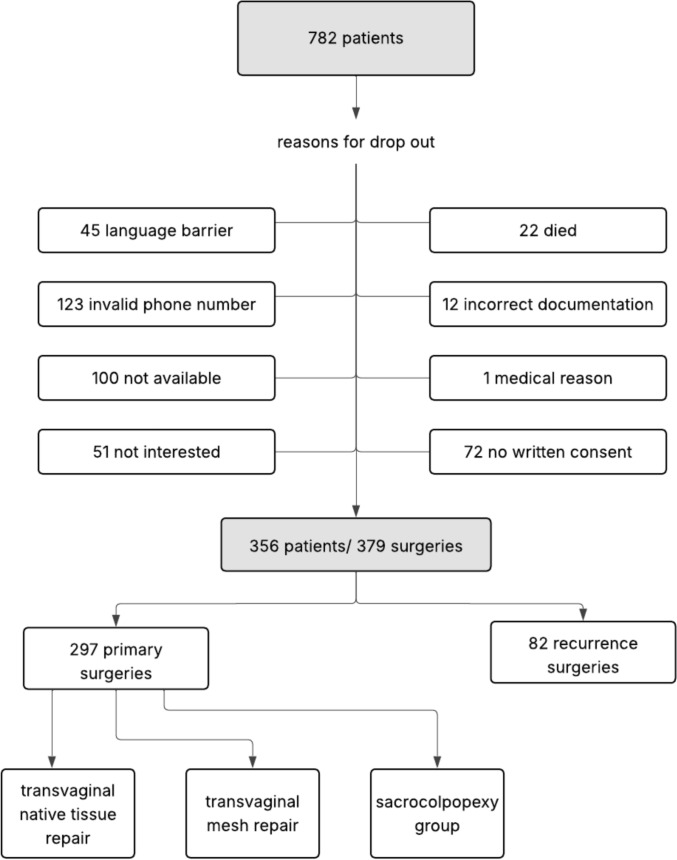 Figure 1
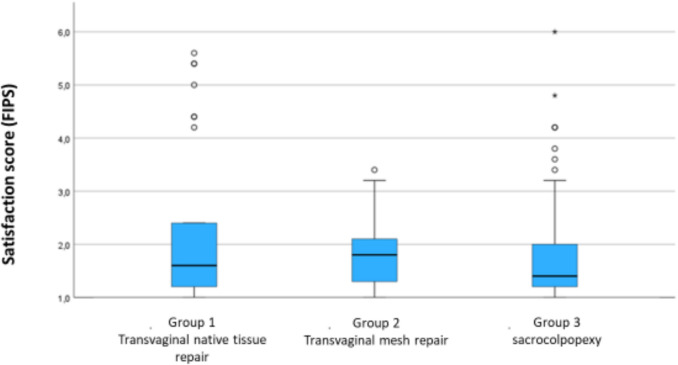 Figure 2
Peer Reviews
No public reviews on file for this paper yet. If you reviewed it on a platform where reviews are public (OpenReview, ICLR, NeurIPS, ICML), you can paste yours below so the community can read it here.
Videos
No videos yet. Explain this paper in a talk, walkthrough, or lecture? Add one.
Taxonomy
TopicsPelvic floor disorders treatments · Enhanced Recovery After Surgery · Bladder and Urothelial Cancer Treatments