Disparities in Urine Testing Among Febrile Children in US Emergency Departments
Than S. Kyaw, Carina De La Cueva, Natalia Leva, Debbie Goldberg, Isabel E. Allen, Maya Overland, Sam Washington, Hillary L. Copp

TL;DR
This study found that racial and ethnic disparities in urine testing for febrile children in US emergency departments decreased over time, with Hispanic and Black females eventually receiving similar testing rates as White females.
Contribution
The study provides new evidence that racial disparities in urine testing for febrile children have decreased over two decades in US emergency departments.
Findings
Hispanic and non-Hispanic Black females had lower urine testing rates than non-Hispanic White females in 2002–2012.
Urine testing rates for Hispanic and non-Hispanic Black females increased significantly over the study period.
By 2021, racial and ethnic disparities in urine testing for febrile females had disappeared.
Abstract
To evaluate the association of race and ethnicity with urine testing for febrile children in the emergency department and to measure trends in urine testing from 2002 to 2021. We conducted a cross-sectional analysis of children aged 2–24 months with a recorded temperature of ≥ 38 °C who presented to an emergency department in the United States from 2002 to 2021 using the National Hospital Ambulatory Medical Care Survey. We assessed trends in urine testing stratified by sex, race, and ethnicity over two decades and performed univariate and multivariate analyses. Between 2002 and 2021, there were 31,552,201 estimated emergency department visits by febrile children aged 2–24 months with recorded temperature ≥ 38.0 °C. In 2002–2012, Hispanic females and non-Hispanic Black females had significantly lower frequencies (13–19% vs. 26%; p < 0.001) compared to non-Hispanic White females.…
Genes, proteins, chemicals, diseases, species, mutations and cell lines named across the full text — each resolved to its canonical identifier and authoritative record.
Click any figure to enlarge with its caption.
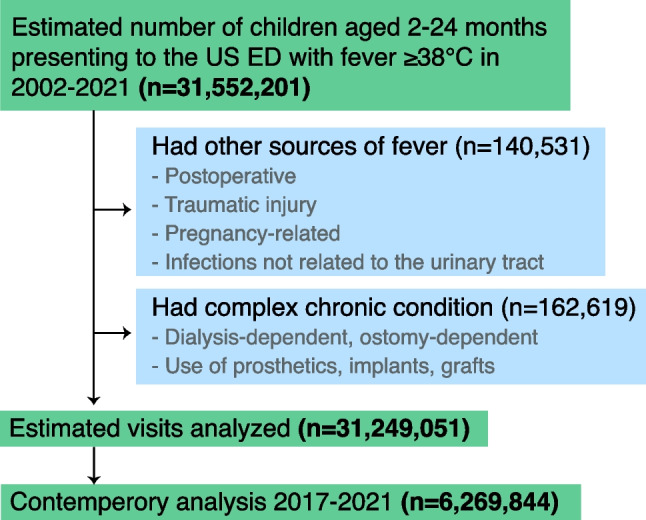 Figure 1
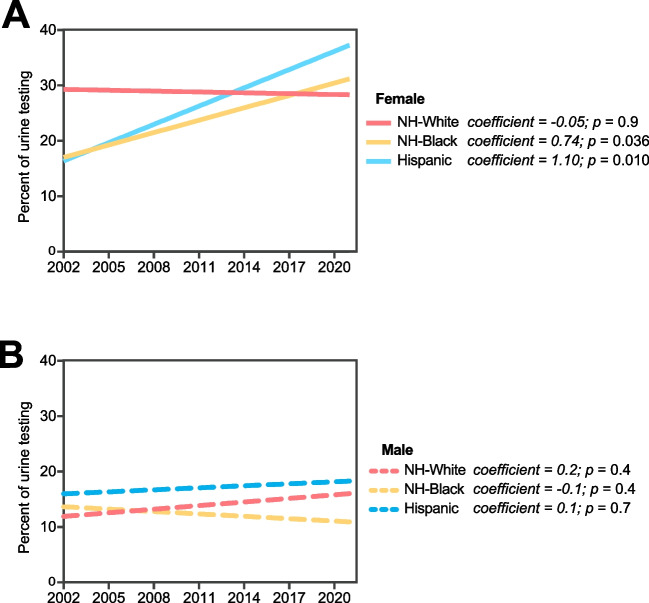 Figure 2
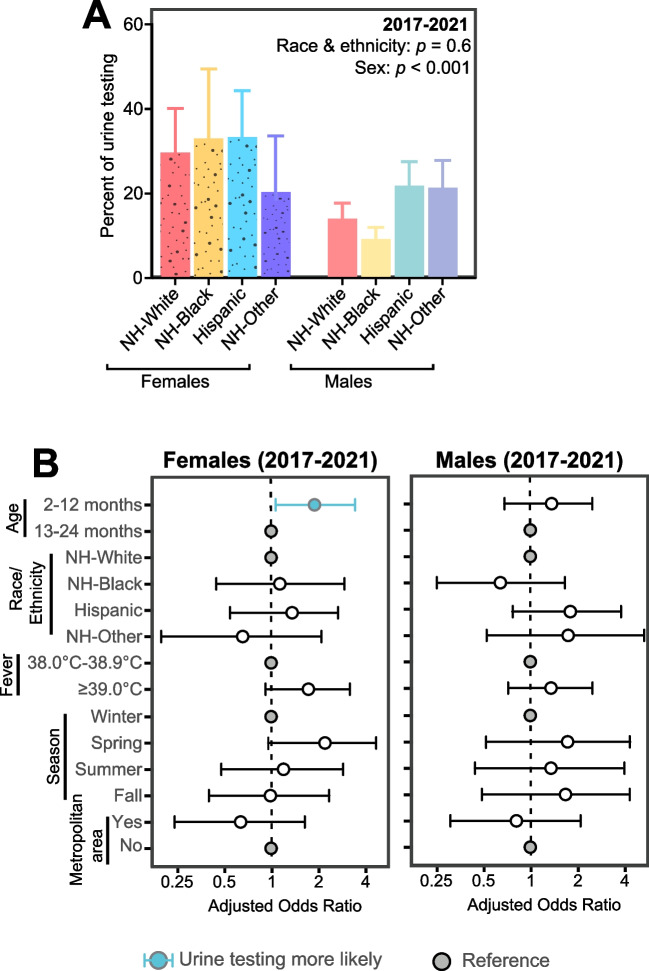 Figure 3
Peer Reviews
No public reviews on file for this paper yet. If you reviewed it on a platform where reviews are public (OpenReview, ICLR, NeurIPS, ICML), you can paste yours below so the community can read it here.
Videos
No videos yet. Explain this paper in a talk, walkthrough, or lecture? Add one.
Taxonomy
TopicsPediatric Urology and Nephrology Studies · Climate Change and Health Impacts · Urinary Tract Infections Management