Increased Infiltration of CD4 +, CD8 +, and CD68 + Cells at the Invasive Front Is Associated With Favorable Prognosis in Obstructive Colorectal Cancer: A Retrospective Observational Study
Goro Takahashi, Seiichi Shinji, Toshiyuki Ishiwata, Takeshi Yamada, Kay Uehara, Akihisa Matsuda, Tomio Arai, Ryuji Ohashi, Yasuyuki Yokoyama, Takuma Iwai, Hiroshi Yoshida

TL;DR
High levels of CD4+, CD8+, and CD68+ immune cells at the tumor edge in obstructive colorectal cancer are linked to better survival outcomes.
Contribution
This study identifies immune cell infiltration at the tumor invasive front as a strong independent prognostic factor in obstructive colorectal cancer.
Findings
CD4+, CD8+, and CD68+ cells are more abundant at the tumor invasive front than in the tumor center.
High CD4+ and CD68+ cell densities at the invasive front correlate with improved cancer-specific survival.
Total immune cell density at the invasive front is the strongest independent predictor of survival.
Abstract
Obstructive colorectal cancer (OCRC) presents as an oncologic emergency with poor prognosis. Although tumor‐infiltrating lymphocytes (TILs) and tumor‐associated macrophages (TAMs) are known to affect colorectal cancer outcomes, their roles in OCRC remain unclear. We retrospectively analyzed 66 patients with Stages II–III OCRC who underwent curative resection following endoscopic decompression. CD4+, CD8+, and CD68+ cell densities at the tumor center and invasive front were quantified using multiplex immunofluorescence imaging. Cancer‐specific survival (CSS) was assessed in relation to immune cell infiltration. Target immune cells were significantly more abundant at the invasive front compared to the tumor center. High densities of CD4+ TILs and CD68+ TAMs at the invasive front were associated with superior CSS (p = 0.0079 and p = 0.0088, respectively). Total immune cell density—defined…
Genes, proteins, chemicals, diseases, species, mutations and cell lines named across the full text — each resolved to its canonical identifier and authoritative record.
Click any figure to enlarge with its caption.
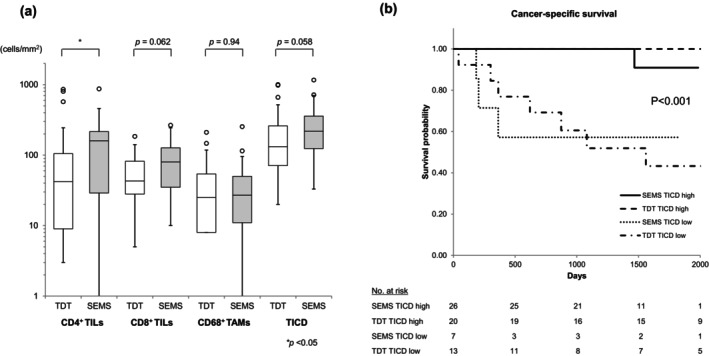 Figure 1
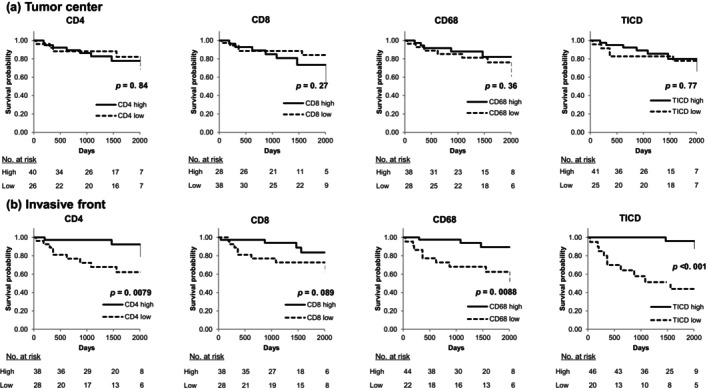 Figure 2
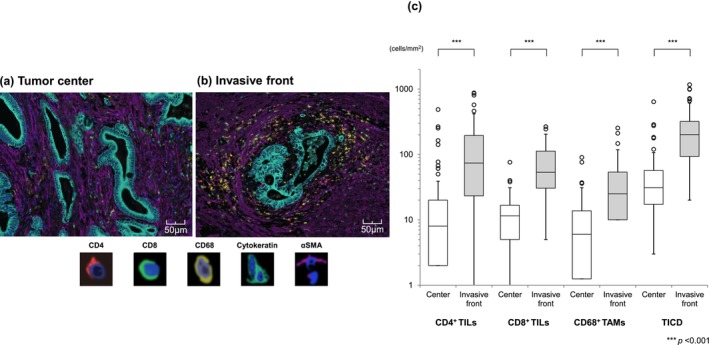 Figure 3
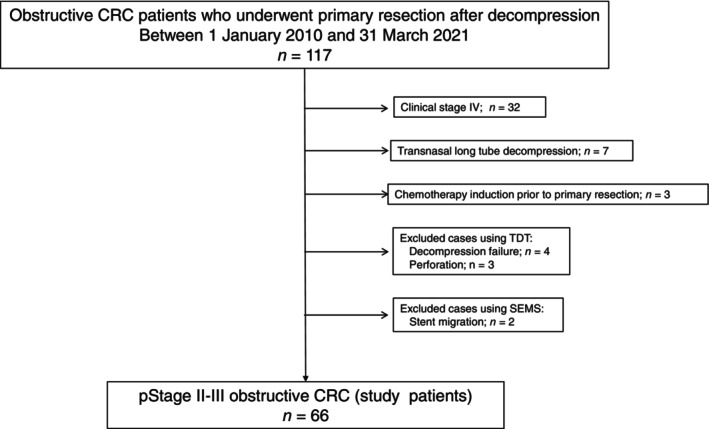 Figure 4
Peer Reviews
No public reviews on file for this paper yet. If you reviewed it on a platform where reviews are public (OpenReview, ICLR, NeurIPS, ICML), you can paste yours below so the community can read it here.
Videos
No videos yet. Explain this paper in a talk, walkthrough, or lecture? Add one.
Taxonomy
TopicsColorectal Cancer Surgical Treatments · Inflammatory Biomarkers in Disease Prognosis · Cancer Immunotherapy and Biomarkers