Waist-to-height ratio as a non-invasive marker of renal sinus fat: a MRI-based cohort study
Diego Moriconi, Miikka-Juhani Honka, Ekaterina Saukko, Emilia Moritz, Aino Latva-Rasku, Prince Dadson, Nelli Tuomola, Laura Pekkarinen, Paulina Salminen, Pirjo Nuutila, Eleni Rebelos

TL;DR
This study finds that waist-to-height ratio is a better predictor of kidney fat than BMI, which could help assess kidney health in people with obesity.
Contribution
The study demonstrates that WHtR is a novel and independent predictor of renal sinus fat percentage compared to traditional measures like BMI.
Findings
Waist-to-height ratio (WHtR) is significantly associated with renal sinus fat percentage (RSF%) independent of BMI.
RSF% is independently correlated with estimated glomerular filtration rate (eGFR) after adjusting for other factors.
Changes in RSF after bariatric surgery correlate with changes in WHtR and Body Roundness Index (BRI).
Abstract
Renal sinus fat (RSF) is an ectopic fat depot whose expansion has been linked to hypertension and chronic kidney disease. We assessed a range of adiposity indices to determine whether they offer more accurate predictions of RSF than BMI. Renal sinus fat (RSF) and RSF relative to total kidney area (RSF%) were assessed via MRI in 74 individuals with severe obesity and 47 lean volunteers. 50 persons with obesity were re-evaluated 6 to 12 months after undergoing bariatric surgery. In multivariable regression analyses adjusted for age, sex, and BMI, the Body Roundness Index (BRI), waist-to-height ratio (WHtR), and waist circumference showed the strongest associations with RSF. Of these, only WHtR was significantly associated with RSF%. In univariate analyses, both RSF and RSF% were inversely correlated with estimated glomerular filtration rate (eGFR); however, in multivariate analysis, only…
Genes, proteins, chemicals, diseases, species, mutations and cell lines named across the full text — each resolved to its canonical identifier and authoritative record.
Click any figure to enlarge with its caption.
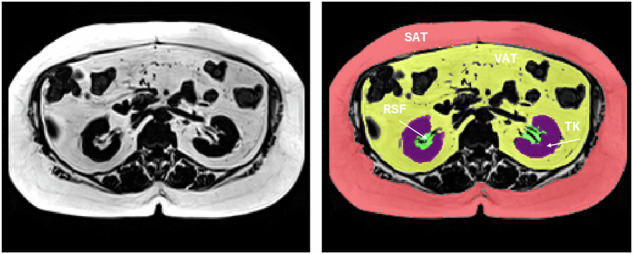 Figure 1
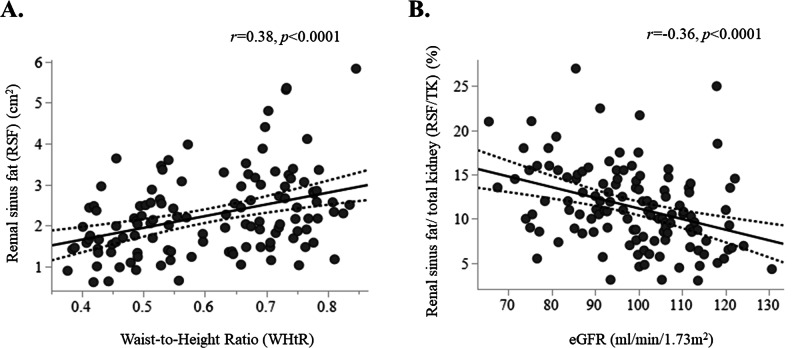 Figure 2
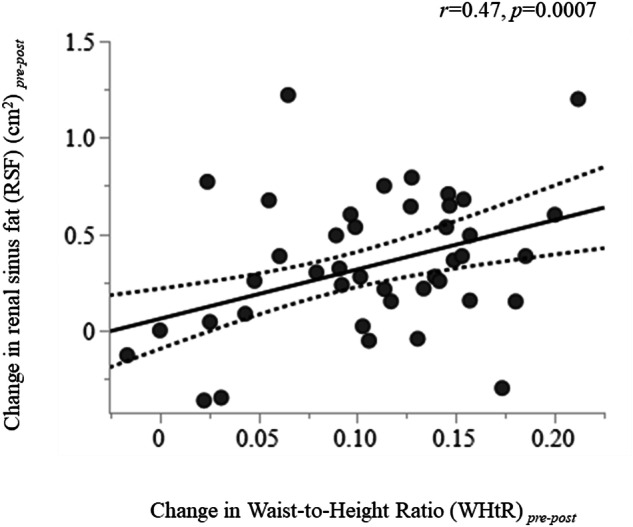 Figure 3
Peer Reviews
No public reviews on file for this paper yet. If you reviewed it on a platform where reviews are public (OpenReview, ICLR, NeurIPS, ICML), you can paste yours below so the community can read it here.
Videos
No videos yet. Explain this paper in a talk, walkthrough, or lecture? Add one.
Taxonomy
TopicsCardiovascular Disease and Adiposity · Parathyroid Disorders and Treatments · Chronic Kidney Disease and Diabetes