Assessing the Link Between Physical Activity and Musculoskeletal Disorders in Taxi Drivers: A Comparison of Accelerometry and Self‐Report Measures
Marta Marín‐Berges, Pablo A. Lizana, Isabel Iguacel, Marcos Echevarría‐Polo, Valentina Marroquín‐Pinochet, Constanza Rivas‐Sanhueza, German Vicente‐Rodríguez, Alejandro Gómez‐Bruton

TL;DR
This study compares how well self-reported and wearable device measurements of physical activity predict musculoskeletal pain in taxi drivers, finding that neither method shows a clear link to pain levels.
Contribution
The study highlights discrepancies between self-reported and objective physical activity measures and their lack of association with MSD prevalence in taxi drivers.
Findings
Self-reported physical activity was significantly overestimated compared to accelerometry measurements.
No significant association was found between physical activity levels and musculoskeletal disorder prevalence.
Taxi drivers showed high prevalence of musculoskeletal pain, particularly in the neck and lower back.
Abstract
Taxi drivers are at an elevated risk for work‐related musculoskeletal disorders (MSDs), and the reasons for this are prolonged sitting, static postures, and whole‐body vibration. Physical activity (PA) may mitigate MSD risk but is often assessed subjectively. This study compared objective (wrist‐worn accelerometry) and subjective (IPAQ‐S) measures of PA and sedentary behaviours by examining their associations with MSD prevalence in taxi drivers from Spain and Chile. In this cross‐sectional study, 170 taxi drivers (mean age 51.9 ± 10.7 years; 87.1% male) completed sociodemographic and Nordic questionnaires on MSDs (7‐day recall), and the IPAQ‐S for PA. A subsample of 36 wore a wrist‐worn accelerometer for seven days to quantify sedentary time and PA amount and intensities. Overall, 68.8% of drivers reported pain in at least one body region in the past 7 days, most commonly the neck…
Genes, proteins, chemicals, diseases, species, mutations and cell lines named across the full text — each resolved to its canonical identifier and authoritative record.
Click any figure to enlarge with its caption.
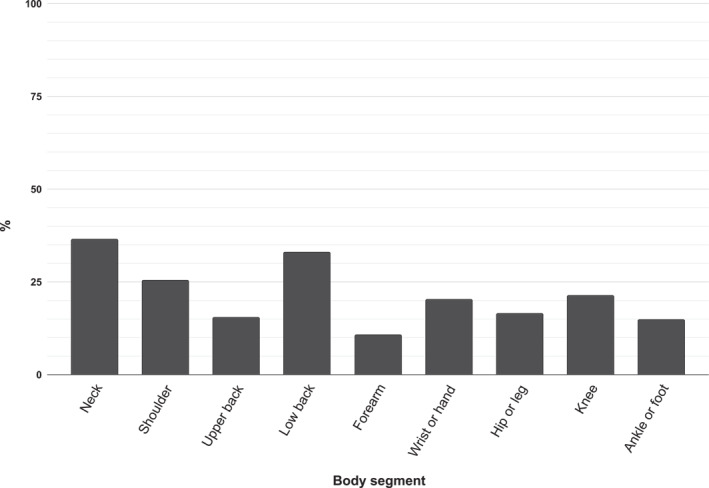 Figure 1
Peer Reviews
No public reviews on file for this paper yet. If you reviewed it on a platform where reviews are public (OpenReview, ICLR, NeurIPS, ICML), you can paste yours below so the community can read it here.
Videos
No videos yet. Explain this paper in a talk, walkthrough, or lecture? Add one.
Taxonomy
TopicsSleep and Work-Related Fatigue · Older Adults Driving Studies · Ergonomics and Musculoskeletal Disorders