Family history of stroke and cardiovascular diseases in early-onset cryptogenic ischaemic stroke
Maximilian C Sihvo, Pauli Ylikotila, Marialuisa Zedde, Rosario Pascarella, Tomi Sarkanen, Dalius Jatužis, Kristina Ryliškienė, Bettina von Sarnowski, Radim Licenik, Phillip Ferdinand, Janika Kõrv, Liisa Kõrv, Alessandro Pezzini, Ana Catarina Fonseca, André Paula

TL;DR
This study finds that a family history of stroke and blood clots is linked to early-onset cryptogenic stroke, suggesting inherited risks and clotting issues.
Contribution
The study identifies new associations between family history of stroke and VTE with early-onset cryptogenic ischaemic stroke.
Findings
eCIS patients had higher family history of stroke in first-degree relatives and grandparents.
Family history of early-onset VTE in first-degree relatives was strongly associated with eCIS.
Associations were stronger in patients with high-risk patent foramen ovale.
Abstract
Familial aggregation of stroke is well-documented, yet few studies have examined associations between stroke subtypes—particularly early-onset cryptogenic ischaemic stroke (eCIS)—and broader family history (FH) of cardiovascular disease. Such associations may provide insights into underlying etiologic mechanisms. In this multicentre case–control study, we included eCIS patients aged 18–49 years and matched stroke-free controls. We analysed the association between FH of stroke, venous thromboembolism (VTE), coronary artery disease (CAD), aneurysms and eCIS using multivariable logistic regression, with a subgroup analysis stratifying patients by high-risk patent foramen ovale (HR-PFO). We enrolled 508 eCIS patients (182 [36%] with HR-PFO) and 520 controls. Compared with controls, patients more frequently reported FH of stroke among first-degree relatives (FDR) (20% vs. 14%, P = .01) and…
Genes, proteins, chemicals, diseases, species, mutations and cell lines named across the full text — each resolved to its canonical identifier and authoritative record.
Click any figure to enlarge with its caption.
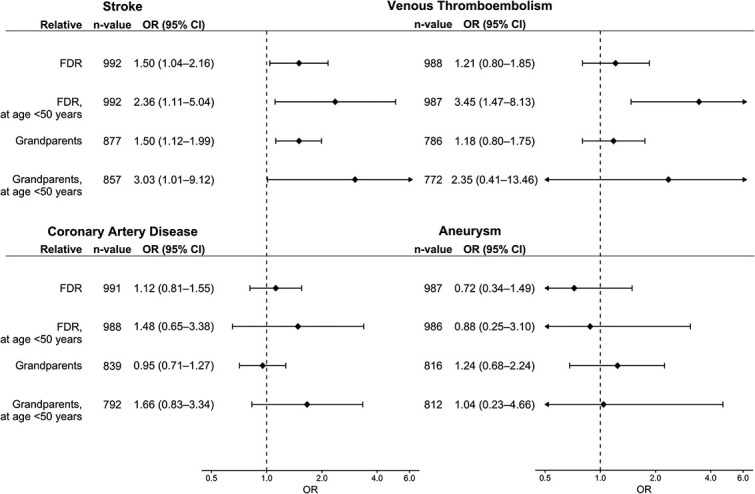 Figure 1
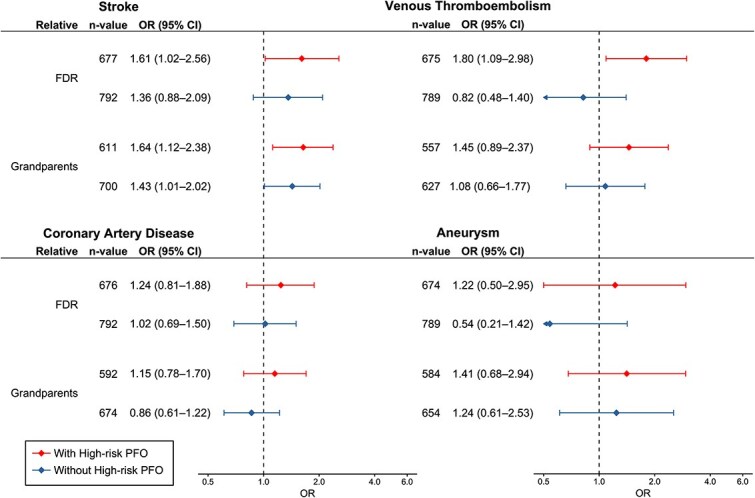 Figure 2
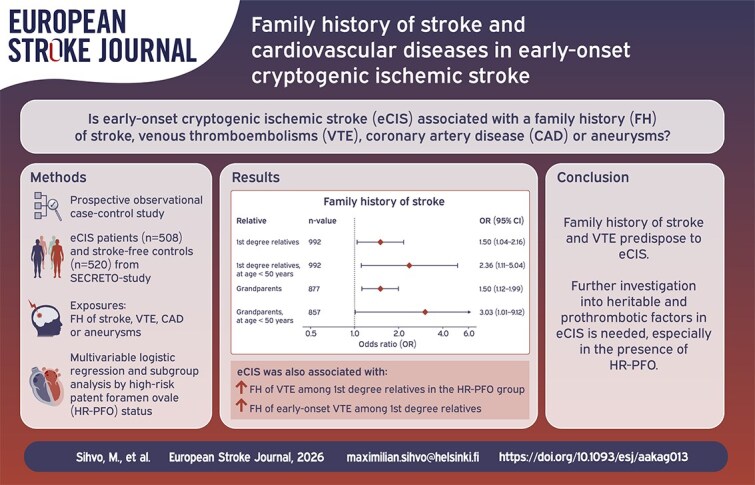 Figure 3
Peer Reviews
No public reviews on file for this paper yet. If you reviewed it on a platform where reviews are public (OpenReview, ICLR, NeurIPS, ICML), you can paste yours below so the community can read it here.
Videos
No videos yet. Explain this paper in a talk, walkthrough, or lecture? Add one.
Taxonomy
TopicsOropharyngeal Anatomy and Pathologies · Cerebrovascular and Carotid Artery Diseases · Cerebrovascular and genetic disorders