Optical Coherence Tomography Changes in Central Nervous System Inflammatory Demyelinating Diseases: A Longitudinal Retrospective Study
Duaa T Daradkeh, Mohammad A AL Shdaifat, Mutaz N Sarayrah, Anzor R Al Alwan, Walaa A Shatnawi, Ahmed Khatatbeh

TL;DR
This study uses OCT to track retinal changes in different types of central nervous system inflammatory demyelinating diseases over one year, showing progressive degeneration.
Contribution
The study provides longitudinal OCT data across multiple CNS-IDD subgroups, highlighting OCT's potential as a biomarker for disease monitoring.
Findings
NMOSD and SPMS showed the most significant retinal degeneration over 12 months.
CIS patients had the best baseline and maintained relative preservation over time.
Optic disc swelling increased in all groups, especially in SPMS, NMOSD, and MOGAD.
Abstract
Background Optical coherence tomography (OCT) is considered an indispensable, non-invasive imaging modality that provides insights into neuroaxonal integrity in several retinal and optic nerve disorders by offering high-resolution, cross-sectional visualization of retinal and optic nerve head layers. With its capability of providing imaging of retinal microstructures, recently, OCT has been used in the assessment of central nervous system inflammatory demyelinating diseases (CNS-IDDs). These diseases, such as clinically isolated syndrome (CIS), relapsing-remitting multiple sclerosis (RRMS), secondary progressive multiple sclerosis (SPMS), neuromyelitis optica spectrum disorder (NMOSD), and myelin oligodendrocyte glycoprotein antibody-associated disease (MOGAD), are frequently associated with visual pathway impairment. Our purpose in this research is to evaluate longitudinal OCT changes…
Genes, proteins, chemicals, diseases, species, mutations and cell lines named across the full text — each resolved to its canonical identifier and authoritative record.
Click any figure to enlarge with its caption.
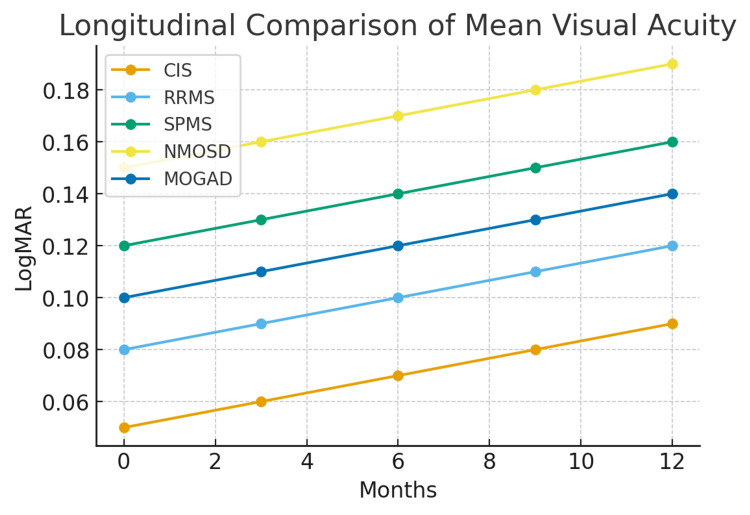 Figure 1
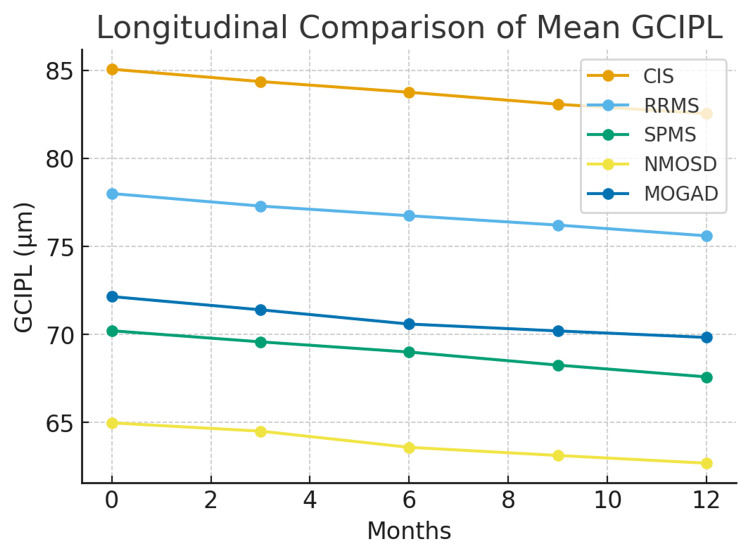 Figure 2
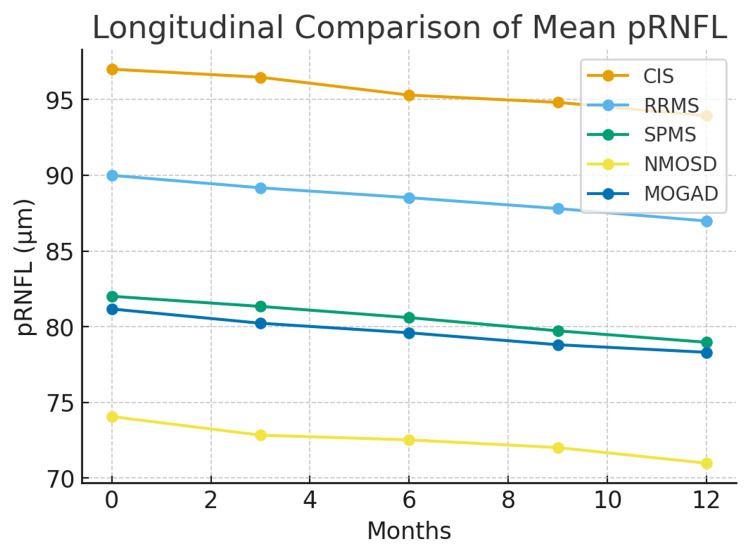 Figure 3
Peer Reviews
No public reviews on file for this paper yet. If you reviewed it on a platform where reviews are public (OpenReview, ICLR, NeurIPS, ICML), you can paste yours below so the community can read it here.
Videos
No videos yet. Explain this paper in a talk, walkthrough, or lecture? Add one.
Taxonomy
TopicsMultiple Sclerosis Research Studies · Peripheral Neuropathies and Disorders · Cerebral Venous Sinus Thrombosis