Long-term prognostic value of microvascular obstruction by cardiac magnetic resonance in ST-segment elevation myocardial infarction
Raquel P. Amier, Casper W. H. Beijnink, José F. Rodriguez Palomares, Martijn W. Smulders, Gonzalo Pizarro Sánchez, Rodrigo Fernández-Jiménez, Filipa X. Valente, Albert C. van Rossum, Niels van Royen, Borja Ibañez, Robin Nijveldt

TL;DR
This study shows that microvascular obstruction detected by MRI after heart attacks is linked to higher death risk for up to six years, but not beyond.
Contribution
The study provides long-term (up to 6 years) prognostic data on microvascular obstruction in STEMI patients using cardiac MRI.
Findings
MVO was associated with a 2.23-fold higher risk of all-cause mortality up to six years post-STEMI.
The association between MVO and mortality dissipated after six years of follow-up.
MVO was not significantly linked to combined mortality and ischemic events before or after six years.
Abstract
Microvascular obstruction (MVO) portends a higher risk of remodelling and adverse events following ST-segment elevation myocardial infarction (STEMI). However, data regarding the implications of MVO in STEMI beyond five years of follow-up are scarce. This is a pooled analysis of three observational studies including 876 prospectively enrolled reperfused first STEMI patients, who underwent cardiac magnetic resonance imaging with late gadolinium enhancement (LGE), between 2003–2019. Median follow-up duration was 6.3 (IQR 3.6–9.3) years. The primary outcome was all-cause mortality. The secondary outcome was a combined endpoint of all-cause mortality and recurrent ischemic events (i.e., myocardial infarction or stroke). We performed Cox regression analyses with a time-dependent covariate. The study population consisted of 876 patients, mean age 59 years ± 12, 720 men (82%). MVO was…
Genes, proteins, chemicals, diseases, species, mutations and cell lines named across the full text — each resolved to its canonical identifier and authoritative record.
Click any figure to enlarge with its caption.
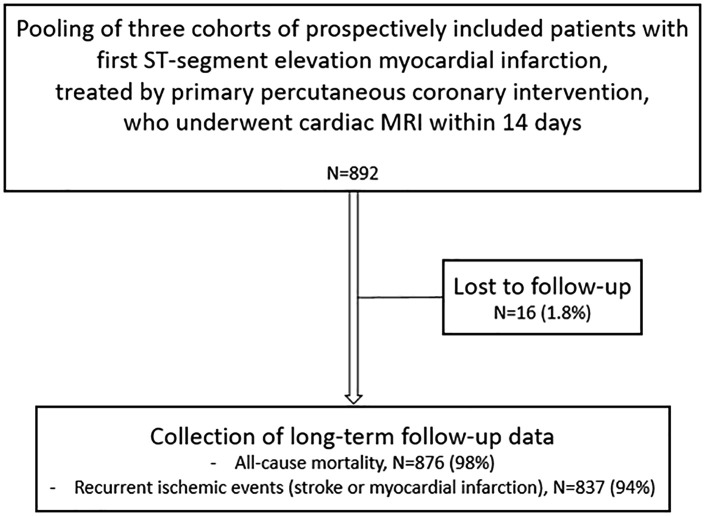 Figure 1
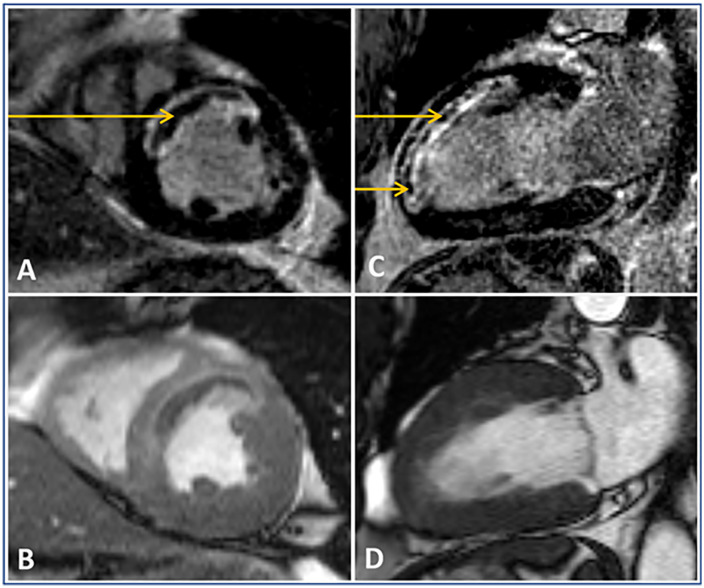 Figure 2
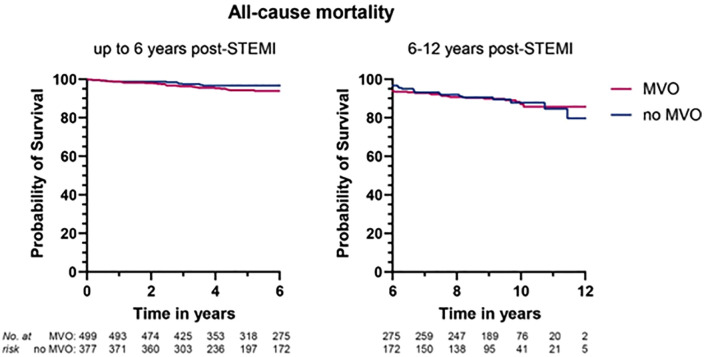 Figure 3
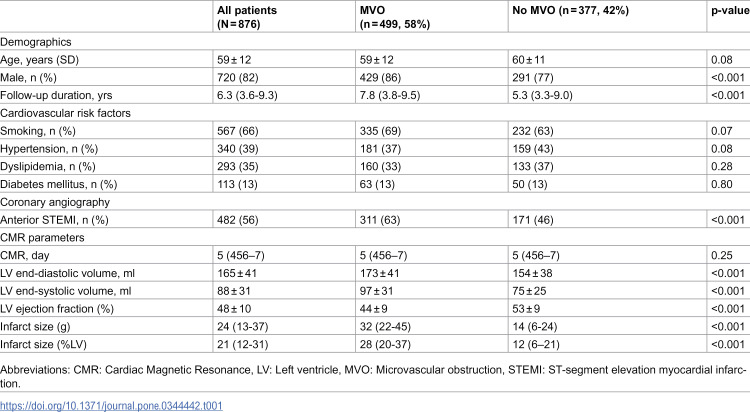 Figure 4
 Figure 5
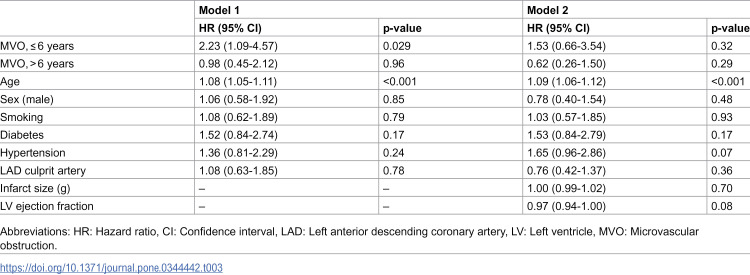 Figure 6
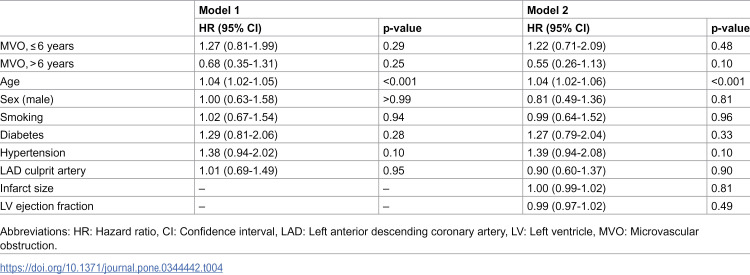 Figure 7
Peer Reviews
No public reviews on file for this paper yet. If you reviewed it on a platform where reviews are public (OpenReview, ICLR, NeurIPS, ICML), you can paste yours below so the community can read it here.
Videos
No videos yet. Explain this paper in a talk, walkthrough, or lecture? Add one.
Taxonomy
TopicsCardiac Imaging and Diagnostics · Acute Myocardial Infarction Research · Takotsubo Cardiomyopathy and Associated Phenomena