Tele-cognitive rehabilitation for adult lower-grade glioma: An interim prospective pilot feasibility study
Christina Weyer-Jamora, Melissa S Brie, Paige M Bracci, Ellen M Smith, Tracy L Luks, Stephanie Phan, Steve E Braunstein, Nancy Ann Oberheim-Bush, Nicholas A Butowski, Jennifer L Clarke, Karin Gehring, Adrian Aguilera, John de Groot, Susan M Chang, Shawn L Hervey-Jumper

TL;DR
This study explores whether tele-cognitive rehabilitation can help adults with lower-grade gliomas improve cognitive function, finding that one method (GMT) shows promise while others face challenges.
Contribution
The study introduces tele-cognitive rehabilitation as a feasible and potentially effective intervention for cognitive impairments in lower-grade glioma patients.
Findings
GMT showed adequate feasibility and satisfaction with 82% adherence and high satisfaction scores.
Working memory improved in 26% of GMT participants from baseline to postintervention.
Texting and ReMind had lower adherence and satisfaction compared to GMT.
Abstract
Cognitive impairments are common in lower-grade gliomas (grades 1–3), but treatment options are limited. Tele-cognitive rehabilitation offers a potential solution. We conducted an interim pilot study to assess the feasibility, satisfaction, and early efficacy of tele-cognitive rehabilitation. We enrolled adults with stable LrGG (≥6 months posttreatment) who had subjective and objective cognitive impairments (>1 SD below-average in ≥2 domains). Participants received 3 months of individual Goal Management Training (GMT), app-based ReMind, or texting. Cognition and patient-reported outcomes were assessed at baseline (T1), postintervention (T2), and 9 months postbaseline (T3). We assessed enrollment, adherence, and satisfaction. Adherence was defined as ≥80% of participants completing ≥80% of the protocol; satisfaction as ≥6/7 for GMT and texting, and ≥4/5 for ReMind on a self-report…
Genes, proteins, chemicals, diseases, species, mutations and cell lines named across the full text — each resolved to its canonical identifier and authoritative record.
Click any figure to enlarge with its caption.
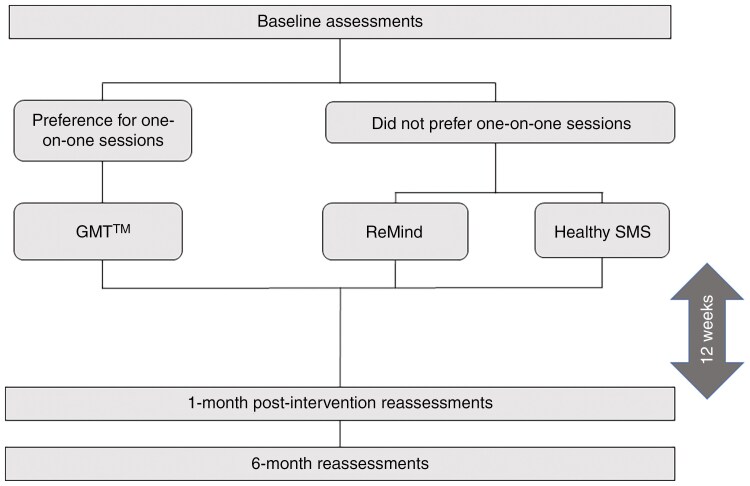 Figure 1
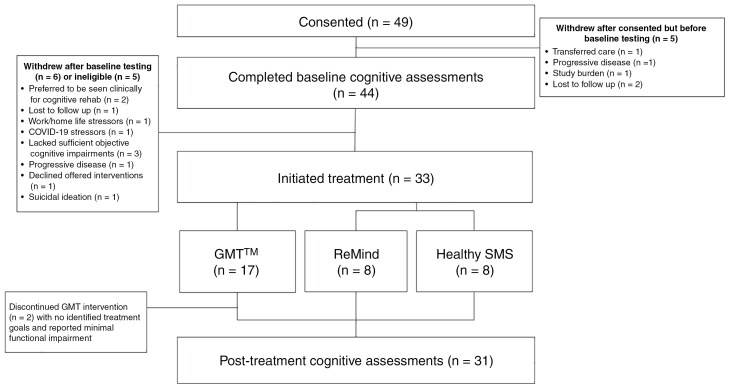 Figure 2
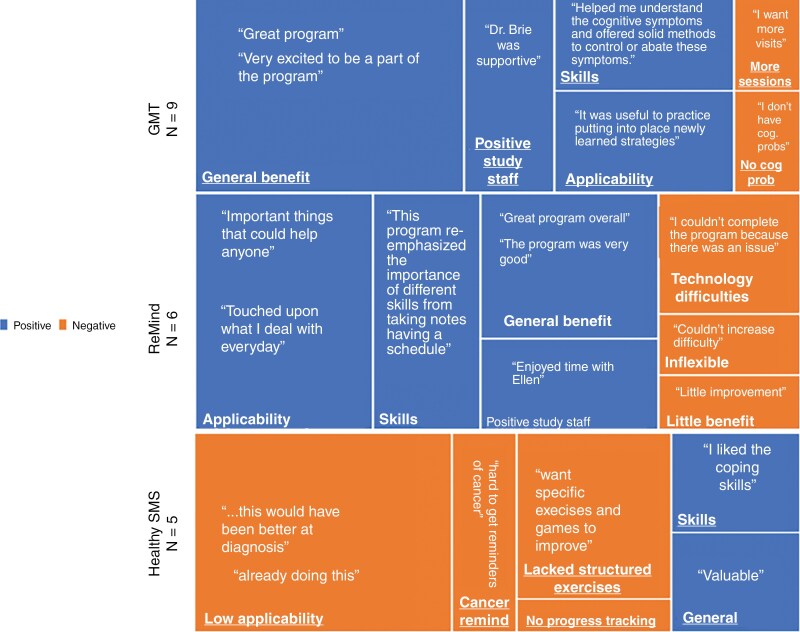 Figure 3
Peer Reviews
No public reviews on file for this paper yet. If you reviewed it on a platform where reviews are public (OpenReview, ICLR, NeurIPS, ICML), you can paste yours below so the community can read it here.
Videos
No videos yet. Explain this paper in a talk, walkthrough, or lecture? Add one.
Taxonomy
TopicsCancer-related cognitive impairment studies · Stroke Rehabilitation and Recovery · Dementia and Cognitive Impairment Research