The accessory adapters FAF1, FAF2, and UBXN7 accelerate proteasomal degradation by increasing prior p97-mediated substrate unfolding
Matthias Kracht, Alexander Kröning, Johannes van den Boom, Pinki Gahlot, Sandra Koska, Leo Kiss, Hemmo Meyer

TL;DR
This study reveals how accessory proteins help the p97 complex unfold proteins more efficiently for degradation by the proteasome.
Contribution
The study identifies how FAF1, FAF2, and UBXN7 enhance p97-mediated unfolding by positioning Ufd1 for efficient substrate loading.
Findings
Accessory adapters FAF1, FAF2, and UBXN7 stimulate proteasomal degradation by increasing p97 unfolding rates.
A helix-UBX segment in FAF1/2 tethers Ufd1's ubiquitin-binding module to p97, improving substrate loading.
Disrupting the helix-Ufd1 interaction reduces degradation efficiency, confirming the role of accessory adapters.
Abstract
The AAA-ATPase VCP/p97 with its adapter Ufd1-Npl4 unfolds ubiquitylated substrate proteins to prepare degradation in the proteasome; however, the function of critical accessory factors remains unclear. Here, we show in the mammalian system that efficient protein degradation in the proteasome requires accessory adapters that boost p97-mediated unfolding likely by positioning Ufd1 for substrate loading. In a reaction that reconstitutes p97-Ufd1-Npl4–mediated unfolding coupled to proteasomal degradation, degradation was inefficient but stimulated by accessory adapters FAF1, FAF2, or UBXN7. Stimulation of proteasomal degradation was largely caused by an increase of p97 unfolding rates, conveyed by a helix-UBX segment in FAF1/2 that tethered the UT3 ubiquitin binding module of Ufd1 to the p97 N-domain. Mutations that abrogated the helix-Ufd1 interaction reduced stimulation of degradation,…
Genes, proteins, chemicals, diseases, species, mutations and cell lines named across the full text — each resolved to its canonical identifier and authoritative record.
Click any figure to enlarge with its caption.
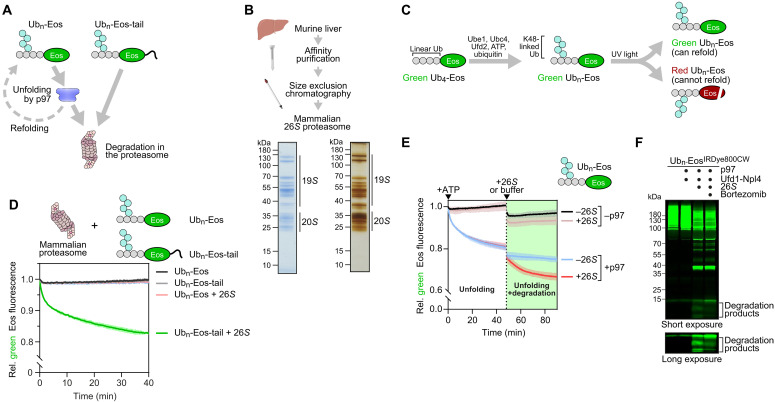 Figure 1
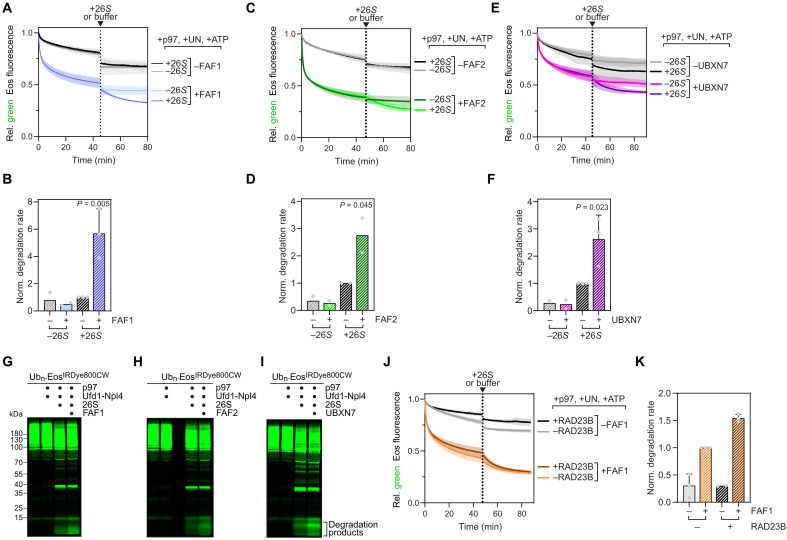 Figure 2
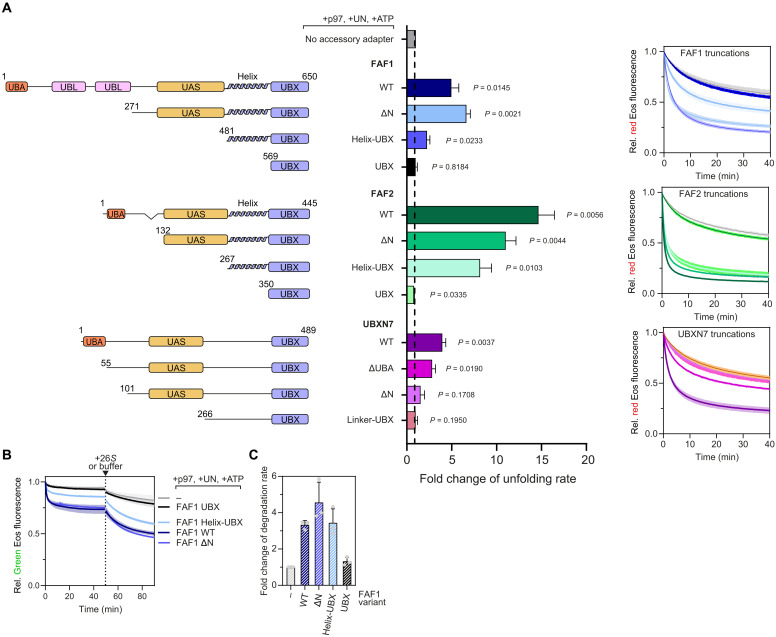 Figure 3
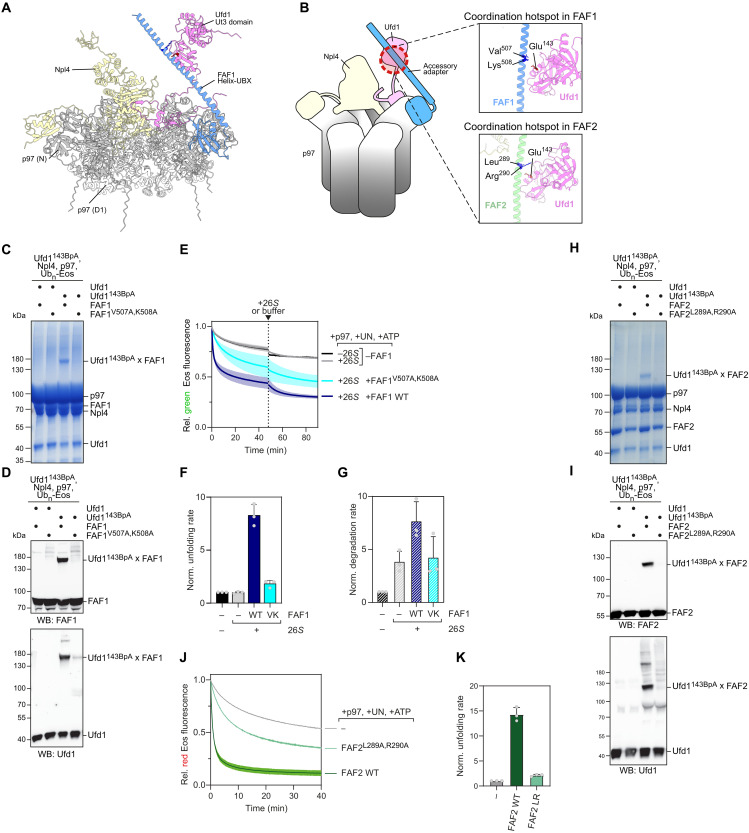 Figure 4
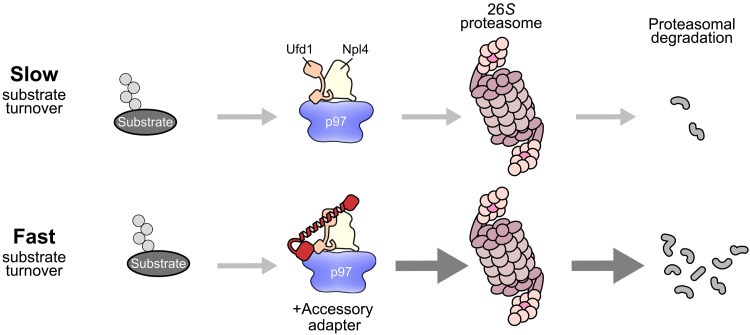 Figure 5
Peer Reviews
No public reviews on file for this paper yet. If you reviewed it on a platform where reviews are public (OpenReview, ICLR, NeurIPS, ICML), you can paste yours below so the community can read it here.
Videos
No videos yet. Explain this paper in a talk, walkthrough, or lecture? Add one.
Taxonomy
TopicsUbiquitin and proteasome pathways · Endoplasmic Reticulum Stress and Disease · Heat shock proteins research