Utilization of Fertility Treatment in Japan During the First Year of Insurance Coverage: Analysis of Real‐World Health Claims Data
Makoto Okawara, Tomoichiro Kuwazuru, Moe Masunaga, Kenji Fujimoto, Masako Nagata, Takeshi Iwasa, Yoshihisa Fujino

TL;DR
This study examines how fertility treatment usage in Japan changed after becoming covered by public health insurance, showing age-related trends and gender disparities.
Contribution
The study provides real-world data on fertility treatment utilization in Japan following insurance coverage, highlighting age and gender patterns.
Findings
Infertility prevalence was highest in women aged 30–34 years (3.9%) and men aged 30–34 years (0.5%).
Assisted reproductive technology (ART) became more common after age 35, while general fertility treatment decreased with age.
Male infertility diagnosis and treatment rates remained low, indicating potential access barriers.
Abstract
In April 2022, fertility treatments, including assisted reproductive technology (ART), became eligible for public health insurance coverage in Japan. This study describes the prevalence and characteristics of infertility diagnoses and fertility treatments during the first year of coverage. This study analyzed claims data from 14 health insurance associations from April 2022 to March 2023. Infertility diagnoses and fertility treatments, and related comorbidities were identified via diagnosis, procedure, and drug codes. Among 590,006 women and 619,551 men, the highest prevalence of infertility was seen in women (3.9%) and men (0.5%) aged 30–34 years. General fertility treatment was more common among younger women but decreased with age, while ART became more prevalent after age 35. The major prescriptions were hormone preparations for ART and luteal insufficiency among women. The…
Genes, proteins, chemicals, diseases, species, mutations and cell lines named across the full text — each resolved to its canonical identifier and authoritative record.
Click any figure to enlarge with its caption.
 Figure 1
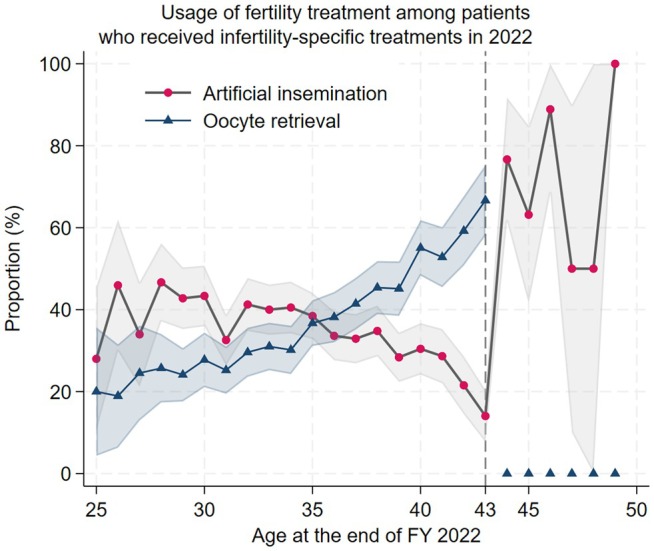 Figure 2
Peer Reviews
No public reviews on file for this paper yet. If you reviewed it on a platform where reviews are public (OpenReview, ICLR, NeurIPS, ICML), you can paste yours below so the community can read it here.
Videos
No videos yet. Explain this paper in a talk, walkthrough, or lecture? Add one.
Taxonomy
TopicsFamily Dynamics and Relationships · Agricultural risk and resilience · Reproductive Health and Technologies