All‐Optical Diffractive Operators for Rapid, Computer‐Free Morphological Transformations
Yuxiang Sun, Fenglei Wang, Jing Han, Geyang Qu, Zezheng Zhang, Yan Wei, Chuang Yang, Qifeng Ruan, Shengjie Wang, Heming Wei, Chaoran Huang, Jun Guan, Jingtian Hu

TL;DR
This paper introduces an all-optical system that uses diffractive layers to perform fast, computer-free image processing tasks like erosion and dilation.
Contribution
The novel contribution is a scalable, deep learning-trained diffractive optical system for rapid, parallel morphological transformations without digital computation.
Findings
Diffractive surfaces can perform erosion and dilation operations using optical wavefront processing.
The system enables image denoising and adjustable transformation kernels through training.
Experiments show the optical process is highly parallel and suitable for large image datasets.
Abstract
Morphological transformations are playing a key role in visual information processing with diverse applications ranging from bioimaging to video surveillance and environmental monitoring. However, these operations are becoming increasingly computationally intensive, requiring substantial memory and processing power as the size of image datasets expands. This paper describes a fast, highly parallel approach to perform morphological transformations by diffractive computing. These all‐optical processors consist of successive diffractive surfaces designed to perform dilation and erosion operations by learning the relations between input and transformed images via a deep learning‐based optimization process. Unlike existing digital methods, our free‐space diffractive devices implement these transformations in a computer‐free manner by directly processing the optical wavefront. The cascaded…
Genes, proteins, chemicals, diseases, species, mutations and cell lines named across the full text — each resolved to its canonical identifier and authoritative record.
Click any figure to enlarge with its caption.
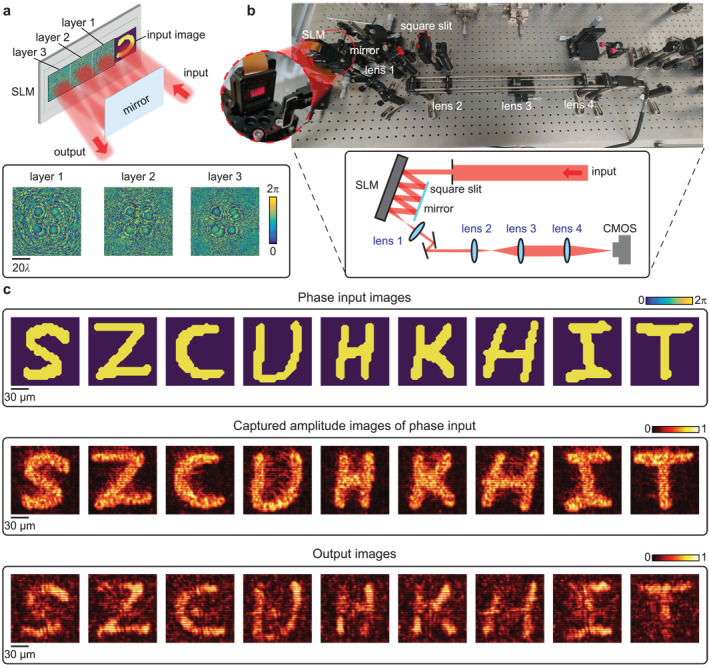 Figure 1
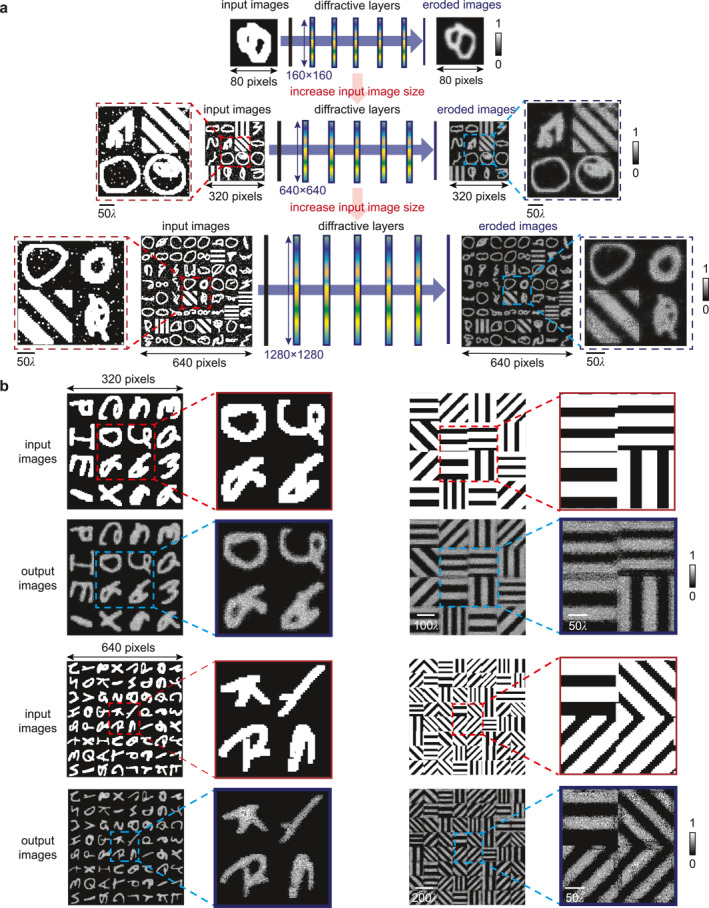 Figure 2
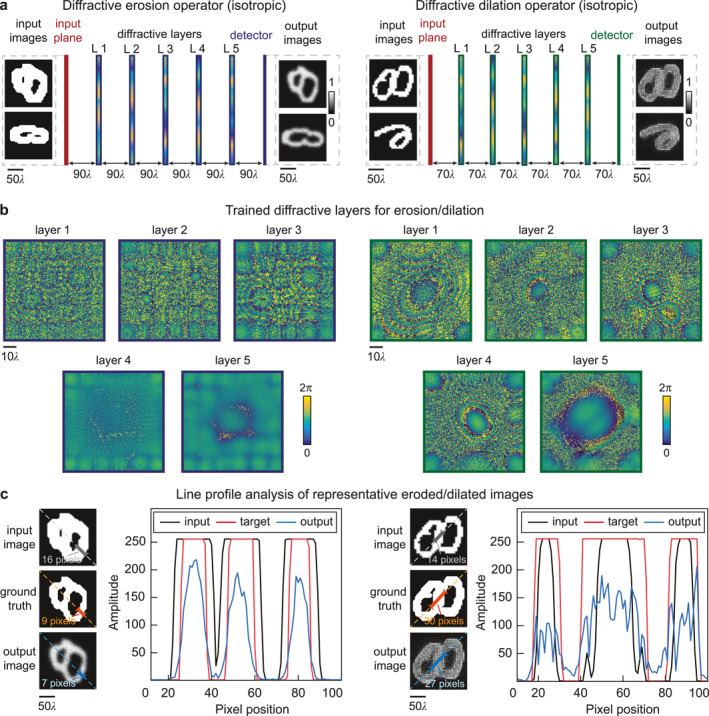 Figure 3
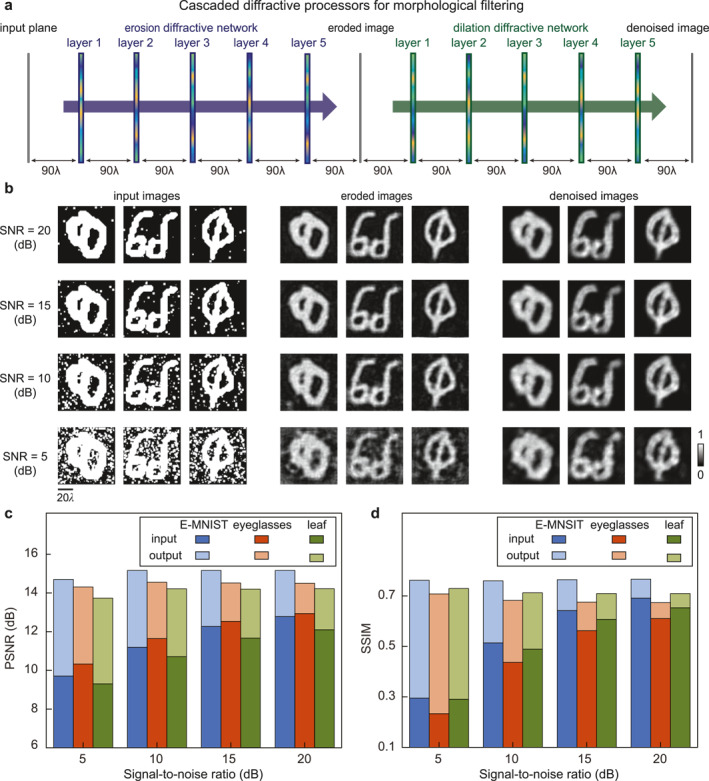 Figure 4
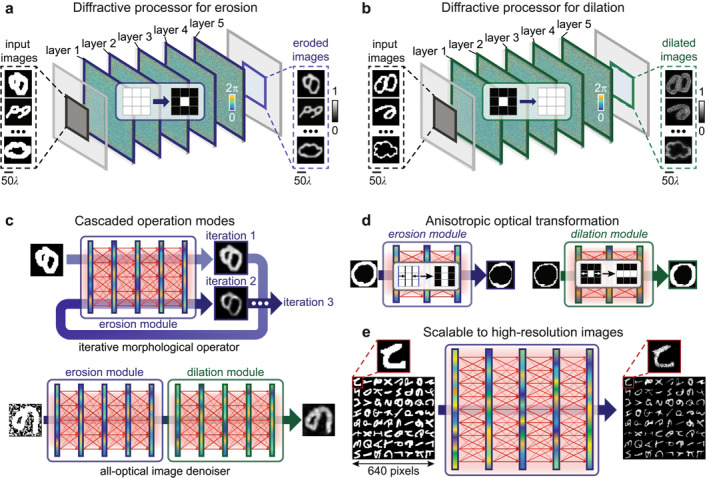 Figure 5
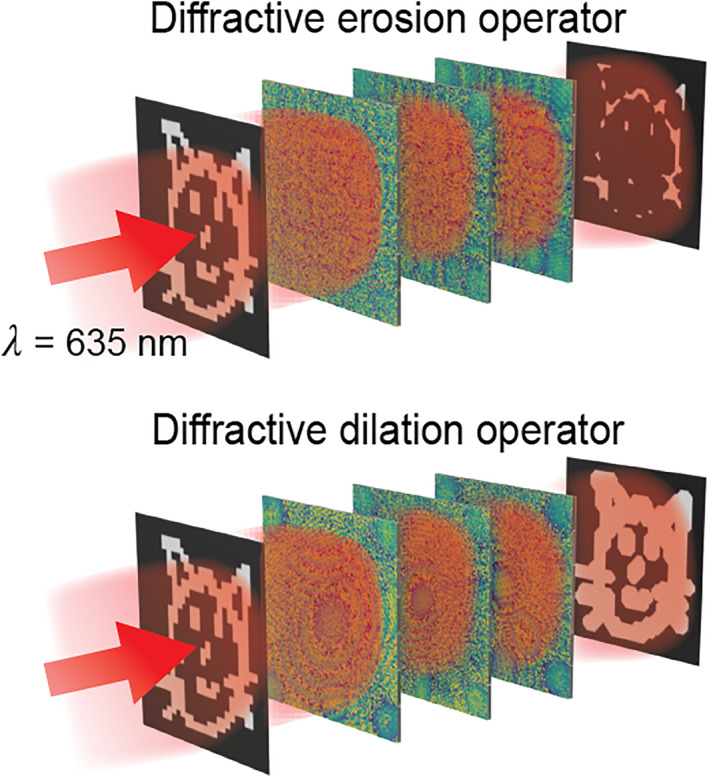 Figure 6
Peer Reviews
No public reviews on file for this paper yet. If you reviewed it on a platform where reviews are public (OpenReview, ICLR, NeurIPS, ICML), you can paste yours below so the community can read it here.
Videos
No videos yet. Explain this paper in a talk, walkthrough, or lecture? Add one.
Taxonomy
TopicsAdvanced Optical Imaging Technologies · Quasicrystal Structures and Properties · Metamaterials and Metasurfaces Applications