Do Public Perceptions of the Environment Align With Empirical Measures?
Pamela L. Booth, Lynette J. McLeod, Philip Stahlmann‐Brown

TL;DR
This study compares public perceptions of the environment in New Zealand with scientific data to identify areas of agreement and disagreement.
Contribution
The novel contribution is a comprehensive comparison of public and expert environmental perceptions across ten domains using a nationally representative survey.
Findings
Public ratings of air quality aligned with empirical data and expert opinions.
Perceptions of rivers and lakes were lowest, matching scientific assessments.
For most domains, the public viewed the environment more positively than scientific evidence suggests.
Abstract
To create effective environmental communications and policies, it is crucial to understand how laypeople, scientists, and experts perceive the environment. This study, based on a large‐scale, nationally representative survey from Aotearoa New Zealand and scientific reports and literature, examines the similarities and differences in perceptions across ten environmental domains: air; protected natural areas; native bush and forests; marine environments; coastal waters and beaches; marine plants and animals; terrestrial (land and freshwater) plants and animals; natural environments in towns and cities; wetlands; and rivers and lakes. The New Zealand public rated their air quality highest and rivers and lakes lowest, aligning with empirical measures and expert opinions. For other domains, public perceptions varied, often seeing the overall state as better than what the scientific studies…
Click any figure to enlarge with its caption.
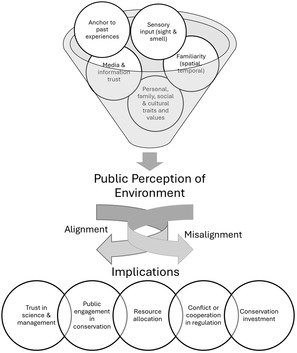 Figure 1
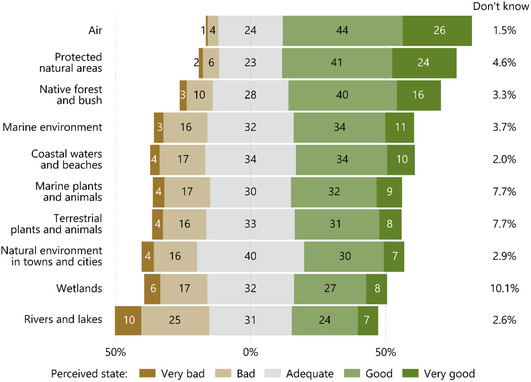 Figure 2
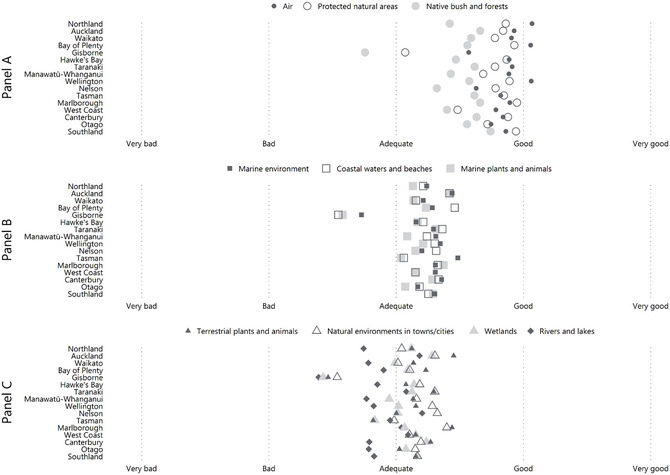 Figure 3
Peer Reviews
No public reviews on file for this paper yet. If you reviewed it on a platform where reviews are public (OpenReview, ICLR, NeurIPS, ICML), you can paste yours below so the community can read it here.
Videos
No videos yet. Explain this paper in a talk, walkthrough, or lecture? Add one.
Taxonomy
TopicsClimate Change Communication and Perception · Risk Perception and Management · Environmental Education and Sustainability