Plasmon Enhancement Reveals Origin of the Dark States of Photoluminescence Intermittency in Quantum Dots
Jialu Li, Zhihao Chen, Guofeng Zhang, Bin Li, Changgang Yang, Wenli Guo, Xue Han, Chuang Wang, Zhuang Ying, Jinhui Wang, Ruiyun Chen, Chengbing Qin, Jianyong Hu, Liantuan Xiao, Suotang Jia

TL;DR
This paper explains the cause of dark states in quantum dots using plasmon enhancement, which could help improve their performance in applications.
Contribution
The study identifies the origin of dark states in quantum dots as nonradiative multiple recombination centers activated by phonon kicks.
Findings
Dark states in quantum dots originate from band-edge carrier trapping by nonradiative multiple recombination centers.
Plasmonic gold nanoparticles enhance dark-state photoluminescence intensity, enabling clearer observation.
A Monte Carlo simulation models dark and transition states, quantifying nonradiative rates.
Abstract
Dark states of photoluminescence (PL) intermittency in colloidal quantum dots (QDs) interrupt PL emission and significantly reduce emission intensity, severely hindering QD applications. However, the origin of dark states remains ambiguous due to their extremely low intensity, which impedes the development of effective suppression strategies. In this study, we use plasmonic gold nanoparticles to significantly increase the radiative rate of excitons, and thereby enhancing the dark‐state PL intensity. Calculations of radiative rate scaling based on the dark‐state PL intensity and lifetime reveal that the dark states originate from band‐edge carrier trapping by collectively activated nonradiative multiple recombination centers (MRCs). Transition states that accompany the dark states are frequently observed in PL trajectories, revealing the presence of a positive feedback mechanism for the…
Genes, proteins, chemicals, diseases, species, mutations and cell lines named across the full text — each resolved to its canonical identifier and authoritative record.
Click any figure to enlarge with its caption.
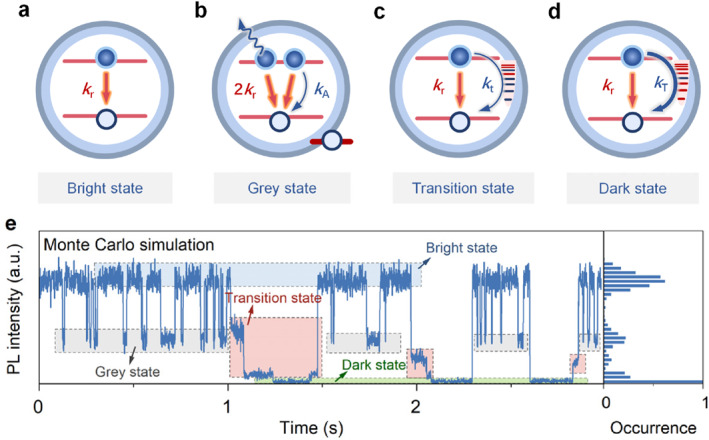 Figure 1
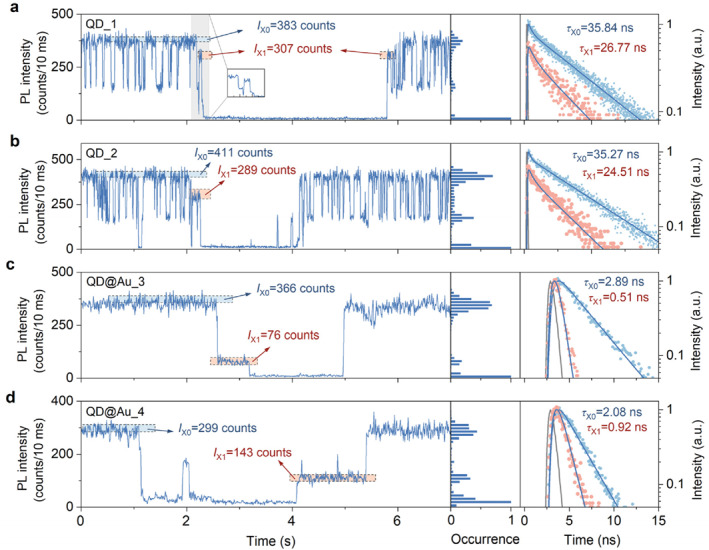 Figure 2
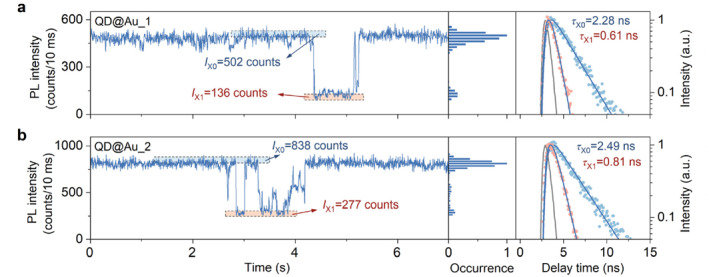 Figure 3
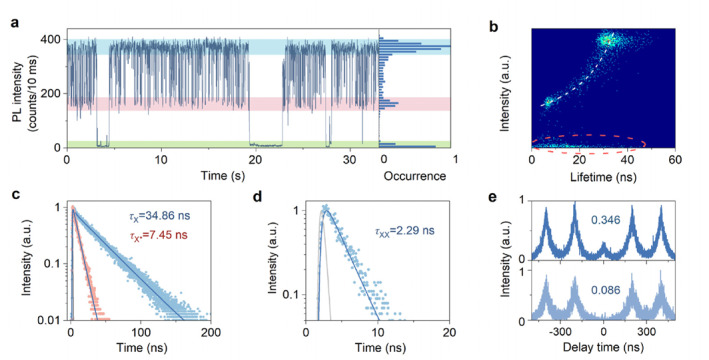 Figure 4
Peer Reviews
No public reviews on file for this paper yet. If you reviewed it on a platform where reviews are public (OpenReview, ICLR, NeurIPS, ICML), you can paste yours below so the community can read it here.
Videos
No videos yet. Explain this paper in a talk, walkthrough, or lecture? Add one.
Taxonomy
TopicsPlasmonic and Surface Plasmon Research · Quantum Dots Synthesis And Properties · Gold and Silver Nanoparticles Synthesis and Applications