Role of the RBMS Family in Different Cancers and Research Progress
Hanchi Wu, Rui Hou, Yuhan Zhang, Hanfang Fan, Junying Xu, Huiyu Wang

TL;DR
This paper reviews how RNA-binding motif single-stranded interacting proteins (RBMSs) influence cancer development and progression in various types of cancer.
Contribution
The paper provides a comprehensive review of RBMS family roles in multiple cancers and their regulatory mechanisms.
Findings
RBMS proteins regulate oncogenes, growth factors, and cell cycle proteins in cancer.
RBMSs are involved in tumorigenesis and tumor progression across several cancer types.
The paper summarizes current research on RBMSs in breast, prostate, lung, liver, gastric, and colorectal cancers.
Abstract
RNA-binding proteins (RBPs), as posttranscriptional regulators, can modulate the activity and stability of target RNAs and participate in the whole life cycle of RNA processing, localization, modification and translation. RNA-binding motif single-stranded interacting proteins (RBMSs) comprise a critical subgroup within the RNA-binding protein (RBP) family, sharing the same domain characteristics as other RBPs. Several studies have shown that RBMSs can participate in tumorigenesis and tumor progression through mechanisms such as regulating the expression of oncogenes, growth factors and cell cycle proteins. In this paper, we reviewed the role of RBPs and related research progress in breast, prostate, lung, liver, gastric and colorectal cancers.
Genes, proteins, chemicals, diseases, species, mutations and cell lines named across the full text — each resolved to its canonical identifier and authoritative record.
Click any figure to enlarge with its caption.
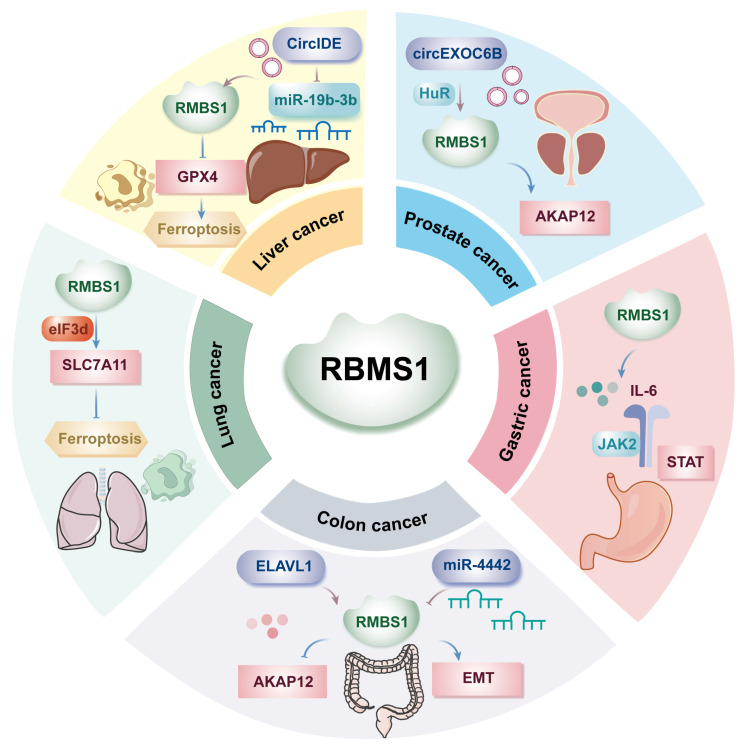 Figure 1
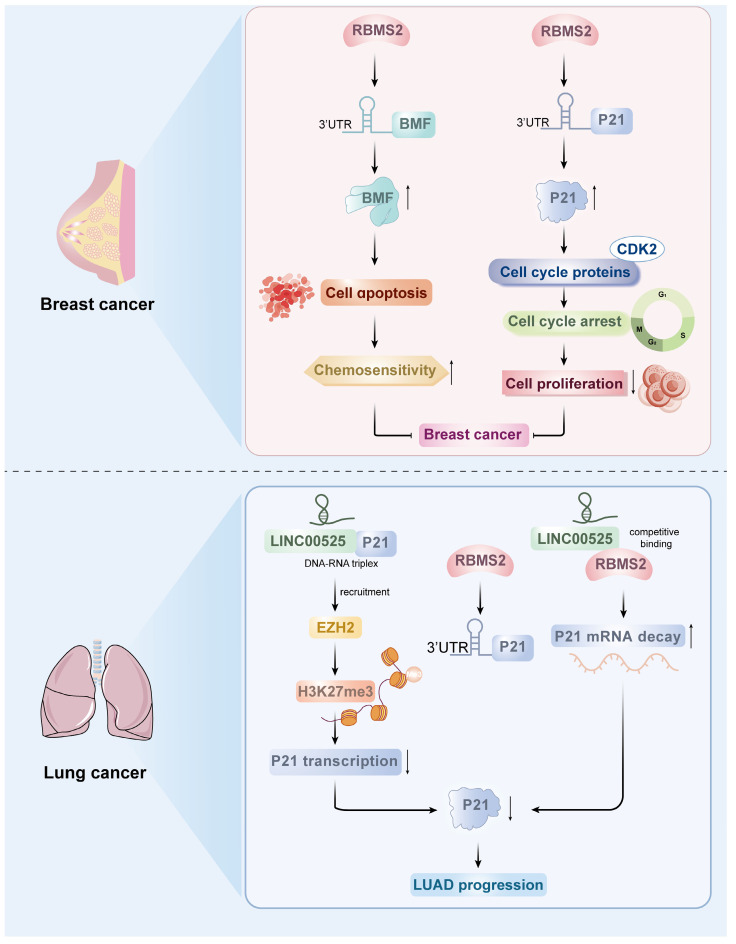 Figure 2
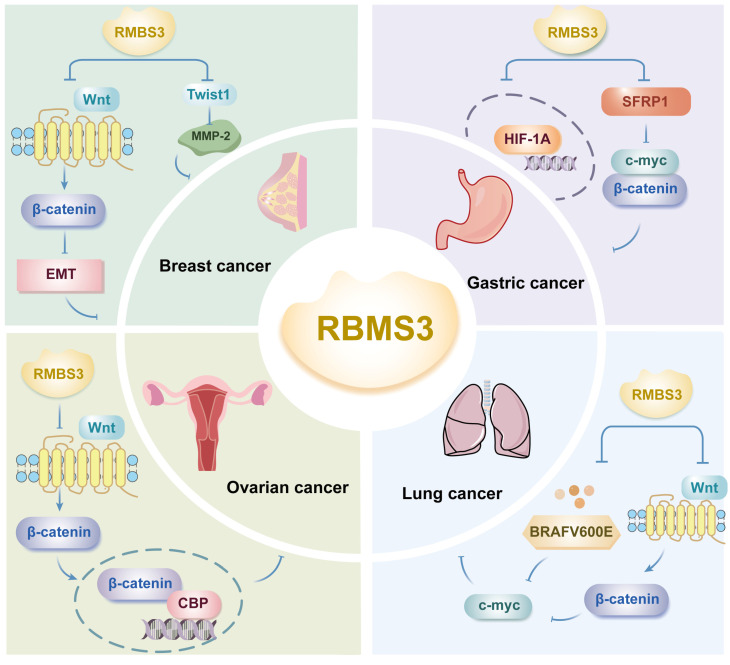 Figure 3
Peer Reviews
No public reviews on file for this paper yet. If you reviewed it on a platform where reviews are public (OpenReview, ICLR, NeurIPS, ICML), you can paste yours below so the community can read it here.
Videos
No videos yet. Explain this paper in a talk, walkthrough, or lecture? Add one.
Taxonomy
TopicsProtein Kinase Regulation and GTPase Signaling · Mechanisms of cancer metastasis · Wnt/β-catenin signaling in development and cancer