KTaO3‑Based Supercurrent Diode
Muqing Yu, Jieun Kim, Ahmed Omran, Zhuan Li, Jiangfeng Yang, Sayanwita Biswas, Chang-Beom Eom, David Pekker, Patrick Irvin, Jeremy Levy

TL;DR
Researchers demonstrated a supercurrent diode effect using a LAO/KTO interface, enabling nonreciprocal superconducting currents with potential applications in quantum circuits.
Contribution
A reconfigurable superconducting weak link platform at the LAO/KTO interface is introduced to realize the supercurrent diode effect.
Findings
The supercurrent diode effect is achieved using nanoscale weak link geometry at the LAO/KTO interface.
The rectification efficiency reaches up to 13% under optimal magnetic field conditions.
Asymmetric vortex motion due to inversion-symmetry-breaking geometry explains the observed effect.
Abstract
The supercurrent diode effect (SDE), characterized by nonreciprocal critical currents, represents a promising building block for future dissipationless electronics and quantum circuits. Realizing SDE requires breaking both time-reversal and inversion symmetry in the device. Here we use conductive atomic force microscope (c-AFM) lithography to pattern reconfigurable superconducting weak links (WLs) at the LaAlO3/KTaO3 (LAO/KTO) interface. By deliberately engineering the WL geometry at the nanoscale, we realize SDE in these devices in the presence of modest out-of-plane magnetic fields. The SDE polarity can be reversed by simply changing the WL position, and the rectification efficiency reaches up to 13% under optimal magnetic field conditions. Time-dependent Ginzburg–Landau simulations reveal that the observed SDE originates from asymmetric vortex motion in the…
Genes, proteins, chemicals, diseases, species, mutations and cell lines named across the full text — each resolved to its canonical identifier and authoritative record.
Click any figure to enlarge with its caption.
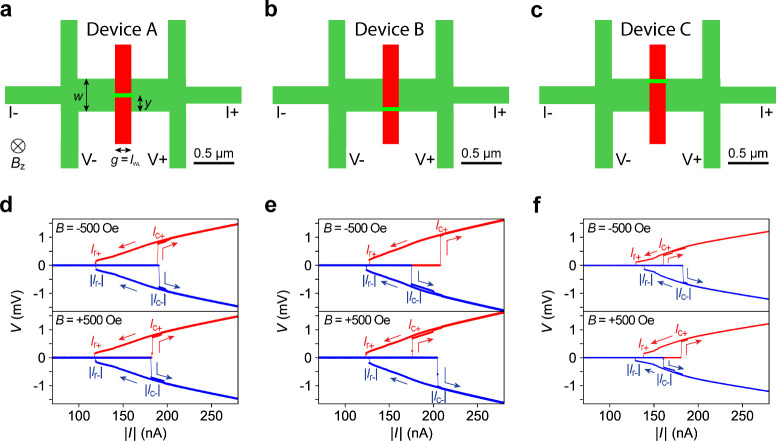 Figure 1
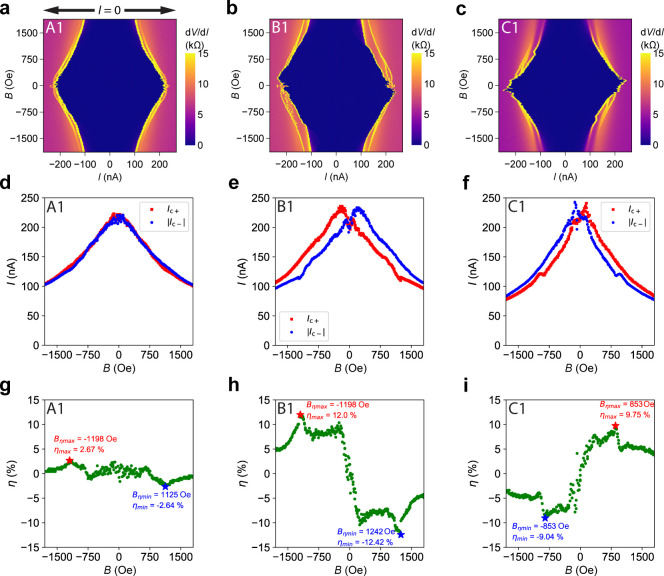 Figure 2
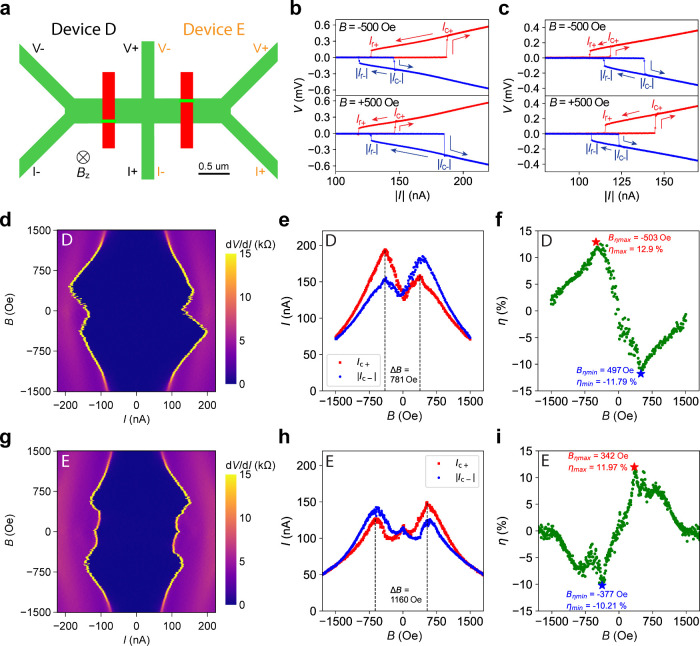 Figure 3
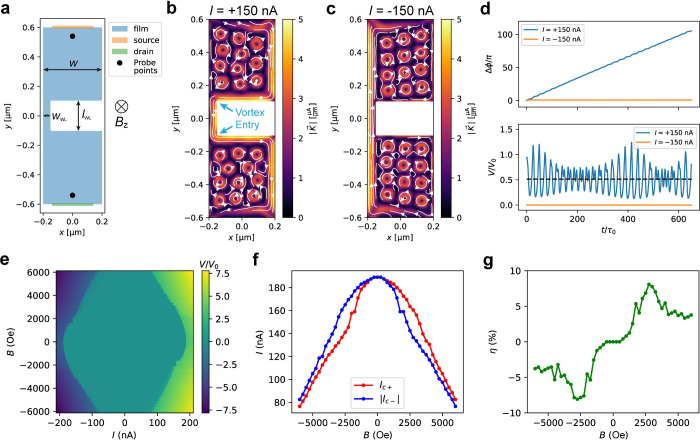 Figure 4
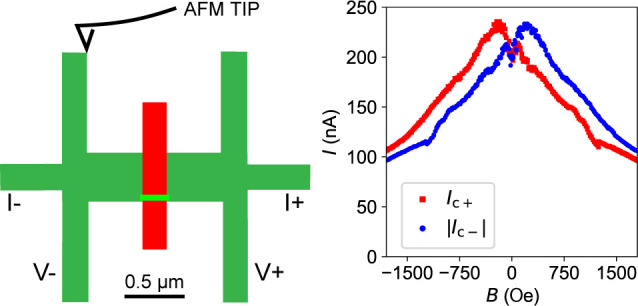 Figure 5
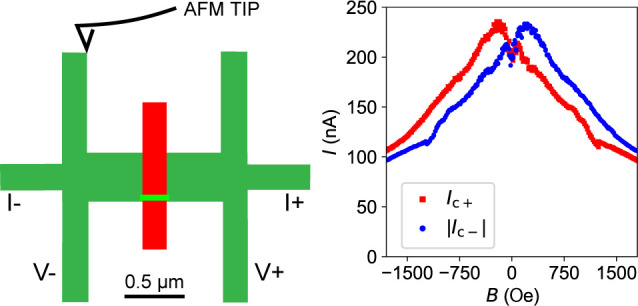 Figure 6
 Figure 7
 Figure 8
 Figure 9
Peer Reviews
No public reviews on file for this paper yet. If you reviewed it on a platform where reviews are public (OpenReview, ICLR, NeurIPS, ICML), you can paste yours below so the community can read it here.
Videos
No videos yet. Explain this paper in a talk, walkthrough, or lecture? Add one.
Taxonomy
TopicsElectronic and Structural Properties of Oxides · Iron-based superconductors research · Advanced Condensed Matter Physics