Revealing the Full Potential of Glycolated Mixed Ionic-Electronic Semiconductors – Symmetric Monomer Polymerization to Boost Electrochemical Transistor Performance
Lize Bynens, Paola Mantegazza, Adam Marks, Yeongmin Park, Arwin Goossens, Stefania Moro, Tyler J. Quill, Garrett Lecroy, Christina Cheng, Arianna Magni, Laurence Lutsen, Jochen Vanderspikken, Simon E. F. Spencer, Koen Vandewal, Alberto Salleo, Giovanni Costantini, Wouter Maes

TL;DR
This paper explores how polymer synthesis methods affect the performance of organic electrochemical transistors.
Contribution
A symmetric monomer polymerization method is introduced to eliminate homocoupling, improving transistor performance.
Findings
A homocoupling-free polymer shows a 3-fold increase in electronic mobility.
Symmetric polymerization leads to better bulk properties and OECT performance.
Homocoupling significantly impacts the performance of OECT channel materials.
Abstract
Organic electrochemical transistors (OECTs) enable the transduction of ionic signals into electronic outputs, positioning them as ideal candidates for next-generation sensing and (bio)signal processing applications. Recent years have witnessed the development of various OECT channel materials, affording insights into structural fine-tuning to achieve optimal performance and/or stability. However, homocouplings, commonly present in alternating conjugated polymers, have largely been overlooked. This study investigates the effect of homocoupling on OECT materials by employing two synthesis methods – standard Stille polymerization and an alternative symmetric approach – to create the p-type enhancement-mode benchmark polymer pgBTTT. The impact of homocoupling, and its absence, is studied by comparing the bulk properties of the two polymers and evaluating their respective OECT metrics. The…
Genes, proteins, chemicals, diseases, species, mutations and cell lines named across the full text — each resolved to its canonical identifier and authoritative record.
Click any figure to enlarge with its caption.
 Figure 1
 Figure 2
 Figure 3
 Figure 4
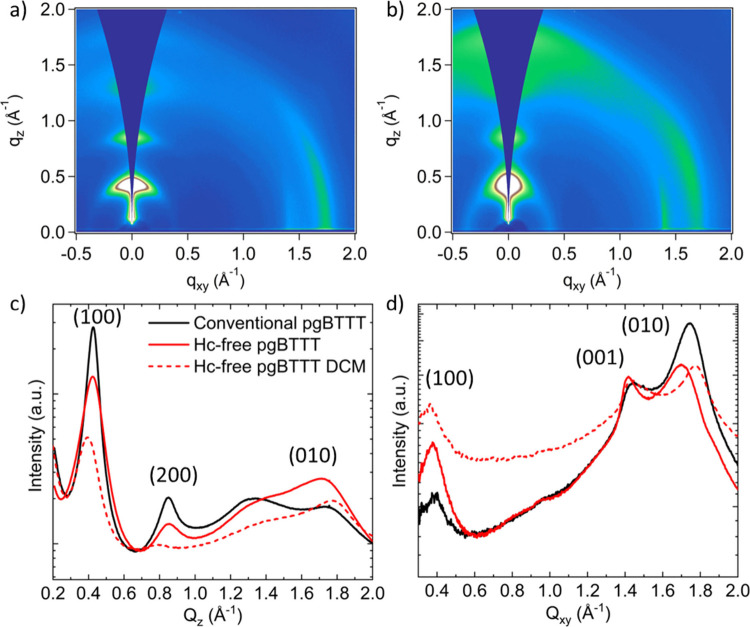 Figure 5
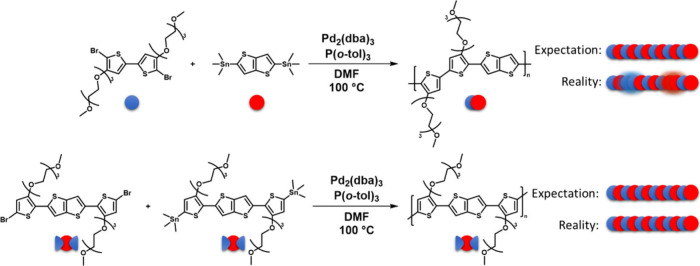 Figure 6
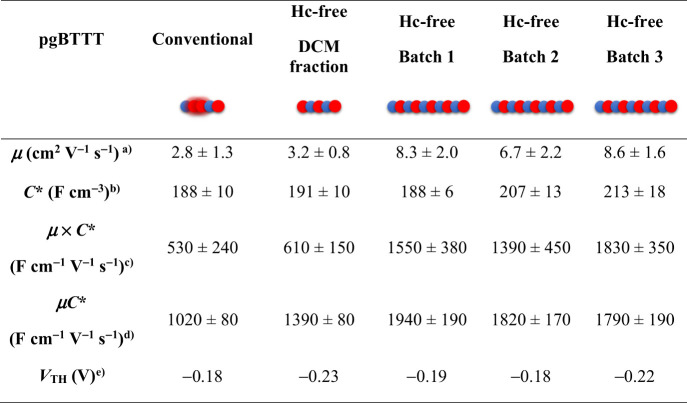 Figure 7
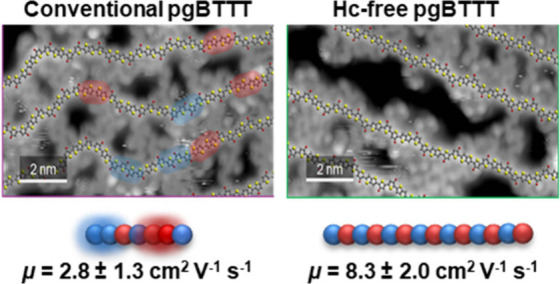 Figure 8
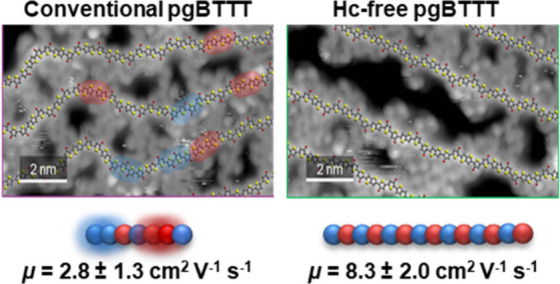 Figure 9
Peer Reviews
No public reviews on file for this paper yet. If you reviewed it on a platform where reviews are public (OpenReview, ICLR, NeurIPS, ICML), you can paste yours below so the community can read it here.
Videos
No videos yet. Explain this paper in a talk, walkthrough, or lecture? Add one.
Taxonomy
TopicsConducting polymers and applications · Organic Electronics and Photovoltaics · Covalent Organic Framework Applications