Designing a FAIR Catalogue of Services for the Heritage Science community
Laura Benassi, Jana Striova, Diego Quintero Balbas, Brian Matthews, Laura Benassi, Yaxing Wei, Laura Benassi, Katrina Exter, Laura Benassi

TL;DR
The paper describes the creation of a FAIR-compliant digital platform that helps heritage science researchers find and access scientific services, enhancing collaboration and accessibility.
Contribution
The novel contribution is the development of a co-created, FAIR-aligned, and AI-enhanced service catalogue tailored for the heritage science community.
Findings
The E-RIHS Catalogue of Services is now operational, providing a unified access point for heritage science services.
The platform includes features like semantic search, multilingual support, and an AI-based recommendation engine.
User feedback is integrated to continuously improve the platform's functionality and relevance.
Abstract
The European Research Infrastructure for Heritage Science (E-RIHS), recently granted with European Research Infrastructure Consortium (ERIC) legal status, aims to advance research by facilitating access to cutting-edge scientific services and tools in the domain of heritage science. One of the major challenges and achievements during its implementation phase (2022–2024, G.A. 101079148) was the creation of the Catalogue of Services (CoS)—a digital platform that helps users find, request, and manage access to both physical and digital services offered by E-RIHS partners. This paper introduces the concept, design, and development of the E-RIHS CoS, emphasising how it follows FAIR (Findable, Accessible, Interoperable, Reusable) and Open Science principles. Built with a strong focus on real research needs, the platform features a flexible and scalable architecture. It includes tools like…
Genes, proteins, chemicals, diseases, species, mutations and cell lines named across the full text — each resolved to its canonical identifier and authoritative record.
Click any figure to enlarge with its caption.
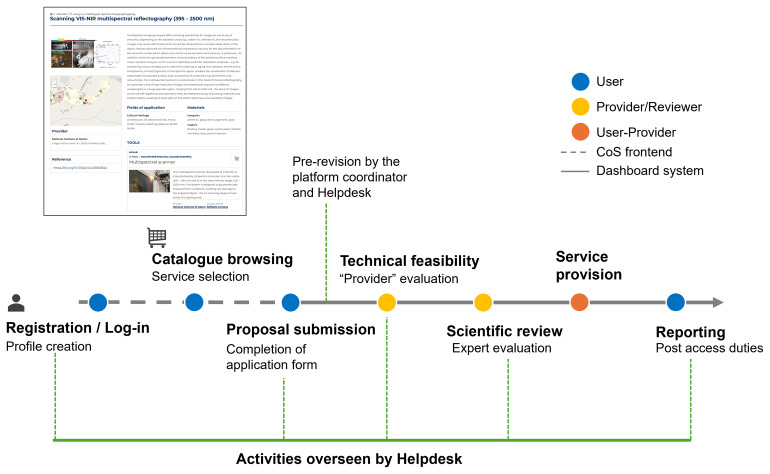 Figure 1
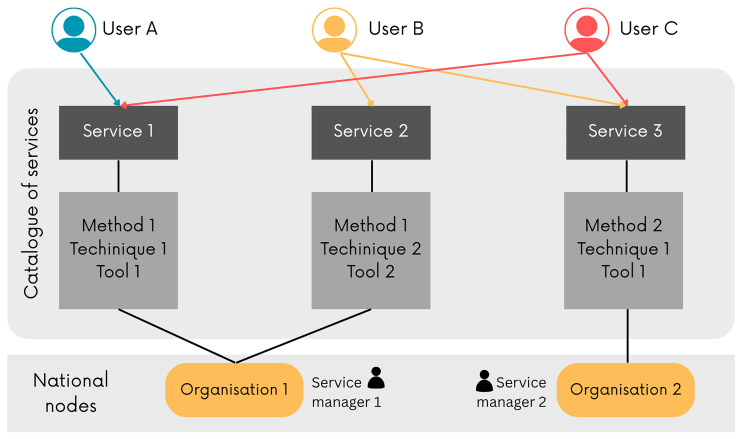 Figure 2
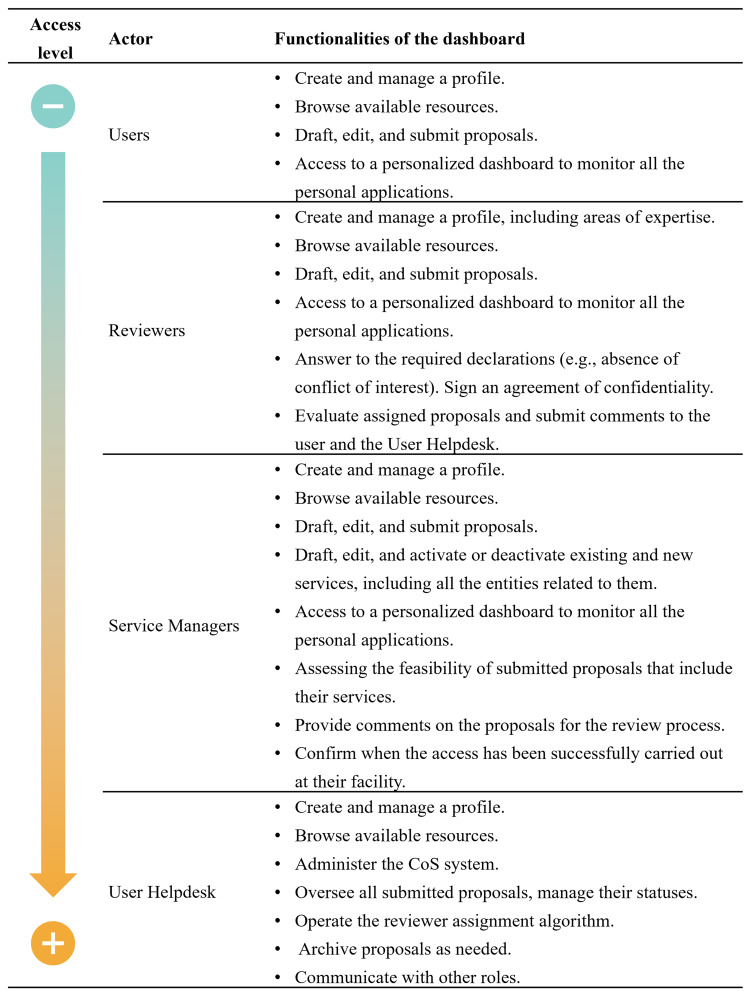 Figure 3
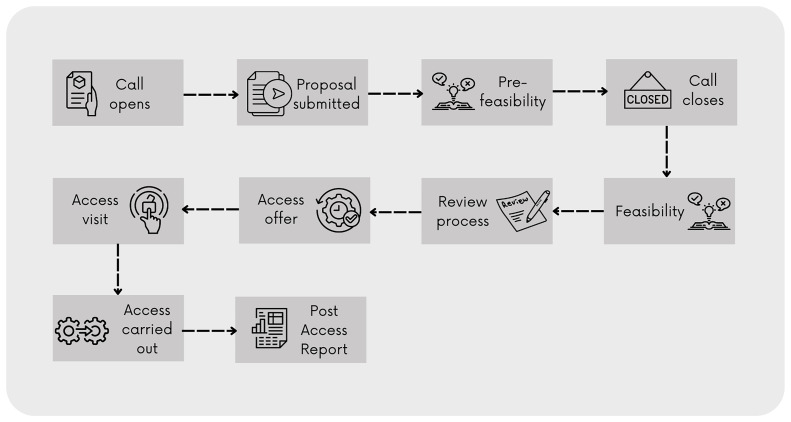 Figure 4
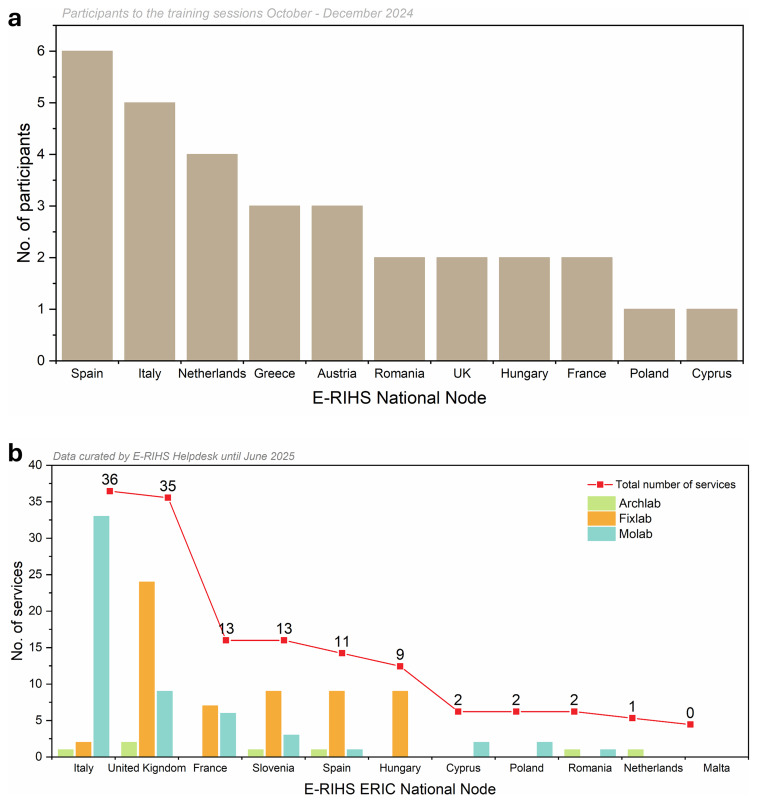 Figure 5
|
|
|
|
| ||
|---|---|---|---|---|---|
|
| Structured and semantically enriched metadata | • | • | ||
| Data indexed via a semantic engine powered by Elastichsearch | • | ||||
| Free text search powered by Elastichsearch | • | ||||
| Unique persistent identifiers for data | • | ||||
| Existence of Open APIs | • | • | |||
| Controlled vocabularies and multilingual thesauri (developed in
| • | • | • | ||
| Cross-platform and cross-community service discovery | • | • | |||
| Collaborative dashboard with a different access rights system | • | • | |||
| Secure single sign-on system (e.g. ORCID) | • | ||||
| JSON-based schemas that model entities (service, person,
| • | ||||
| Adherence to EOSC and CORDRA standards | • | • | • | ||
| Data ingestion and exchange with external platforms (EOSC,
| • | • | |||
| Machine-actionable metadata and knowledge representation
| • | • | |||
| Research outputs (Reports, Datasets) available on Zenodo | • | • | • | ||
| Research outputs identification via DOI | • | • | |||
| Open-source software | • | • | • | ||
| Tracking and monitoring of all the activities inside the CoS | • | • | |||
| User Helpdesk support | • | ||||
| Data export in different formats | • | • | • | ||
| Email automation | • |
| Schema | Description |
|---|---|
| Service | This schema is intended to model the metadata and details required to document and describe service
|
| Organisation | It represents the research institution, museum, etc., to which one or more persons can be affiliated. It
|
| Person | It represents a person affiliated with a specific organisation. It contains information such as name,
|
| Technique | This schema is intended to model the metadata and details required to document and describe
|
| Tool/Equipment/Software | It represents the Equipment, Tool or Software from more than one equipment employed. It describes
|
| Method | It describes the procedure on how the Tool/Equipment/Software is set-up and used. It is expected to be a
|
| KPI | It represents the Equipment, Tool or tool form from more than one equipment employed. It describes
|
|
| Art and Architecture Thesaurus |
|
| Artificial Intelligence |
|
| Application Programming Interface(s) |
|
| Access to Research Infrastructure Administration |
|
| Advanced Research Infrastructure for Archaeological Data Networking in Europe |
|
| Central European Infrastructure Consortium |
|
| Common Language Resources and Technology Infrastructure |
|
| Coordinated Research Infrastructure Building Enduring Life-science services |
|
| Digital Research Infrastructure for the Arts and Humanities |
|
| European Research Infrastructure on Heritage Science |
|
| European Research Infrastructure on Heritage Science – Implementation Phase |
|
| European Research Infrastructure on Heritage Science – Preparatory Phase |
|
| European Data Model |
|
| European Life-science Infrastructure for Biological Information |
|
| European Open Science Cloud |
|
| European Research Infrastructure Consortium |
|
| European Straregy Forum on Research Infrastructures |
|
| Findable, Accessible, Interoperable, Reusable |
|
| Information and Communication Tecnhology |
|
| Integrated Platform for the European Research Infrastructure on Cultural Heritage |
|
| Integrating Platforms for the European Research Infrastructure ON Heritage Science |
|
| International Organization for Standardization |
|
| Key Performance Indicator(s) |
|
| Pooling Activities, Resources and Tools for Heritage E-research Networking, Optimization and Synergies |
|
|
|
|
| Simple Knowledge Organization System |
|
| Structured Query Language |
|
| User Experience |
- —European Union NextGenerationEU – National Recovery and Resilience Plan (NRRP)
- —Horizon Europe Framework Programme
Peer Reviews
No public reviews on file for this paper yet. If you reviewed it on a platform where reviews are public (OpenReview, ICLR, NeurIPS, ICML), you can paste yours below so the community can read it here.
Videos
No videos yet. Explain this paper in a talk, walkthrough, or lecture? Add one.
Taxonomy
TopicsResearch Data Management Practices · Digital and Traditional Archives Management · Library Science and Information Systems
Introduction
The Heritage Science community – a broad and multidisciplinary field that operates across different contexts with heterogeneous domains of knowledge and stakeholders (including non-experts and the public) – has grown in the last few decades, and research on both tangible and intangible heritage is gaining interest worldwide ^ 1, 2 ^. The efforts - advocated to coordinate scientific cooperation among specialists in this field - have led to the establishment of a dedicated European Research Infrastructure (RI) ^ 3 ^.
E-RIHS, included in the ESFRI roadmap in 2016 under the Social Sciences and Humanities domain and which recently became an ERIC, brings together laboratories, scientific archives, and institutions across Europe and beyond, providing integrated access to resources that support heritage-related research. Like other European RIs, E-RIHS aims at providing resources and services for research and innovation ^ 4 ^, by offering access to facilities and expertise, data, and state-of-the-art analytical instrumentation, as well as online tools for data management and processing, to support heritage research in advancing scientific discovery and enabling collaboration across disciplines and borders.
To ensure effective access to scientific services, it is crucial to present the relevant information in a comprehensive, structured, and harmonized manner. This approach enhances both their visibility and discoverability. Additionally, users should be able to compare similar services easily and identify those best suited to their specific research needs. Such capabilities support a unified access model across RIs, a crucial goal also in heritage science, where users (e.g., conservators, heritage professionals, and other stakeholders) play an active role in knowledge co-creation and its translating into practice ^ 2 ^. A Catalogue of Services (CoS) is a crucial tool for achieving these goals. In brief, it can be defined as an organized portfolio (i.e., list of services), accessible to the users (i.e., external researchers accessing the RIs services). It includes information regarding the service offered, the contact persons, and the access process ^ 5, 6 ^.
The CoS acts as a showcase and a single-entry point for managing users’ interactions among the internal and external researchers (i.e., providers and users). Given the diversity of the disciplines involved in heritage science, as well as the widely variable expertise level of the potential users, clarity, accessibility, and guidance through co-creation and interaction with experts are critical.
This article outlines the process undertaken by the E-RIHS community over the past ten years to transition from a static, email-managed catalogue to a smarter, dynamic system powered by modern digital technologies and aligned with international standards. The development of the new E-RIHS CoS builds on prior initiatives, such as the IPERION HS European project (G.A.871034), which laid the groundwork for organizing service data and provided valuable insights into the complex, real-world needs of the heritage science community.
The E-RIHS CoS provides a single-entry point to explore physical and digital services organized into four platforms: ARCHLAB (scientific archives), FIXLAB (fixed laboratories), MOLAB (mobile laboratories), and DIGILAB (digital data and tools). The CoS supports E-RIHS’s mission to enable Open Science practices and foster interoperability among research infrastructures around Europe and beyond. Additionally, by integrating a semantic metadata model, natural language search capabilities, and a system of dashboards, it offers a streamlined and FAIR-compliant pathway from service discovery to access implementation.
Background for the development of E-RIHS CoS
Several RIs in Europe have developed digital CoS, and marketplaces to provide researchers with access to scientific services, datasets, and software. These platforms enhance resource visibility and usability while exploiting the benefits of data reusability and advanced analytical technologies. To this aim, one of the most challenging aspects of creating a reliable CoS, suitable for a wide range of potential users, is setting interoperable systems, and standardised and normalised metadata concerning datasets and services ^ 7 ^.
To assess the current landscape within RIs and to address the challenges associated with developing a heritage science CoS, a mapping of existing solutions at the European level was undertaken starting from the E-RIHS PP project (2017–2020, G.A. 739503) ^ 8 ^. The mapping employed two complementary methodologies: direct interviews with RIs managers and hands-on testing of other catalogues from the user perspective. Although structurally different from traditional CoS, marketplaces were also included to provide comparative insights. In the ESFRI landmark, E-RIHS is one of the 11 RIs in the Social Science and Humanities domain. Among these, only two offer physical services in addition to digital resources. Besides, E-RIHS is the only one that currently primarily offers access to physical services.
Among the different catalogues revised, several well-developed CoS that support access to both physical and digital services were identified for an in-depth examination: ELIXIR ^ 9 ^ and CORBEL ^ 10 ^ in the life sciences domain, the Virtual Unified Office of CERIC-ERIC ^ 11 ^ in materials science, CESSDA in social sciences ^ 12 ^, and the ELVIS portal of DISSCo in biodiversity research ^ 13 ^. These CoS include advanced functionalities such as proposal management, reviewer assignment, and service usage tracking, capabilities that are essential also for E-RIHS.
Another example of advanced CoS represents the ARIA software developed by Instruct-ERIC, a European RI in the biology field, a cloud-based tool that facilitates access to the RIs’ scientific services. It is currently used by at least nine RIs, demonstrating its versatility ^ 14 ^. However, the unique complexity and interdisciplinary nature of the heritage science domain required the development of a tailored model to effectively support the specific requirements of scientific services within E-RIHS.
Furthermore, the interviews with the CoS managers/developers provided key insights into the underlying workflows, as well as the processes used to manage evaluation of the research proposals. For example, the dashboard system employed by ARIA software allows for managing different proposal evaluations and monitoring the project visit in the premises of the host institution, while facilitating the communication among all the actors involved.
The following CoS key characteristics were identified for its successful implementation: a) adequate service description, b) metadata quality, c) harmonised data structure, d) user interface clarity, and e) search functionalities to facilitate discoverability. In this respect, the first E-RIHS CoS was developed during the E-RIHS Preparatory Phase (2017–2020), marking a significant step forward for the heritage science community in creating a dynamic, online catalogue.
The initial conceptual data model was informed by the knowledge and outcomes of previous European projects – particularly PARTHENOS ^ 15 ^, IPERION CH ^ 16 ^, and ARIADNE ^ 17, 18 ^. It was implemented as a Relational Database Management System, developed in SQL technology, and represented a major improvement over existing tools and frameworks available at the time for managing heritage science services ^ 8 ^. One of the main challenges was to structure the database to reflect the multi-valued attributes to conform the specific entities created to cover the extensive information at the base of the CoS: service, contact person, technique, tools, archive, platform, etc.), and some controlled lists of metadata were created collaboratively with the service managers.
The first online catalogue, conceived as a sort of e-commerce website, was released during the IPERION HS project in 2020 ^ 19 ^. The scientific services offered by 100 institutions were delivered through three platforms: ARCHLAB, FIXLAB, and MOLAB. Users and service managers (then referred to as “providers”) tested the first version of the catalogue, allowing for fixing bugs and unclear submission processes, and criticalities for future improvements were identified and registered.
The process to access the scientific services is illustrated in Figure 1: users create a profile, then browse the catalogue to select the most adequate service(s) that best match their research needs, and finally submit a proposal. Successful proposals were granted based on the technical feasibility (evaluated by the provider) and subsequently on scientific excellence, reviewed by an international and independent panel of experts. A system of dashboards in the CoS backend was created with different levels of permission according to specific roles: platform coordinator, helpdesk, provider, and user. All notifications were managed through an automatic email system throughout the entire process. Finally, the user was responsible for completing two surveys and uploading a report (referred to as “post-access duties”). All data and files could be downloaded and analysed to monitor the IPERION HS access performance.
Scheme of the CoS system released during the IPERION HS project.The different phases and actors involved are indicated.
Despite its pioneering role, the platform developed within E-RIHS PP and IPERION HS faced challenges related to lack of metadata standardization, user interface complexity, and scalability. For example, many scientific techniques included in the catalogue had no standard designation, and scientists used different ways to refer to the same instrumentation. Similar issues were connected with complex methodologies or the targeted materials investigated by a single technique. All these factors made the selection of the most adequate service for a non-expert difficult.
Building on the experience of IPERION HS and informed by the launch of the SSHOC and EOSC marketplaces in 2021 and 2022, respectively, the E-RIHS community undertook an update of its CoS model starting from 2022. This revision aligned the model with emerging interoperability and FAIR data standards, while integrating innovative features aimed at improving service discoverability and enhancing the user experience. The resulting new E-RIHS CoS draws upon the heritage science community’s prior work and incorporates key advancements from other research infrastructures, delivering a more robust, interoperable, and user-friendly system.
FAIR-by-design methodology
ESFRI has emphasized the central role of RIs in advancing Open Science, specifically advocating for the adoption of FAIR principles and the provision of quality-assured open data. According to ESFRI ^ 20 ^, RIs are key actors in driving cultural change, enhancing data quality, and broadening access within the evolving EOSC ecosystem.
In this framework, E-RIHS has developed its CoS in alignment with this vision, FAIR-by-design and fully interoperable with EOSC, acting both as a data and services provider. It enables seamless data integration and discovery, fostering the practice of Open Science in heritage science. This is achieved through the curation of service data displayed, facilitating the findability and interoperability. Each service is described using a detailed metadata schema that includes technical specifications, associated platforms, hosting institutions, service managers, and relevant references. The embedded policies and tools, such as machine-actionable Data Management Plans (DMPs), Creative Commons licensing, and the assignment of persistent identifier systems contribute to ensure metadata quality. The FAIR compliance of the features of the new E-RIHS CoS is summarized in the Table below ( Table 1).
**Table 1.: Key components of the E-RIHS CoS vs. FAIR principles
21– 25 . Adapted from 26.**
All these elements reflect the new approach to a “research need-oriented catalogue” ^ 27 ^. Through rigorous schema design, semantic enrichment, federated authentication, and open dissemination mechanisms, E-RIHS facilitates Open Science practices and promotes reproducibility, transparency, and collaboration in heritage science research.
Architecture, structure, and functions of the system
The development of the E-RIHS CoS was preceded by the creation of its digital environment. A dedicated GitHub workspace ^ 22, 23, 27 ^ hosts schemas ( Table 2) and documentation, while a metadata knowledge base ^ 28 ^, powered by CORDRA ^ 29 ^ serves as the central repository for service-related digital objects.
**Table 2.: List of the schemas available on GitHub
27 .**
An innovative addition with respect to the first CoS model implemented during IPERION HS is represented by the “Method” schema. This new entity captures the procedural knowledge required to conduct services across different service managers. The “Method” describes the way a specific equipment is employed by a service manager to offer a particular service. This could be the same for different service managers ( Figure 2), yet its preparation needs a certain level of standardisation and the designation of the actor or institution in charge of the definition of this entity. This schema enhances reproducibility and supports the harmonisation of service offerings across the E-RIHS network.
Simplified schema of the architecture of the E-RIHS CoS and its interaction with the potential users.
The combination of these schemas allows for a modular and scalable representation of services. The OpenTheso-based vocabulary platform – a multilingual and multi-hierarchical thesaurus manager that follows the ISO-25964 standard ^ 24, 30 ^ – further supports multilingualism and semantic clarity. Its integration with the CoS via open APIs ensures dynamic vocabulary management.
This CoS has been developed following two main guiding principles: responsiveness to the research needs of users and a co-creation approach involving service managers, users, and ICT experts. This marks a strategic transition from a “technique-oriented” to a “research need-oriented” catalogue. A key aspect was the creation of an independent platform built on a scalable, modular architecture, in collaboration with Net7 ICT company ^ 31 ^. This design allows the platform to adapt and grow with the evolving needs of the RI, easy to integrate with new features and emerging technologies.
The architecture and requirements were defined through extensive consultations with stakeholders, including researchers, service managers, and infrastructure administrators. Interviews and iterative user experience (UX) testing cycles enabled the project team to identify key pain points and user expectations. The insights gained informed the creation of a detailed specification document that guided system development.
The new E-RIHS CoS ^ 32, 33 ^ is a standalone platform composed of two primary components: (1) a frontend interface serving as the entry point for users, and (2) a backend system dedicated to managing and monitoring proposals and access activities. Its implementation relied on contemporary web technologies, including the Laravel PHP framework for the backend and the Elasticsearch engine for semantic and faceted search. Laravel supports a robust, maintainable codebase including role-based access, workflow automation, and secure data handling. On the other hand, Elasticsearch enables robust and scalable search functionality, combining natural language processing with structured filtering. It also supports high-performance querying across large datasets, delivering fast and precise results essential for navigating extensive research service catalogues.
Advanced filters have been incorporated into the search functionality, to filter services for example, by type, research domain, geographic location, and availability. This feature enables users to precisely target relevant services, significantly improving search efficiency and user experience. The Elasticsearch-based implementation fosters an intuitive discovery process, even for unfamiliar users employing specific keywords or terminology and ensures that the system can scale effectively as the number of services and users grows, maintaining consistent performance and reliability.
The CoS involves four key actors ( Figure 3): the User, the Service Manager (previously “provider”), the Reviewer, and the User Helpdesk. Access level varies according to the role and the dashboard system is tailored for each actor. The User Helpdesk is responsible for overseeing and managing the entire process, from submission to post-access activities, and for assigning roles to the other actors involved.
List of roles involved in the E-RIHS CoS and their corresponding dashboard functionalities.
Behind the CoS, a detailed workflow ( Figure 4) was embedded in the system and reflects the access model ^ 34 ^ defined by E-RIHS: proposals are submitted through periodic cut-off calls, undergo technical feasibility checks by service managers, and are subsequently evaluated by independent reviewers.
*CoS workflow as defined by the E-RIHS Access Policy
34 .*
The procedure is simple; users can browse the catalogue, even without creating a profile, which makes the service information open. To select services and add them to a research proposal, the users must register and log in, enrich their profile with detailed information on their scientific background and experience, fill down the online application form, and submit it within the deadline of the call for proposals.
The on-line form guides users through the proposal process and functions as a metadata generator. It feeds both the backend analytics, by extracting performance metrics, and the recommendation algorithm, by capturing comprehensive data on research needs, access requirements, and project contexts. Once the application has been submitted, service managers assess the proposal's feasibility. This step represents a co-creation phase between users and service managers, since the service manager can provide comments to improve the proposal. Should the application be partially feasible or unfeasible, it returns to the draft phase, and users are encouraged to improve the proposal, change, or remove services, and resubmit the application before the established deadline. Feasible proposals undergo a review phase. An algorithm within the CoS system selects three reviewers based on the declared areas of expertise in the metadata of the profiles and the keywords of the proposal. Reviewers score the application based on defined criteria and provide comments to the users. Top-rated applications are granted access to the services. Following this phase, users and service managers agree on the access modalities and timeline, carry out the access, and collaboratively discuss and interpret data and results. At the end of the process, users are required to submit a final report.
The dashboard system helps monitor the entire process from the submission of a proposal to the post-access duties and gathers useful information that can be used to improve the CoS system and user experience. Their design focused on usability and intuitiveness, offering users a streamlined experience that makes it easy to access all key features. To this aim, a system of tabs is used to browse different pages where all the components are stored, such as the list of applications, the list of documents, and the application history.
As outlined in the E-RIHS Access Policy ^ 35 ^, the RI provides continuous access through open calls for excellence-driven access, by ranking the proposals submitted and guaranteeing the maintenance of high-level standards. Two cut-off deadlines are expected by the year, one every six months. Additionally, the system can manage also market-driven and fast-track accesses.
A major innovation in development is the integration of a recommendation engine within the CoS. Inspired by recommender systems used in e-commerce and media platforms, this artificial intelligence (AI) driven component is designed to support users in identifying the most appropriate services based on their research needs. The engine analyzes a broad array of data – equipment characteristics, methodological applications, past project outcomes, and user feedback – to generate personalized service recommendations. Natural language queries are supported to increase accessibility and inclusiveness. Data for training the algorithm are being collected through pilot applications and from E-RIHS providers, with all processing conducted in full compliance with EU data protection regulations. Also, to support the implementation of this framework, dedicated working groups are actively identifying representative research needs and compiling standardized controlled vocabularies and classification schemes to be used in service descriptions.
The effectiveness of the recommendation engine depends on the quality and volume of structured metadata collected via the application form and backend monitoring tools. Users’ engagement through input and feedback directly contributes to refining the system, allowing it to function as a dynamic, self-improving resource that supports decision-making, increases efficiency, and enhances the scientific impact of access activities.
Current state of the CoS
The new E-RIHS CoS platform marked a milestone in delivering integrated access to heritage science services. Its first version, including the dashboard system, was released in October 2024. This release followed an intensive phase of design, prototyping, testing, and iteration, culminating in the transition from development to operational deployment. Training sessions for service managers of the different platforms were conducted from October to December 2024, involving a total of 32 representatives from E-RIHS National Nodes to start inserting services ( Figure 5). The sessions were recorded and distributed to reach a wider audience. Moreover, guidelines were prepared and made publicly accessible through the E-RIHS Zenodo community ^ 34, 36, 37 ^. Additionally, technical support facilitated user onboarding and encouraged early engagement with the platform. At the moment, 124 services are included in the CoS across three of the four platforms, involving ten E-RIHS national nodes ( Figure 5). Their data is under revision and editing by the Users Helpdesk to ensure consistency and homogeneity, the process that will be constantly and regularly updated. Also, digital services from the DIGILAB platform will be included through APIs to allow their discoverability.
a) Participants from E-RIHS nodes trained; b) E-RIHS ERIC Curated services catalogue across three platforms (by June 2025).
Intermediate testing phases involved a significant number of participants, covering multiple dimensions of the user experience, such as intuitiveness of the dashboard, filtering and search mechanisms in the catalogue, as well as the effectiveness of the proposal submission workflow. Reviewers and the User Helpdesk assessed the peer-review system, focusing on proposal evaluation and approval processes. Questions were addressed to selected users on overall usability, performance, and satisfaction, generating both qualitative and quantitative insights that directly informed development cycles.
The iterative UX testing approach resulted in concrete enhancements across the platform. Navigation structures were improved, visual elements were optimized, and user journeys were made more intuitive. System performance and security were validated through comprehensive testing, including penetration tests and code reviews. Feedback collected through testing and real-time usage analytics continues to inform system updates. The co-creation philosophy embedded in the development process has proven essential for achieving a usable and adaptable platform.
To support continuous monitoring and decision-making, the CoS includes a Business Intelligence tool integrated into the User Helpdesk dashboard. This tool enables KPIs tracking and supports strategy adjustments based on platform usage data. The analytics module provides detailed insights across several dimensions:
Proposals: total number and number per call/country; acceptance and reserve list rates; gender-disaggregated data; type classification (new, long-term, resubmission); status tracking.Scientific Disciplines: submission and acceptance breakdowns by discipline.Users: total number of users; submission activity; user-to-proposal ratios.Tools: request frequency per tool and call.
The resulting data can be visualised through graphs and maps and is available for download. Regular updates, based on the iterative engagement process with users and service managers, ensure that CoS remains aligned with the expectations and workflows of its users, consolidating its role as a central component in E-RIHS access provision.
Conclusions and future perspectives
The E-RIHS CoS is contributing significantly to the adoption of Open Science practices within the heritage science community. Through its adherence to FAIR data principles, support for reproducible research workflows, and user-centred design, the CoS promotes accessibility, transparency, and knowledge sharing. It also fosters cross-disciplinary collaboration and co-creation, enriching research at all stages—from project planning to reporting.
The CoS stands as a flagship initiative in digital heritage science infrastructure, showcasing how modular design, AI integration, semantic interoperability, and community co-creation can converge to deliver impactful, sustainable, and inclusive research services.
The E-RIHS CoS has been designed with a modular architecture to ensure long-term extensibility and maintainability. A core area of ongoing development concerns the further refinement of an AI-based recommendation engine. Although the current version of the CoS includes basic personalised suggestions, further enhancements will leverage structured metadata and behavioural analytics to support dynamic service recommendations. These will be powered by machine learning and natural language processing techniques, enabling context-aware recommendations aligned with individual research goals and previous usage patterns. This capability will enhance discoverability and increase the efficiency of service selection processes. The AI-driven metadata analysis will enhance the following features:
Automated enrichment of metadata through natural language processing.Resource indexing and improved catalogue navigation.Predictive analytics for user behaviour and resource utilisation trends.
The application of non-generative AI technologies contributes to efficient data management and consistent metadata updates, forming the backbone of a scalable and intelligent digital infrastructure. The CoS is constantly aligned with the EOSC ecosystem and other domain-specific RIs, such as CLARIN, CERIC ERIC, and DARIAH. Currently available in English; however, a multilingual expansion to support broader accessibility and inclusiveness could be implemented. To this purpose, for example in collaboration with the CLARIN RI, a multilingual metadata management and query translation could include:
Metadata Translation: Automated and manually validated translation of metadata fields, beginning with languages of the E-RIHS National Nodes, using semantic frameworks and controlled vocabularies (e.g., SKOS, AAT, and EDM).Query Translation: Implementation of multilingual search capabilities using CLARIN tools to ensure terminological consistency and user-friendly query interfaces.
CLARIN’s expertise in domain-specific term extraction, translation, and controlled vocabulary creation could guide this process, ensuring high-quality, interoperable multilingual support for both human-readable and machine-actionable metadata ^ 38, 39 ^. Moreover, the semantic annotation of resources could allow a more precise classification and linking of information across domains.
The ERIC legal framework of E-RIHS is reinforcing governance structures and long-term sustainability of the CoS. Under E-RIHS ERIC, responsibilities for catalogue maintenance, technological evolution, user support, and policy compliance will be formally allocated, ensuring continuity and accountability. This governance model will support the long-term operation and strategic development of the platform in alignment with international standards and community needs.
Ethics and consent
Ethical approval and consent were not required.
Abbreviations
**: **
The reference list from the paper itself. Each links out to its DOI / PubMed record.
- 1Curran K Zimmermann N : The dynamics of collaboration in heritage science. Stud Conserv. 2022;67(1–2):136–49. 10.1080/00393630.2021.1875175 · doi ↗
- 2Katrakazis T Heritage A Dillon C : Enhancing research impact in heritage conservation. Stud Conserv. 2018;63(8):450–65. 10.1080/00393630.2018.1491719 · doi ↗
- 3Striova J Pezzati L : The European Research Infrastructure for Heritage Science (ERIHS). Int Arch Photogramm Remote Sens Spatial Inf Sci. 2017;XLII-2/W 5:661–4. 10.5194/isprs-archives-XLII-2-W 5-661-2017 · doi ↗
- 4Directorate-General for Research and Innovation: European research infrastructures. 2025; [cited 2025 Jun 17]. Reference Source
- 5Sembiring M Surendro K : Service catalogue implementation model. 2016 4th International Conference on Information and Communication Technology (I Co ICT).Bandung, Indonesia: IEEE,2016;1–6. 10.1109/I Co ICT.2016.7571894 · doi ↗
- 6Mendes C Da Silva MM : Implementing the service catalogue management. 2010 Seventh International Conference on the Quality of Information and Communications Technology.Porto, Portugal: IEEE,2010;159–64. 10.1109/QUATIC.2010.31 · doi ↗
- 7Accordino F Pecoraro F Luzi D : CESSDA data catalogue: an opportunity to enhance data in social sciences. Int J Digit Libr. 2025;26: 8. 10.1007/s 00799-025-00416-w · doi ↗
- 8Meghini C Benassi L Galeotti M : E-RIHS PP D 8.1 Catalogue of E-RIHS resources and services. 2020; [cited 2025 Jun 17]. 10.5281/zenodo.4002040 · doi ↗