Prevalence of neurocysticercosis and its characteristics among people with epileptic seizures and progressively worsening severe headaches in 60 villages in three provinces of Burkina Faso
Athanase Millogo, Veronique Dermauw, Rasmané Ganaba, Pierre Dorny, Zékiba Tarnagda, Rabiou Cissé, Marie-Paule Boncoeur-Martel, Vivien Richter, Andrea S. Winkler, Hélène Carabin, Eva Clark, Eva Clark, Eva Clark, Eva Clark, Eva Clark

TL;DR
This study found that neurocysticercosis is a significant cause of epilepsy and severe headaches in Burkina Faso, with higher prevalence among people with epilepsy.
Contribution
The study provides the first estimate of NCC prevalence in people with severe headaches in Africa and highlights regional variation in NCC cases.
Findings
16.9% of people with epilepsy had definitive or probable NCC, compared to 7.6% of those with severe headaches.
Most NCC cases showed calcified brain lesions, which may trigger seizures and headaches through inflammation.
Only 46.7% of NCC cases tested positive for antibodies, and 33.3% for antigens, indicating diagnostic challenges.
Abstract
Neurocysticercosis (NCC) is a common cause of epilepsy in low- and middle-income countries (LMICs). Few studies have described neuroimaging findings in individuals with headaches in addition to epilepsy. Our aim was therefore to describe the types of NCC lesions seen on cerebral computed tomography (cCT), among participants with progressively worsening severe headaches (PWSH) and epilepsy living in 60 villages in Burkina Faso, and to determine the prevalence of NCC in these groups,. Data from a screening questionnaire for epilepsy and PWSH and subsequent neurological examination were gathered as part of a baseline cross-sectional component of a cluster randomized controlled trial conducted between February 2011 and January 2012. Those screening positive and a sub-sample of individuals screening negative were investigated by one of the two physicians in the field. Participants for whom…
Genes, proteins, chemicals, diseases, species, mutations and cell lines named across the full text — each resolved to its canonical identifier and authoritative record.
Click any figure to enlarge with its caption.
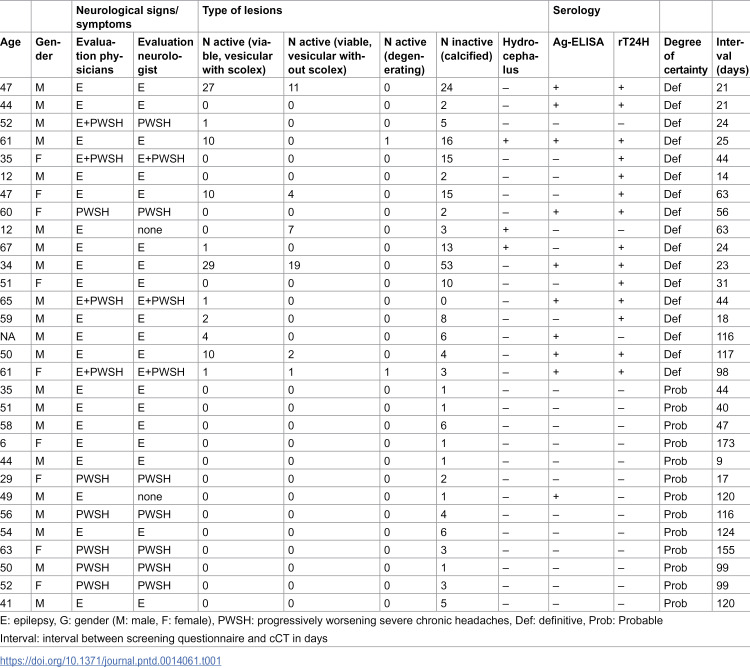 Figure 1
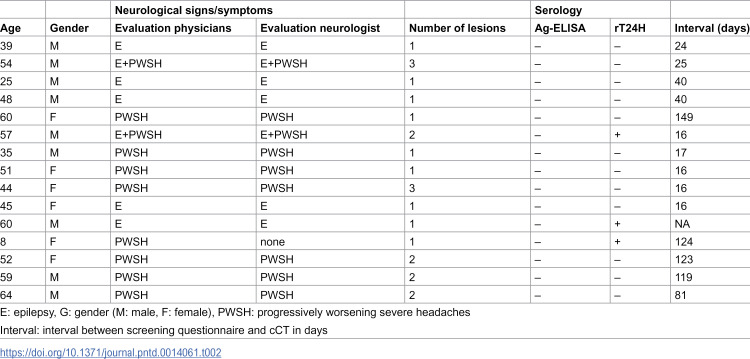 Figure 2
Peer Reviews
No public reviews on file for this paper yet. If you reviewed it on a platform where reviews are public (OpenReview, ICLR, NeurIPS, ICML), you can paste yours below so the community can read it here.
Videos
No videos yet. Explain this paper in a talk, walkthrough, or lecture? Add one.
Taxonomy
TopicsParasitic infections in humans and animals · Cerebrospinal fluid and hydrocephalus · Parasitic Diseases Research and Treatment