Small-vessel Disease in a Patient with Atrial Flutter: Unveiling a Potential Vascular Mechanism of Tachycardia-induced Cardiomyopathy
Sebastian Weyand, Karin Klingel, Peter Seizer

TL;DR
This case study explores how small-vessel disease might contribute to heart dysfunction caused by rapid heartbeats.
Contribution
It presents a potential vascular mechanism linking small-vessel disease to tachycardia-induced cardiomyopathy.
Findings
A patient with atrial flutter showed marked arteriolar wall thickening consistent with small-vessel disease.
Small-vessel disease may impair myocardial perfusion during persistent tachycardia.
The dysfunction observed was reversible, suggesting a treatable cause of cardiomyopathy.
Abstract
A 65-year-old man presented with new-onset exertional dyspnea. The predominant abnormality was a marked concentric thickening of the arteriolar walls with strong smooth muscle actin positivity, consistent with small-vessel disease (SVD). This case illustrates a potential mechanism of tachycardia-induced cardiomyopathy (TIC), in which SVD may contribute to impaired myocardial perfusion and reversible left ventricular dysfunction under persistent tachycardia.
Genes, proteins, chemicals, diseases, species, mutations and cell lines named across the full text — each resolved to its canonical identifier and authoritative record.
Click any figure to enlarge with its caption.
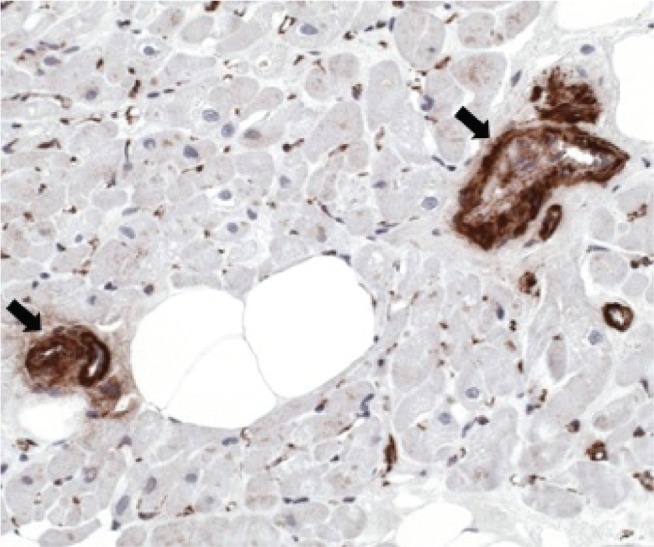 Figure 1
Peer Reviews
No public reviews on file for this paper yet. If you reviewed it on a platform where reviews are public (OpenReview, ICLR, NeurIPS, ICML), you can paste yours below so the community can read it here.
Videos
No videos yet. Explain this paper in a talk, walkthrough, or lecture? Add one.
Taxonomy
TopicsCardiac Arrhythmias and Treatments · Pericarditis and Cardiac Tamponade · Takotsubo Cardiomyopathy and Associated Phenomena