High‐Resolution Diffusion‐Weighted Imaging With Self‐Gated Self‐Supervised Unrolled Reconstruction
Zhengguo Tan, Patrick A. Liebig, Annika Hofmann, Frederik B. Laun, Florian Knoll

TL;DR
This paper introduces a self-supervised algorithm for high-resolution diffusion-weighted imaging that improves image quality and reduces scan time, making it suitable for clinical use.
Contribution
The novel contribution is the use of ADMM unrolling for self-gated self-supervised learning in submillimeter-resolution diffusion-weighted imaging.
Findings
ADMM unrolling generalizes across slices and outperforms existing methods in image sharpness and motion robustness.
The technique achieves 0.7 mm isotropic resolution in 10 minutes with improved SNR and tissue delineation.
ADMM unrolling provides clinically feasible inference time for whole brain diffusion imaging.
Abstract
High‐resolution diffusion‐weighted imaging (DWI) is clinically demanding. The purpose of this work is to develop an efficient self‐supervised algorithm unrolling technique for submillimeter‐resolution DWI. We developed submillimeter DWI acquisition utilizing multi‐band multi‐shot EPI with diffusion shift encoding. We unrolled the alternating direction method of multipliers (ADMM) to perform scan‐specific self‐gated self‐supervised DeepDWI learning for multi‐shot echo planar imaging with diffusion shift encoding on a clinical 7 T scanner. We demonstrate that (1) ADMM unrolling is generalizable across slices, (2) ADMM unrolling outperforms multiplexed sensitivity‐encoding (MUSE) and compressed sensing with locally‐low rank (LLR) regularization in terms of image sharpness, tissue continuity, and motion robustness, and (3) ADMM unrolling enables clinically feasible inference time. Our…
Genes, proteins, chemicals, diseases, species, mutations and cell lines named across the full text — each resolved to its canonical identifier and authoritative record.
Click any figure to enlarge with its caption.
 Figure 1
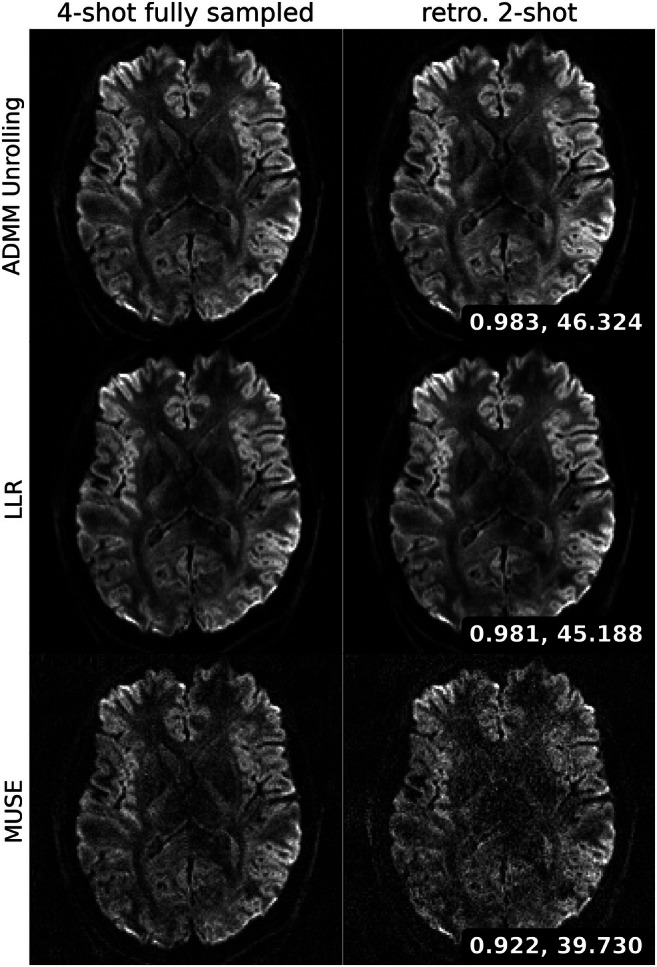 Figure 2
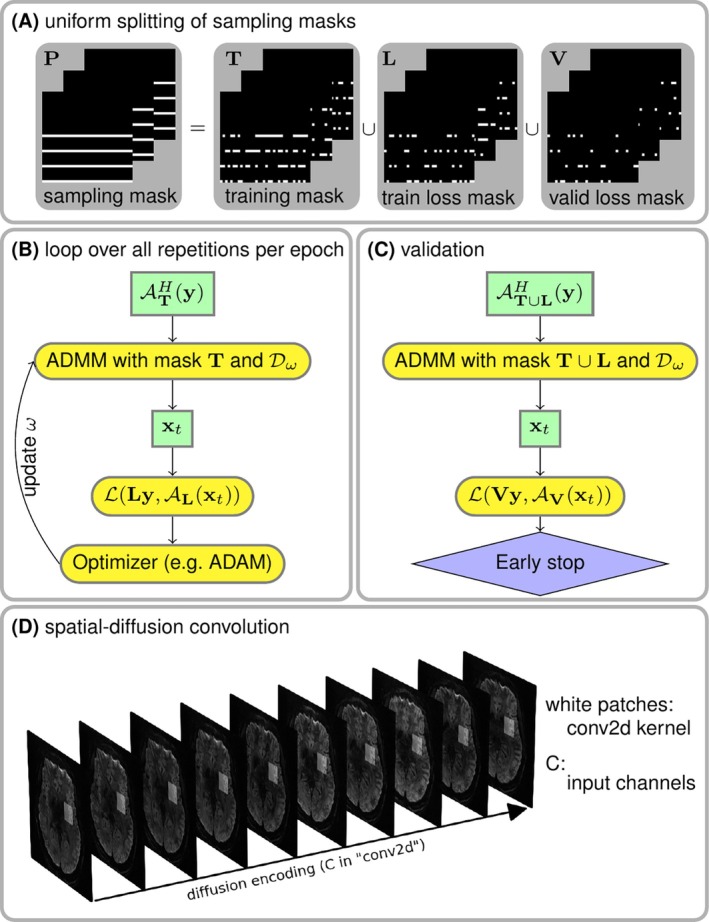 Figure 3
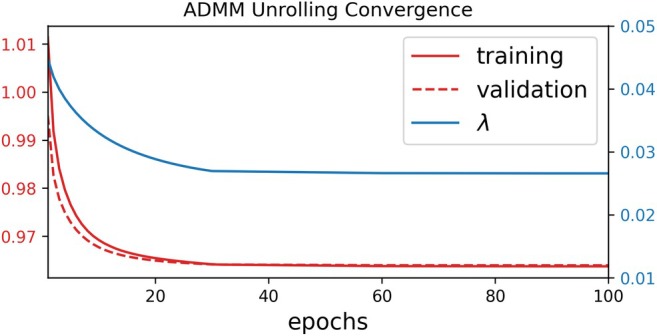 Figure 4
 Figure 5
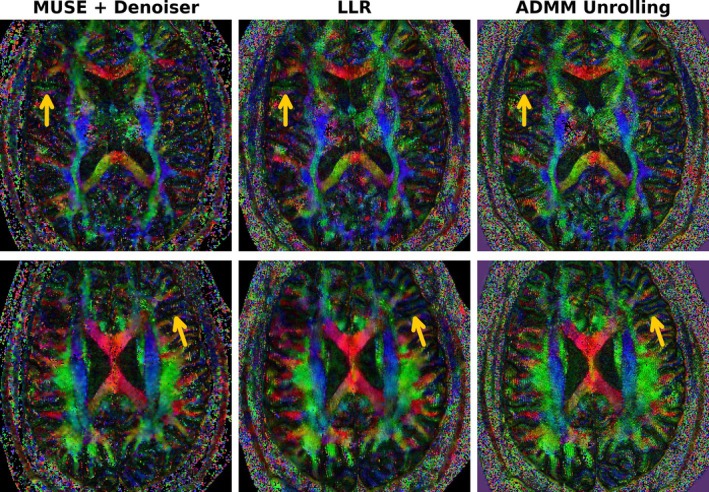 Figure 6
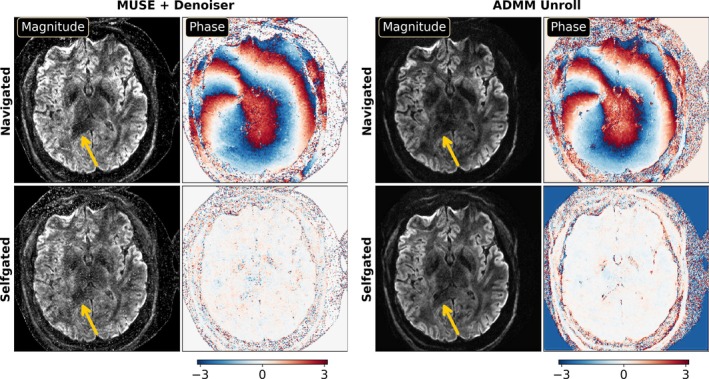 Figure 7
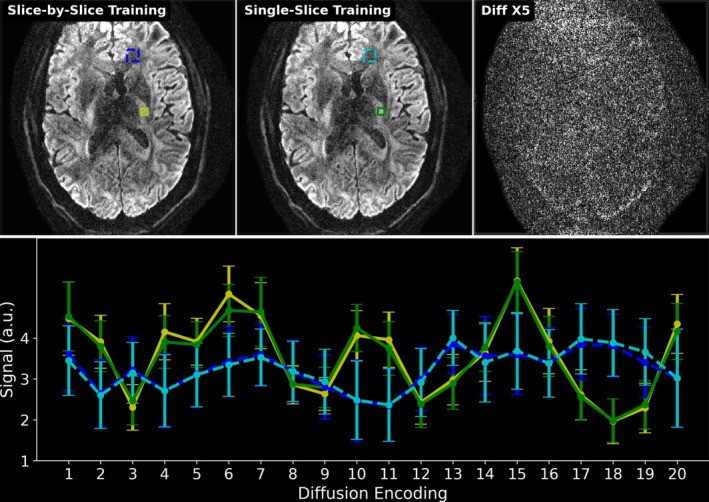 Figure 8
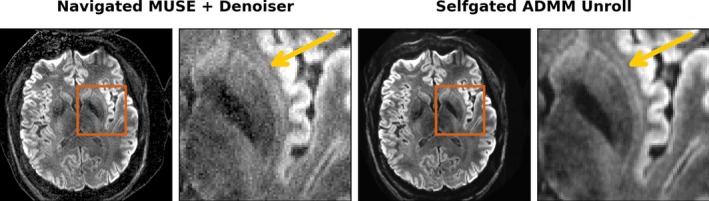 Figure 9
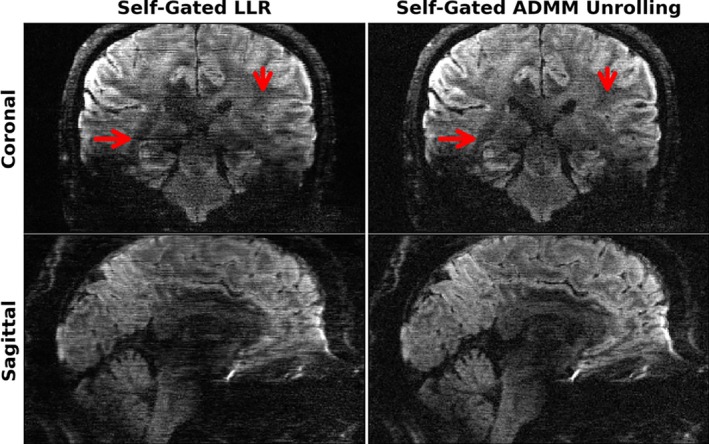 Figure 10
Peer Reviews
No public reviews on file for this paper yet. If you reviewed it on a platform where reviews are public (OpenReview, ICLR, NeurIPS, ICML), you can paste yours below so the community can read it here.
Videos
No videos yet. Explain this paper in a talk, walkthrough, or lecture? Add one.
Taxonomy
TopicsAdvanced Neuroimaging Techniques and Applications · Advanced Fluorescence Microscopy Techniques · Advanced MRI Techniques and Applications