Relative SNR Measurements in Supine vs. Prone Breast MRI
Jeremiah J. Hess, Catherine J. Moran, Preya Shah, Jana Vincent, Fraser J. L. Robb, Bruce L. Daniel, Brian A. Hargreaves

TL;DR
This study compares the signal quality of breast MRI scans taken in supine and prone positions, finding that supine imaging generally provides better signal quality.
Contribution
The study introduces a tissue-independent relative SNR metric to compare MRI signal quality in supine and prone positions.
Findings
Supine position provided significantly higher rSNR in breast tissue and chest wall for all subjects.
Axilla rSNR was higher in supine for four subjects and higher in prone for another four.
Tissue closer than 4cm to the coil in supine position showed higher SNR.
Abstract
Supine breast MRI has the potential to improve patient comfort compared to prone breast MRI, in addition to providing images in the same position as subsequent treatment protocols. Novel flexible coil arrays have enabled high SNR and parallel imaging in supine breast imaging, but the combined effect of coil and patient positioning on SNR has yet to be investigated. The aim of this study is to use a tissue‐independent metric to account for tissue deformation to compare SNR between prone and supine positions, using appropriate coils for each. Relative SNR (rSNR) metric is proposed as the ratio of SNR between a breast coil and a body coil. This metric is demonstrated to be tissue‐independent, allowing for easier SNR comparisons in cases of tissue deformation. We scanned 10 female subjects and compared the rSNR in segmented regions consisting of breast tissue, chest wall, and axilla…
Genes, proteins, chemicals, diseases, species, mutations and cell lines named across the full text — each resolved to its canonical identifier and authoritative record.
Click any figure to enlarge with its caption.
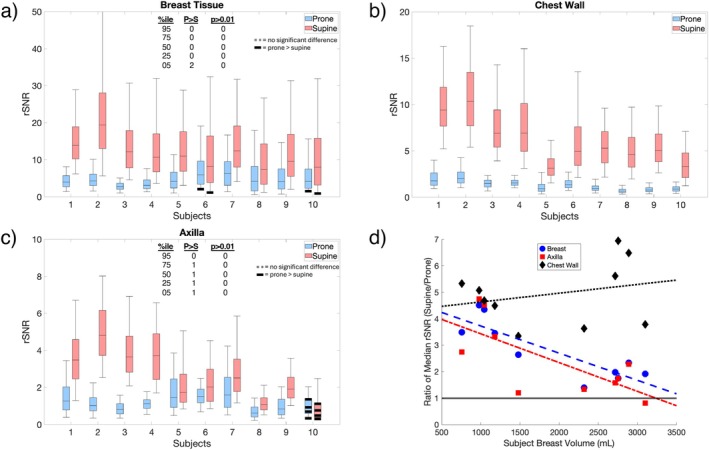 Figure 1
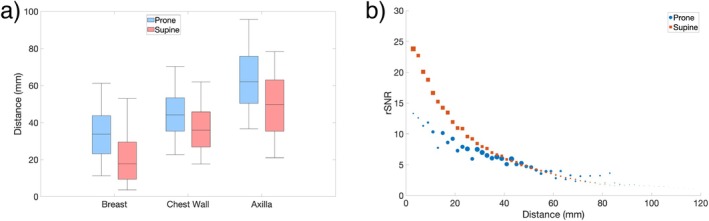 Figure 2
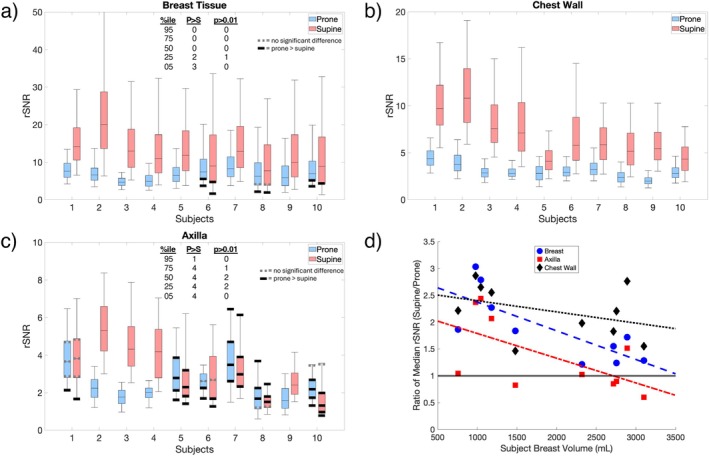 Figure 3
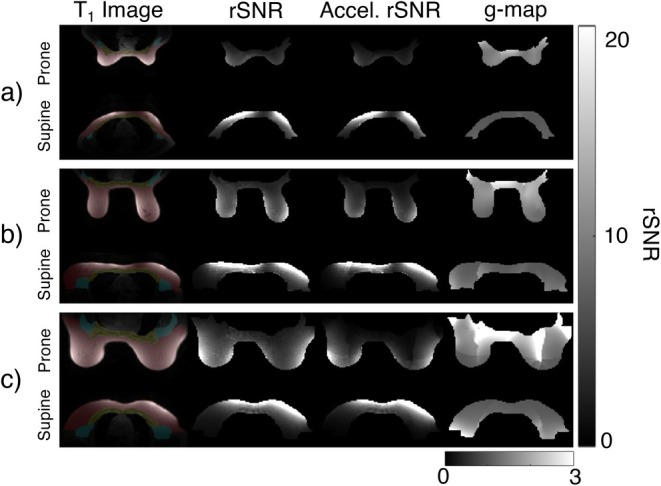 Figure 4
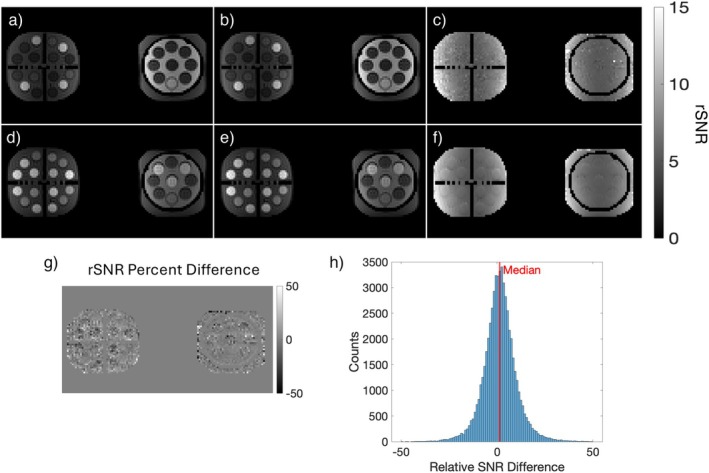 Figure 5
Peer Reviews
No public reviews on file for this paper yet. If you reviewed it on a platform where reviews are public (OpenReview, ICLR, NeurIPS, ICML), you can paste yours below so the community can read it here.
Videos
No videos yet. Explain this paper in a talk, walkthrough, or lecture? Add one.
Taxonomy
TopicsAdvanced MRI Techniques and Applications · MRI in cancer diagnosis · Medical Imaging Techniques and Applications