Spatial validation of acoustic individual identification models without ground truths: a case study with the cao-vit gibbon population
Paul Best, Angela Dassow, Arik Kershenbaum, Tho Duc Nguyen, Megan Pogson, Aishwarya Maheshwari, Ricard Marxer

TL;DR
This paper introduces a new method to evaluate individual identification models for gibbons using spatial data, without needing labeled ground truth data.
Contribution
A novel framework for evaluating AIID models using territoriality assumptions and spatial data, without ground truth labels.
Findings
The method reliably estimates model accuracy with a root mean square error of 0.05 for models under 30% error rate.
Specific flaws in performance estimation are linked to types of AIID errors.
The approach is demonstrated on the critically endangered cao-vit gibbon population.
Abstract
Technological progress has made bioacoustics an important tool for research in the ecology and behaviour of sound producing animals. Using an array of synchronised autonomous recorders, we can localise vocalising animals, and for certain species, computational models can acoustically identify individuals (AIID). Knowing both the precise location and identity of vocalising animals enables a more detailed interpretation of long-term bioacoustic data, but assessing the reliability of AIID models is often difficult, especially for populations that evolve over time. Annotated ground truth labels in test sets are commonly used, but they are often limited in size, and there can be a mismatch with the application data (for instance in case of a change in recording system). Here, we formalise a methodology to evaluate AIID models based on localised predictions, thus bypassing the need for ground…
Genes, proteins, chemicals, diseases, species, mutations and cell lines named across the full text — each resolved to its canonical identifier and authoritative record.
Click any figure to enlarge with its caption.
 Figure 1
 Figure 2
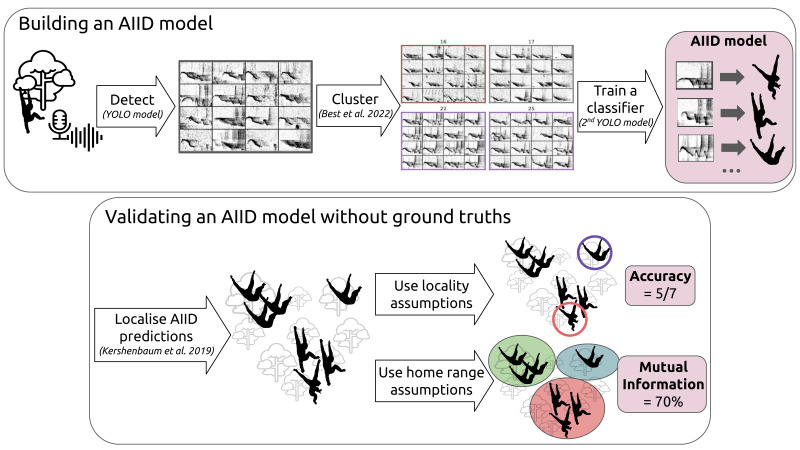 Figure 3
 Figure 4
 Figure 5
 Figure 6
 Figure 7
 Figure 8
 Figure 9
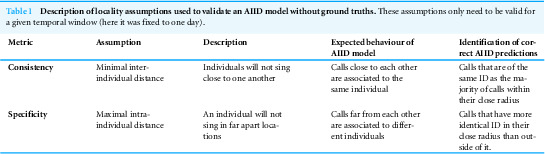 Figure 10
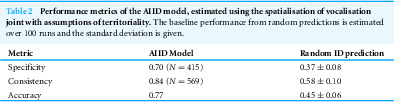 Figure 11
 Figure 12
Peer Reviews
No public reviews on file for this paper yet. If you reviewed it on a platform where reviews are public (OpenReview, ICLR, NeurIPS, ICML), you can paste yours below so the community can read it here.
Videos
No videos yet. Explain this paper in a talk, walkthrough, or lecture? Add one.
Taxonomy
TopicsAnimal Vocal Communication and Behavior · Wildlife Ecology and Conservation · Marine animal studies overview