Real-world data of opicapone in patients with Parkinson’s disease experiencing motor fluctuations: the OPTIMO study
María‑Rosario Luquin, Nuria Lopez-Ariztegui, Juan Carlos Martínez Castrillo, Lydia López Manzanares, Isabel Sastre Bataller, Antonio Koukoulis Fernández, Bárbara Vives Pastor, Berta Solano Vila, María Álvarez Sauco, Javier Pagonabarraga Mora, José Matías Arbelo González

TL;DR
This study shows that adding opicapone to levodopa helps reduce motor fluctuations in Parkinson's patients without worsening dyskinesias.
Contribution
The study provides real-world evidence of opicapone's effectiveness and safety in Parkinson's patients with motor fluctuations.
Findings
Opicapone reduced wearing-off phenomena and off-time in Parkinson's patients.
Clinical improvement was observed without worsening dyskinesias across PD phenotypes.
UPDRS scores improved, indicating better motor function and daily activities.
Abstract
Evaluate the outcomes of opicapone as an add-on treatment to levodopa/DDCI in patients with Parkinson’s disease (PD) and motor fluctuations (MF) in a real-world setting. Observational, retrospective, and post-authorization study in patients with PD and MF treated with opicapone at 16 Spanish Movement Disorders centers. Of 245 patients included (55.9% men; mean [standard deviation] age: 67.7 [10.4] years), 41.9 and 33.6% presented rigid-akinetic and tremor-dominant phenotypes, respectively; 43.8% had a history of dyskinesias. Patients started treatment with 50 mg/day opicapone 8.3 (5.3) years after diagnosis. At initiation, the mean levodopa dose was 620.7 (313.7) mg/day. According to the PGI-C (available in 178 patients), 74.2% of patients reported clinical improvement in MF, without worsening of dykinesias in 64.6%. Clinical improvement of MF with stable/improved dyskinesias was…
Genes, proteins, chemicals, diseases, species, mutations and cell lines named across the full text — each resolved to its canonical identifier and authoritative record.
Click any figure to enlarge with its caption.
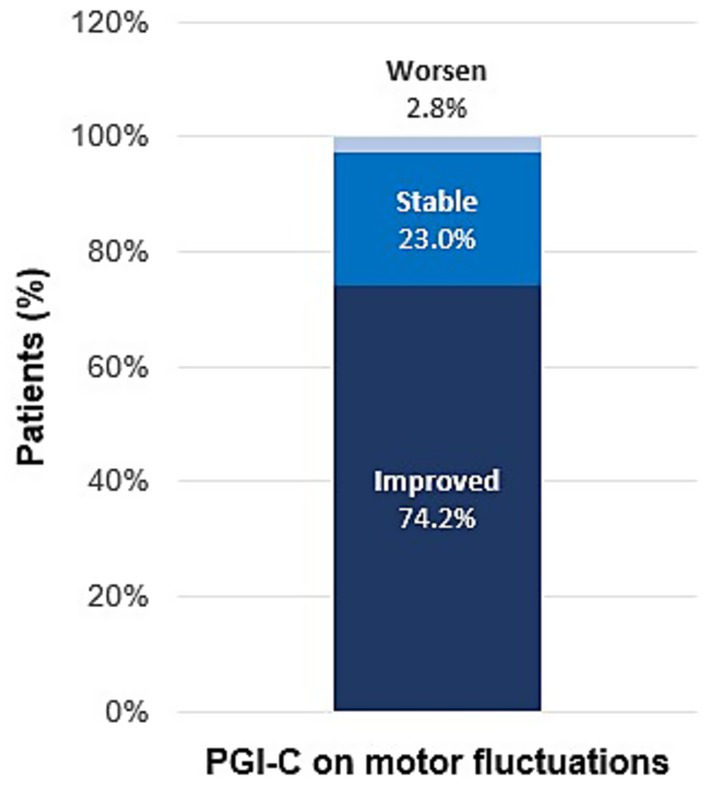 Figure 1
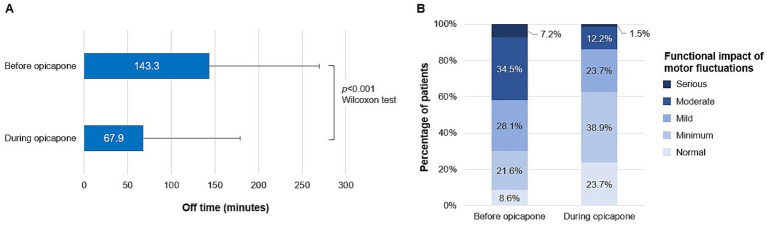 Figure 2
Peer Reviews
No public reviews on file for this paper yet. If you reviewed it on a platform where reviews are public (OpenReview, ICLR, NeurIPS, ICML), you can paste yours below so the community can read it here.
Videos
No videos yet. Explain this paper in a talk, walkthrough, or lecture? Add one.
Taxonomy
TopicsParkinson's Disease Mechanisms and Treatments · Neurological disorders and treatments · Amyotrophic Lateral Sclerosis Research