Short-term real-world outcomes of switching to faricimab in anti-VEGF-refractory retinal vein occlusion: a prospective study
Adnan Kilani, Abdelrahman Assaf, Denise Vogt, Efstathios Vounotrypidis, Melih Parlak, Constantin Jochem, Armin Wolf

TL;DR
Switching to faricimab in patients with retinal vein occlusion who didn't respond to previous treatments improved vision and reduced swelling in a real-world study.
Contribution
Demonstrates effectiveness of faricimab in anti-VEGF-refractory retinal vein occlusion using a modified treat-and-extend regimen in real-world settings.
Findings
Median best-corrected visual acuity improved significantly from 0.2 to 0.1 logMAR.
Central subfield thickness decreased significantly, and intraretinal fluid was reduced in most patients.
Treatment intervals increased with no safety-related adverse events observed.
Abstract
To evaluate short-term real-world outcomes after switching to faricimab using a modified treat-and-extend (TAE) regimen with a single loading dose in patients with retinal vein occlusion (RVO) refractory to prior anti-VEGF therapy. In this prospective study, 27 eyes of 27 patients with macular edema (ME) secondary to RVO and persistent intraretinal fluid (IRF) and central subfield thickness (CST) ≥ 270 μm despite ≥ 3 prior anti-VEGF injections at treatment intervals ≤ 6 weeks were switched to faricimab. Best-corrected visual acuity (BCVA) and optical coherence tomography (OCT) parameters, including CST, IRF, and subretinal fluid (SRF), were assessed from baseline (1st faricimab injection) until 3rd faricimab injection (final visit). Outcomes were analyzed for all RVO combined and stratified by central (CRVO) and branch retinal vein occlusion (BRVO). In the all RVO combined cohort,…
Genes, proteins, chemicals, diseases, species, mutations and cell lines named across the full text — each resolved to its canonical identifier and authoritative record.
Click any figure to enlarge with its caption.
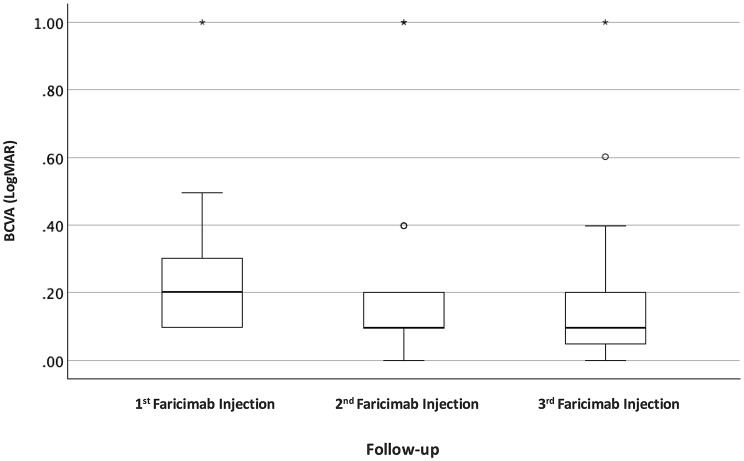 Figure 1
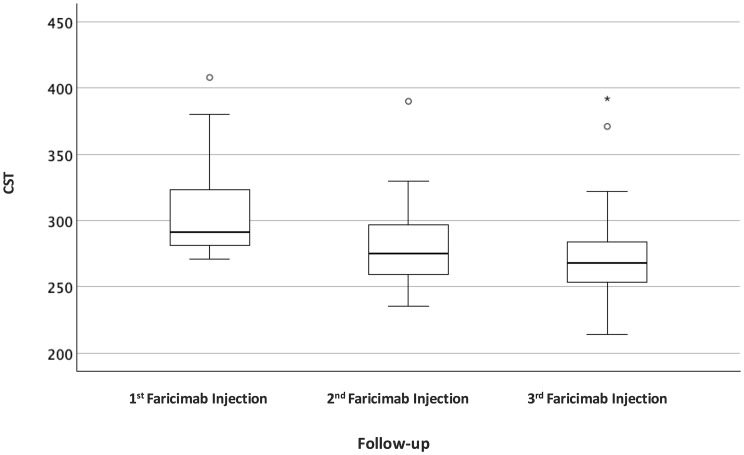 Figure 2
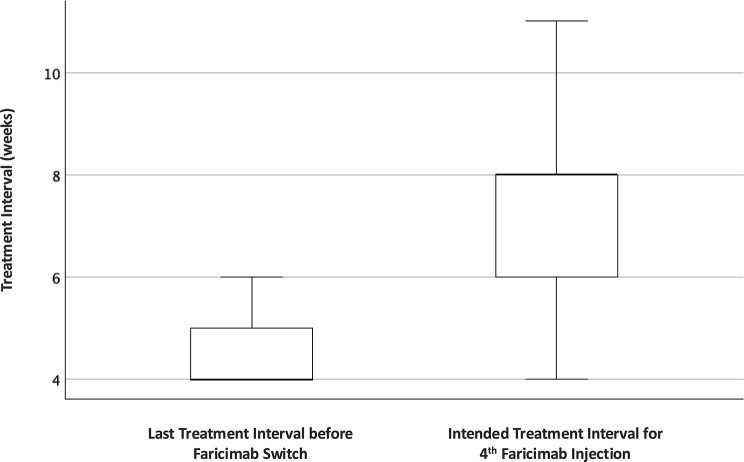 Figure 3
Peer Reviews
No public reviews on file for this paper yet. If you reviewed it on a platform where reviews are public (OpenReview, ICLR, NeurIPS, ICML), you can paste yours below so the community can read it here.
Videos
No videos yet. Explain this paper in a talk, walkthrough, or lecture? Add one.
Taxonomy
TopicsRetinal Diseases and Treatments · Retinal and Macular Surgery · Ocular Diseases and Behçet’s Syndrome