Development and cross-validation of a novel multi-omic assay to assess locoregional recurrence risk and adjuvant therapy benefit in early-stage hormone receptor positive invasive breast cancer patients
Troy Bremer, Karuna Mittal, Chirag Shah, Frank Vicini, Naamit K. Gerber, Melissa Krystel-Whittemore, Clayton C. Yates, Balasubramanyam Karanam, Walter Bell, Samuel G. Borak, Charles E. Cox, Abigail Beard, Geza Acs, Vincent Reid, Zahraa Al-Hilli, Steven C. Shivers

TL;DR
A new multi-omic test was developed to predict recurrence risk and radiation therapy benefit in early-stage hormone receptor positive breast cancer patients.
Contribution
A novel multi-omic assay was developed and cross-validated to assess locoregional recurrence risk and radiation therapy benefit in HR+/HER2- breast cancer.
Findings
Higher Decision Score was associated with increased locoregional recurrence risk after adjusting for clinicopathologic factors.
Radiation resistance index predicted differential radiation therapy effect on recurrence risk in high-risk patients.
Categorical risk groups showed distinct benefits from adjuvant radiation therapy based on biosignature scores.
Abstract
Breast cancer management is shifting towards personalized treatment regimens, particularly for early-stage, hormone receptor positive (HR+) invasive breast cancer (IBC) patients following breast conserving surgery (BCS) where locoregional recurrence (LRR) rates are low. A critical unmet need is the development of tools that can both improve prognostic risk assessment and identify which patients are likely to benefit or not benefit from adjuvant radiation therapy (RT). Herein we developed and cross validated a novel multi-omic assay to assess LRR risk and expected RT benefit for early-stage HR+/HER2-negative IBCs. A retrospective multi-institutional cohort of 922 patients (T1-2, N0-1, HR+, HER2-) treated with definitive breast conserving surgery (BCS) with or without adjuvant treatment was used to develop and cross-validate a test to predict IBC LRR after BCS ± RT. Treatment assignment…
Genes, proteins, chemicals, diseases, species, mutations and cell lines named across the full text — each resolved to its canonical identifier and authoritative record.
Click any figure to enlarge with its caption.
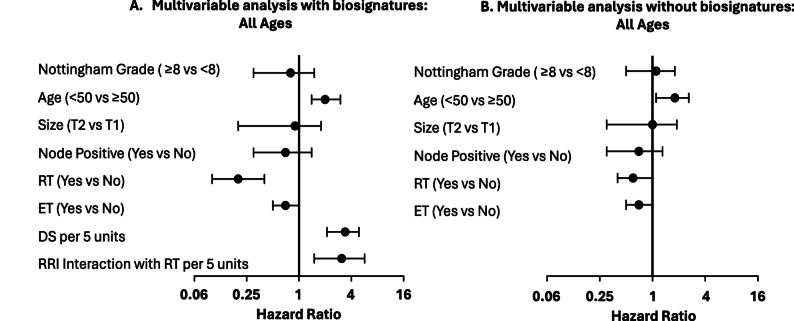 Figure 1
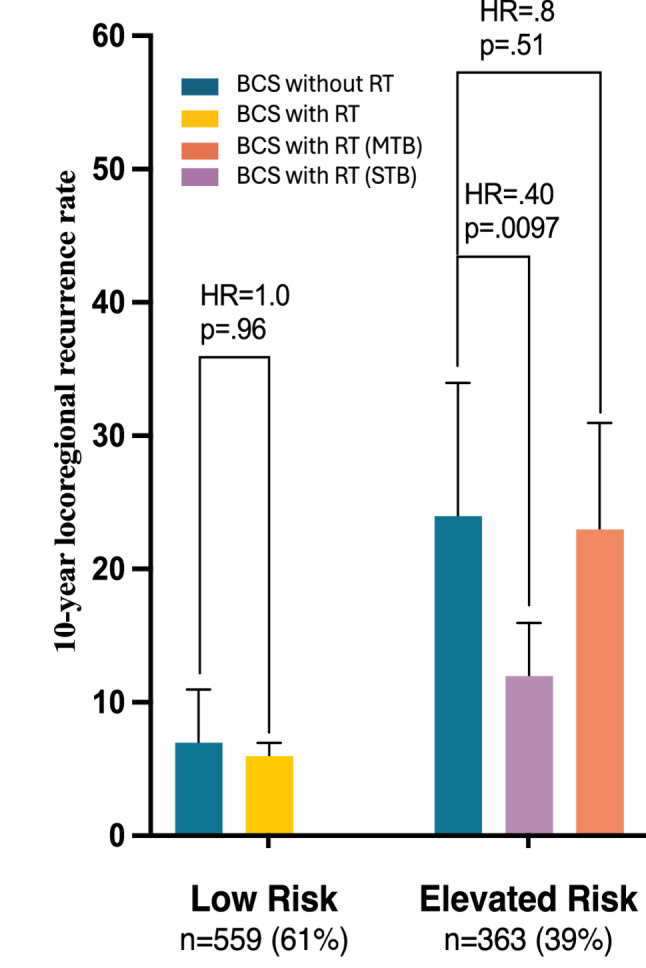 Figure 2
Peer Reviews
No public reviews on file for this paper yet. If you reviewed it on a platform where reviews are public (OpenReview, ICLR, NeurIPS, ICML), you can paste yours below so the community can read it here.
Videos
No videos yet. Explain this paper in a talk, walkthrough, or lecture? Add one.
Taxonomy
TopicsBreast Cancer Treatment Studies · Medical Imaging Techniques and Applications · Breast Lesions and Carcinomas