A Machine Learning Model to Improve Risk Adjustment Accuracy in Medicare
Daniel K. Shenfeld, Lindsay Warrenburg, Eli Silvert, Matthew Guido, Maggie Makar, Karen Joynt Maddox, Amol S. Navathe, Ravi Bharat Parikh, Ezekiel J. Emanuel

TL;DR
A new machine learning model called Franklin improves the accuracy of predicting healthcare costs for Medicare beneficiaries compared to the current system.
Contribution
Franklin, a machine learning model, outperforms the traditional HCC system in predicting Medicare costs and improving risk adjustment accuracy.
Findings
Franklin achieved higher predictive accuracy than HCC with R² log cost of 0.44 versus 0.15.
Franklin improved accuracy for beneficiaries with few or no HCCs and for racial/ethnic minorities.
Franklin outperformed HCC in detecting low-cost beneficiaries with higher sensitivity and specificity.
Abstract
To develop a machine learning (ML) algorithm that improves accuracy compared to the Hierarchical Condition Category (HCC) score used by the Centers for Medicare and Medicaid Services to risk‐adjust payments for > 65 million Americans. Prognostic study using Medicare claims data to train “Franklin”, an ML algorithm predicting one‐year costs, trained using identical data to HCC. Predictive accuracy was evaluated using R 2 log cost, Spearman rho, and sensitivity and specificity. Random sample of 2018–2019 Part A and B claims from aged, community‐based enrollees in Traditional Medicare who were not dually eligible and did not have end‐stage renal disease. The sample consisted of 4,176,666 Medicare beneficiaries (mean [SD] age 74.9 [7.2] years, 55.9% women; 85.9% Non‐Hispanic white, 5.6% African‐American, 3.4% Hispanic). Franklin was more accurate than HCC (R 2 log cost 0.44 vs. 0.15;…
Genes, proteins, chemicals, diseases, species, mutations and cell lines named across the full text — each resolved to its canonical identifier and authoritative record.
Click any figure to enlarge with its caption.
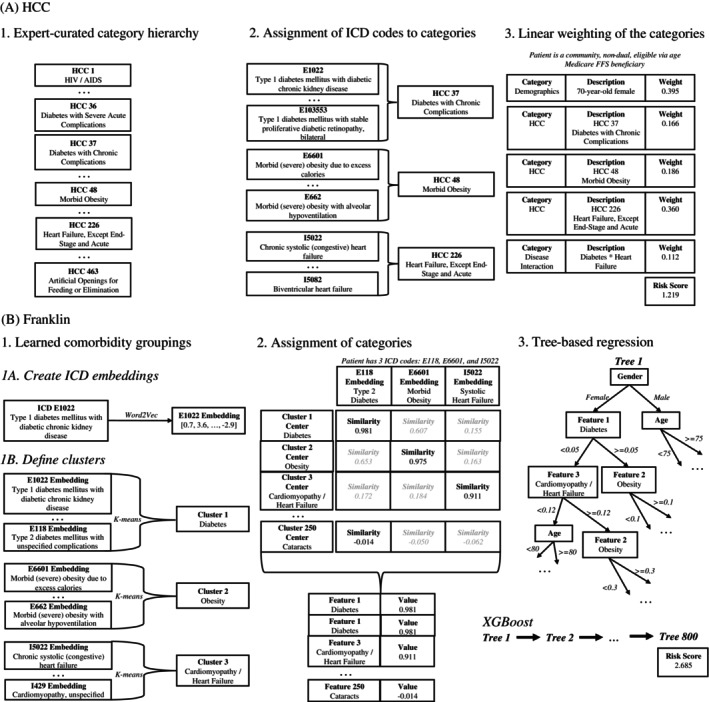 Figure 1
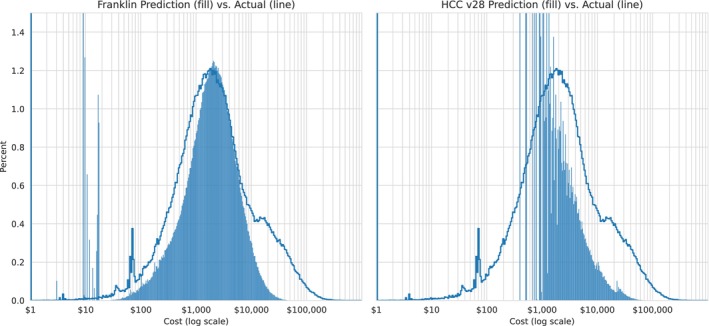 Figure 2
Peer Reviews
No public reviews on file for this paper yet. If you reviewed it on a platform where reviews are public (OpenReview, ICLR, NeurIPS, ICML), you can paste yours below so the community can read it here.
Videos
No videos yet. Explain this paper in a talk, walkthrough, or lecture? Add one.
Taxonomy
TopicsMachine Learning in Healthcare · Artificial Intelligence in Healthcare and Education · Medication Adherence and Compliance