Developmental trajectories of outpatient mental health service contact from childhood to early adulthood in an Australian birth cohort
James M. Ogilvie, Belinda Crissman, Emily Hurren, Carleen M. Thompson, Aydan Kuluk, Troy Allard, Lisa Broidy, Susan Dennison, Steve Kisely, Anna Stewart

TL;DR
The study identifies different patterns of mental health service use from childhood to early adulthood in an Australian cohort, highlighting the need for early intervention.
Contribution
The novel use of Group Based Trajectory Modelling reveals distinct developmental trajectories of mental health service contacts.
Findings
Four distinct trajectories of outpatient mental health service contacts were identified.
The escalating trajectory group had the highest proportion of contacts despite being the smallest group.
Variations in trajectories were associated with factors like residence, socioeconomic status, and diagnosed disorders.
Abstract
Despite increasing empirical support for primary intervention in the early development of mental disorders, limited lifespan developmental research exists to identify the potential timing of such interventions. This study takes a novel approach by applying Group Based Trajectory Modelling (GBTM) to identify patterns of outpatient mental health service (MHS) contacts over the early life-course. GBTM is a statistical method that can assist in identifying subgroups in a population that follow similar developmental trajectories over time. We analyzed longitudinal (age ≈10 to 23 years) outpatient MHS contact data for an Australian birth cohort (N = 5,359) using GBTM. We examined variation across trajectory groups by sex, Indigenous status (non-Indigenous/Indigenous Australians), psychiatric diagnoses associated with hospital admissions, place of residence (metropolitan, regional, remote),…
Genes, proteins, chemicals, diseases, species, mutations and cell lines named across the full text — each resolved to its canonical identifier and authoritative record.
Click any figure to enlarge with its caption.
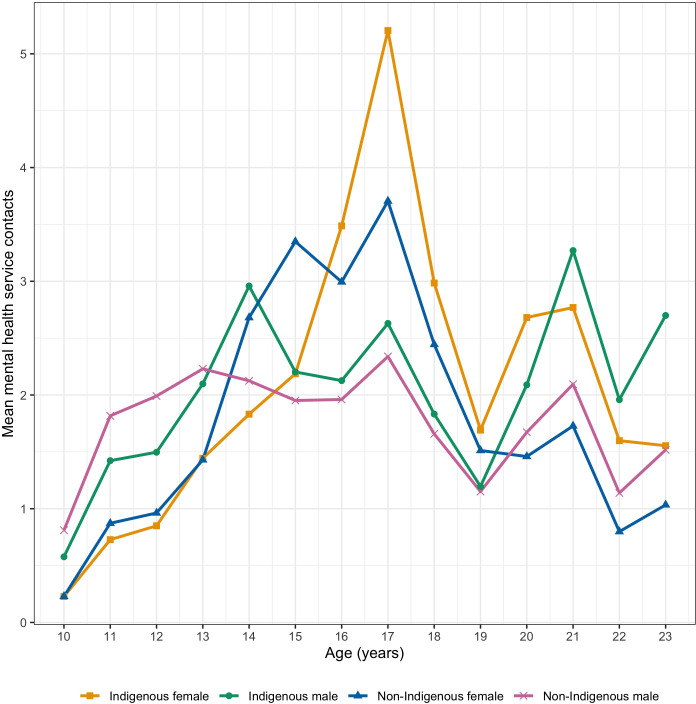 Figure 1
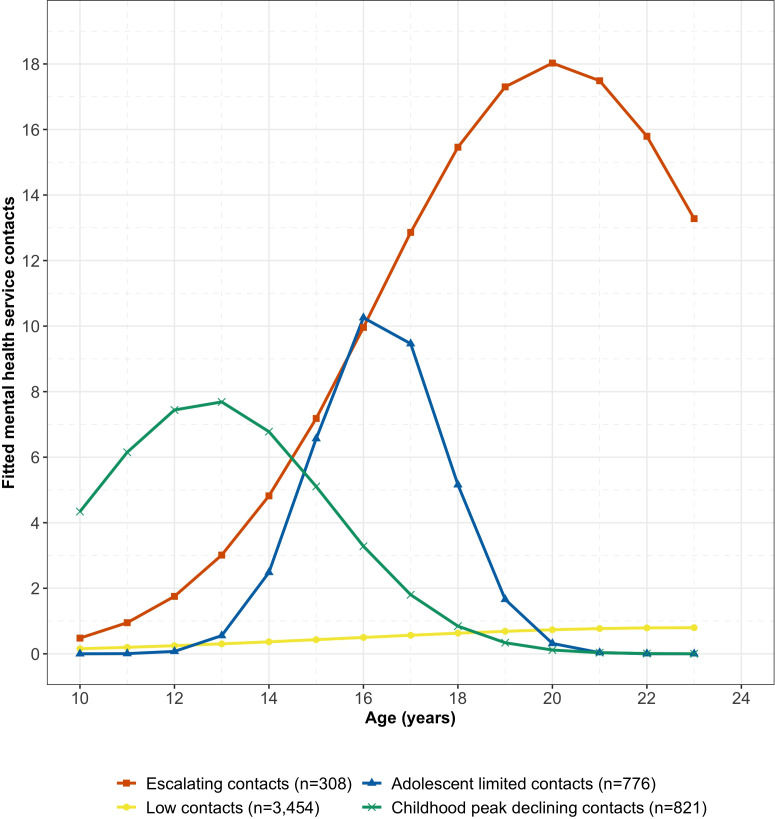 Figure 2
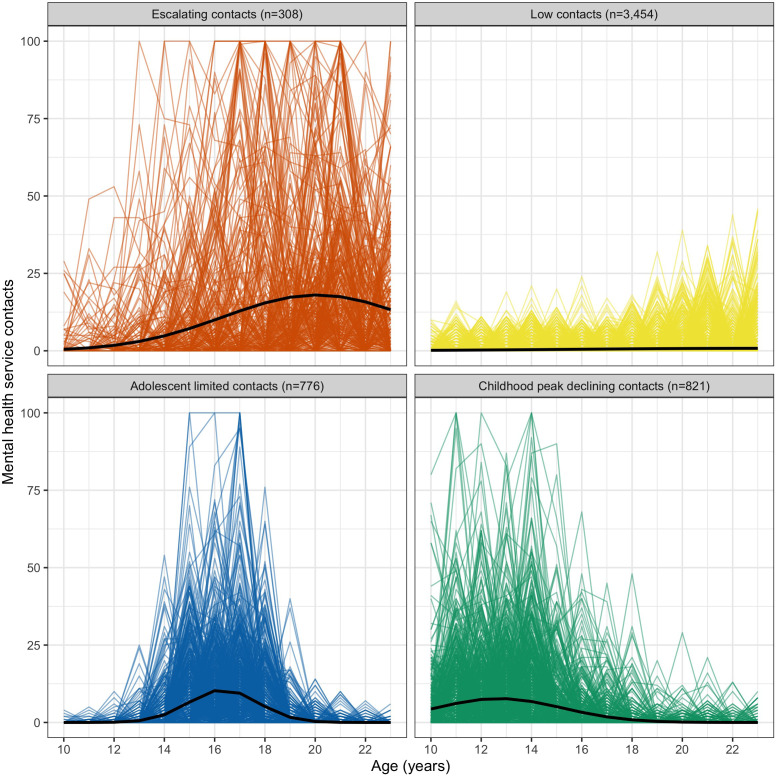 Figure 3
Peer Reviews
No public reviews on file for this paper yet. If you reviewed it on a platform where reviews are public (OpenReview, ICLR, NeurIPS, ICML), you can paste yours below so the community can read it here.
Videos
No videos yet. Explain this paper in a talk, walkthrough, or lecture? Add one.
Taxonomy
TopicsMaternal Mental Health During Pregnancy and Postpartum · Child and Adolescent Psychosocial and Emotional Development · Mental Health Treatment and Access