Highly Stable Photoluminescent CeF3 Nanocrystal as a Versatile Probe for Neurotoxic Alkaloid (Anabasine) Sensing via Fluorescence Modulation
Deepak Dabur, Jie Li, Priyanka Rana, Hui-Fen Wu

TL;DR
Researchers developed a new fluorescent probe using CeF3 nanocrystals to detect the toxic alkaloid anabasine in water samples with high accuracy and minimal preparation.
Contribution
The first ratiometric fluorescent probe using CeF3 nanocrystals for selective and sensitive anabasine detection in environmental water samples.
Findings
CeF3 nanocrystals show dual-emission bands for anabasine detection with a low limit of detection (0.17 μM).
The probe achieves 95–103% recovery in lake, river, and tap water with minimal matrix interference.
The method outperforms traditional techniques like LC-MS/MS and GC-FID by avoiding derivatization or complex pretreatment.
Abstract
This study introduces highly stable photoluminescent CeF3 nanocrystals as a first ratiometric fluorescent probe for the selective detection of the neurotoxic alkaloid anabasine in environmental water matrices. The hexagonal-phase CeF3 nanocrystals (40–50 nm) exhibit dual-emission bands at 322 (quenched) and 433 nm (enhanced) upon anabasine binding, enabling sensitive (LOD: 0.17 μM) and matrix-resistant quantification. Structural (XRD, TEM, EDS) and optical (pH and thermal stability: pH 4–10, 30–90 °C) characterizations confirm robustness for real-world applications. Recovery assays (95–103%) in lake, river, and tap water demonstrate minimal matrix interference, outperforming LC-MS/MS and GC-FID methods that require derivatization or complex sample pretreatment. The cost-effectiveness, simplicity, and ratiometric self-calibration of the method highlight its potential for on-site…
Genes, proteins, chemicals, diseases, species, mutations and cell lines named across the full text — each resolved to its canonical identifier and authoritative record.
Click any figure to enlarge with its caption.
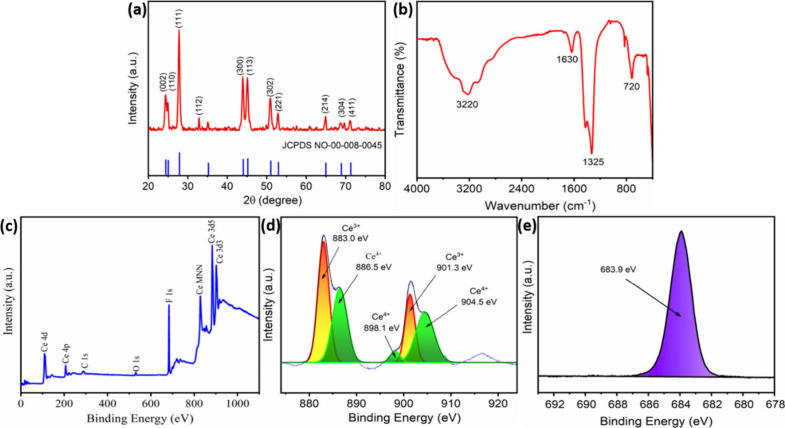 Figure 1
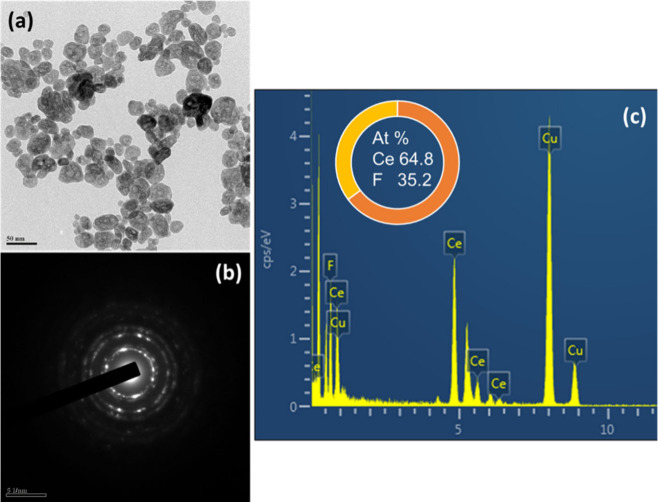 Figure 2
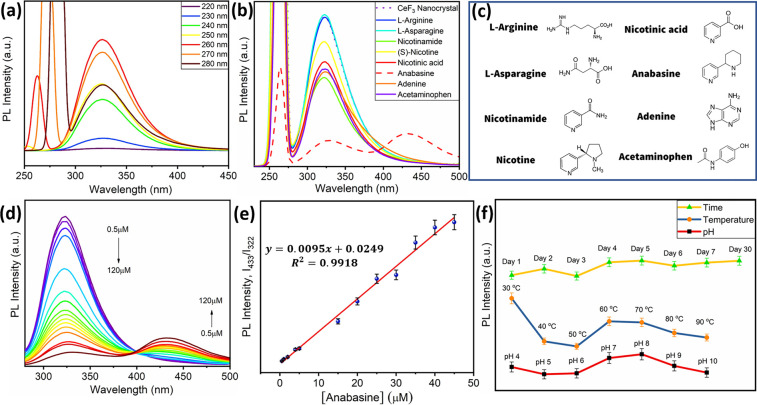 Figure 3
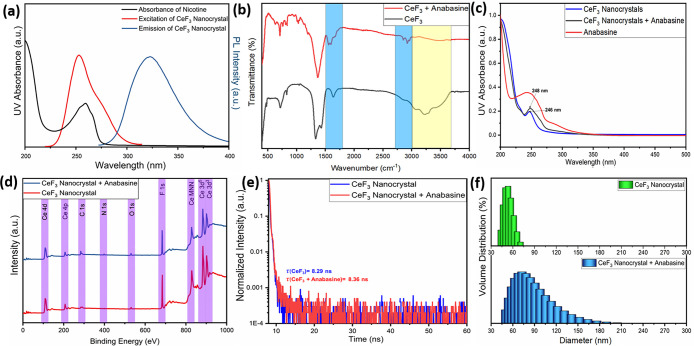 Figure 4
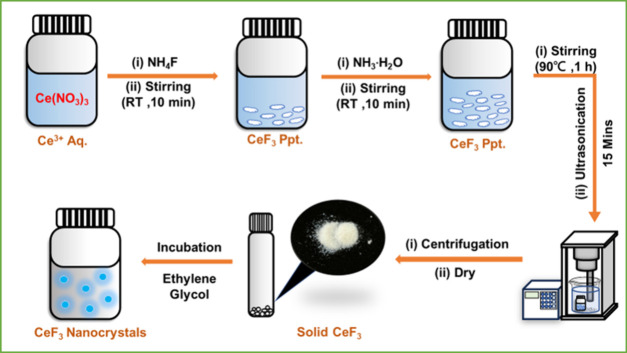 Figure 5
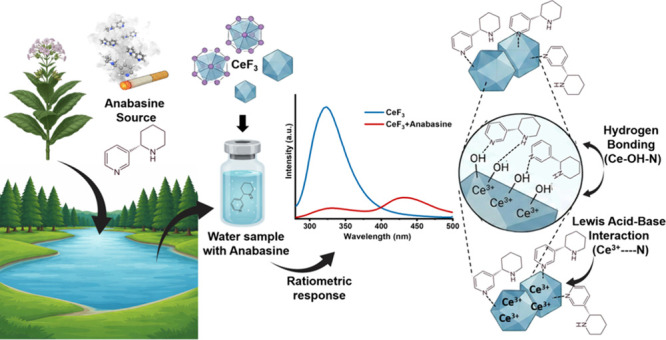 Figure 6
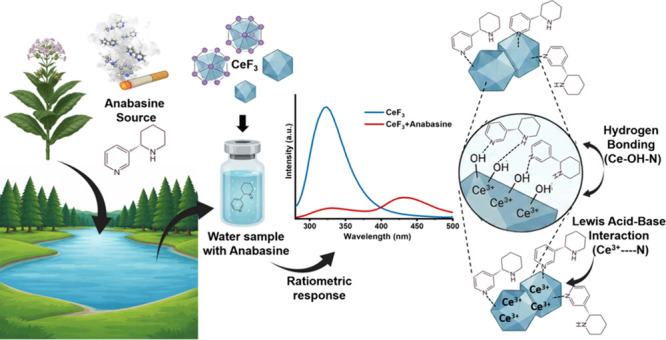 Figure 7
Peer Reviews
No public reviews on file for this paper yet. If you reviewed it on a platform where reviews are public (OpenReview, ICLR, NeurIPS, ICML), you can paste yours below so the community can read it here.
Videos
No videos yet. Explain this paper in a talk, walkthrough, or lecture? Add one.
Taxonomy
TopicsCarbon and Quantum Dots Applications · Nanocluster Synthesis and Applications · Luminescence Properties of Advanced Materials