Tau Regulates Endoreplication in Drosophila Malpighian Tubules
Neha Tiwari, Madhu Tapadia

TL;DR
This study shows that Tau, a protein known for its role in neurons, also helps control DNA replication in non-neuronal tissues of fruit flies.
Contribution
The paper reveals a new role for Tau in regulating endoreplication in Drosophila epithelial cells.
Findings
Loss of Tau increases nuclear size and DNA content in Malpighian tubule cells.
Similar effects are observed in the polyploid salivary gland tissue.
Tau restrains endoreplication in non-neuronal epithelia.
Abstract
Endoreplication drives polyploidy in metabolically active epithelial tissues. Here we show that loss of Drosophila Tau increases nuclear size and DAPI fluorescence in principal and stellate cells of the Malpighian tubule, indicative of elevated DNA content. A similar increase is observed in the salivary gland, another polyploid tissue. These findings reveal a previously unrecognized role for Tau in restraining endoreplication in non-neuronal epithelia.
Genes, proteins, chemicals, diseases, species, mutations and cell lines named across the full text — each resolved to its canonical identifier and authoritative record.
Click any figure to enlarge with its caption.
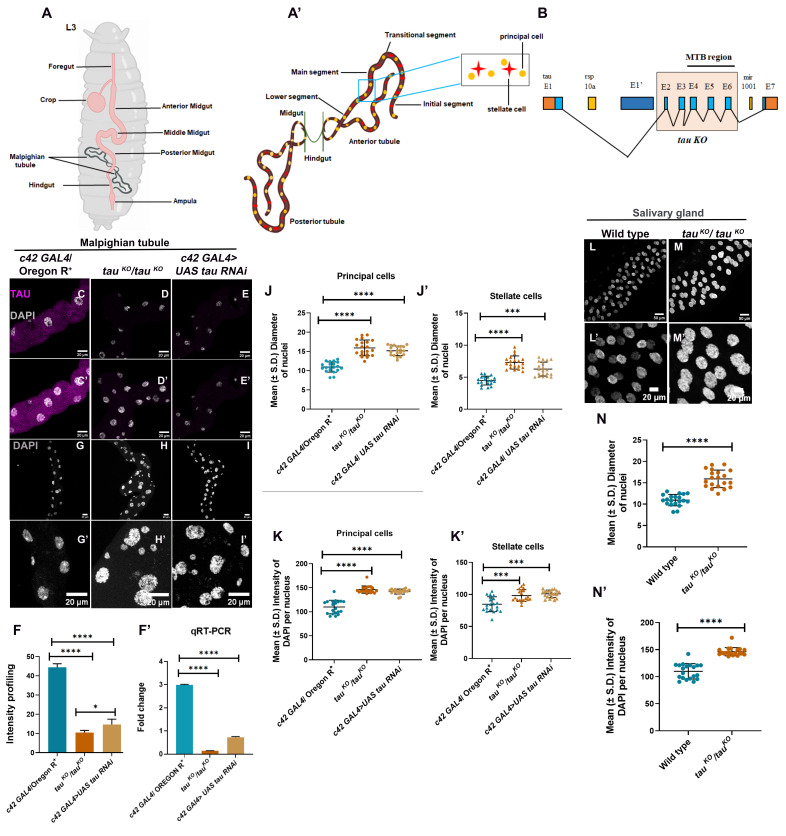 Figure 1
Peer Reviews
No public reviews on file for this paper yet. If you reviewed it on a platform where reviews are public (OpenReview, ICLR, NeurIPS, ICML), you can paste yours below so the community can read it here.
Videos
No videos yet. Explain this paper in a talk, walkthrough, or lecture? Add one.
Taxonomy
TopicsMicrotubule and mitosis dynamics · Developmental Biology and Gene Regulation · Cancer-related Molecular Pathways