Variable deep learning training horizons reveal the temporal complexity of biological systems
Po-Hao Chiu, Jacob I Evarts, Patrick Feng, Neda Bagheri

TL;DR
This paper introduces a deep learning framework that uses variable-length time-series data to study biological systems and identify key transition points.
Contribution
The novel framework allows variable input sequence lengths to better model temporal complexity in biological systems.
Findings
Performance improves with more in silico data but varies with in vitro data.
Temporal dynamics can reveal biological transition points in complex systems.
Abstract
The increasing quantity of time-series images presents new opportunities for extracting biological insights from data. Here, we introduce a deep learning framework with a variable input sequence length to predict cell and colony morphologies. We apply this framework to in silico and in vitro microscopy datasets, evaluating the impact of temporal data on performance. We find that while performance increases monotonically with increasing in silico training data, performance is varied in the in vitro case studies. The varying results reflect the intrinsic challenges stochastic, complex biological systems pose to data-driven modeling, and offer a new method through which we can identify biological transition points using temporal dynamics.
Genes, proteins, chemicals, diseases, species, mutations and cell lines named across the full text — each resolved to its canonical identifier and authoritative record.
Click any figure to enlarge with its caption.
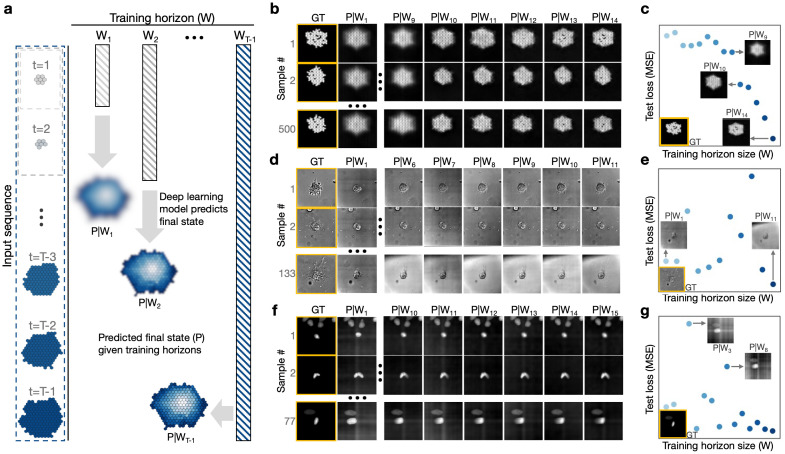 Figure 1
Peer Reviews
No public reviews on file for this paper yet. If you reviewed it on a platform where reviews are public (OpenReview, ICLR, NeurIPS, ICML), you can paste yours below so the community can read it here.
Videos
No videos yet. Explain this paper in a talk, walkthrough, or lecture? Add one.
Taxonomy
TopicsCell Image Analysis Techniques · Digital Holography and Microscopy · Single-cell and spatial transcriptomics