Epidemiology of Molar Furcation Defects: A Multi‐Center Study on Prevalence, Severity, and Risk Indicators
Georgios S. Chatzopoulos, Larry F. Wolff

TL;DR
This study finds that molar furcation defects are common in periodontitis patients, with tooth-specific factors like maxillary and second molars being key risk indicators.
Contribution
The study identifies tooth-specific risk factors for molar furcation defects in a multi-center periodontitis cohort.
Findings
Molar furcation involvement was highly prevalent in periodontitis patients.
Maxillary molars and second molars had significantly higher odds of being affected.
Tooth-specific factors were primary drivers of molar furcation defect risk.
Abstract
In a large cohort of periodontitis patients, molar furcation involvement was highly prevalent but mostly of lower severity. Tooth‐specific factors are primary drivers of risk, with maxillary molars and second molars having significantly higher odds of being affected.
Genes, proteins, chemicals, diseases, species, mutations and cell lines named across the full text — each resolved to its canonical identifier and authoritative record.
Click any figure to enlarge with its caption.
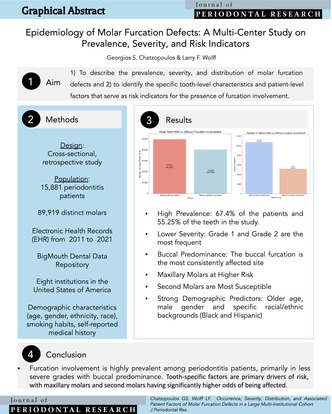 Figure 1
Peer Reviews
No public reviews on file for this paper yet. If you reviewed it on a platform where reviews are public (OpenReview, ICLR, NeurIPS, ICML), you can paste yours below so the community can read it here.
Videos
No videos yet. Explain this paper in a talk, walkthrough, or lecture? Add one.
Taxonomy
TopicsOral microbiology and periodontitis research · Dental Radiography and Imaging · Endodontics and Root Canal Treatments