PMC · DOI:10.1111/nph.70904·January 9, 2026
Do interspecific hybrids lead to new evolutionary avenues in the plant family Lemnaceae?
K. Sowjanya Sree, Klaus‐J. Appenroth

Abstract
This article is a Commentary on Lee et al. (2026), 250: 629–647.
Linked entities
Genes, proteins, chemicals, diseases, species, mutations and cell lines named across the full text — each resolved to its canonical identifier and authoritative record.
Species13
Lemna japonica(species)Spirodela polyrhiza(greater duckweed · species)Lemna perpusilla(species)Japonica(genus)Lemna minor(species)Brachyspira intermedia(species)Lemna gibba(swollen duckweed · species)Landoltia punctata(species)Lemna(duckweed · genus)Lemna aequinoctialis(species)Lemna turionifera(species)Homo sapiens(human · species)Spirodela(genus)
Chemicals2
Figures1
Click any figure to enlarge with its caption.
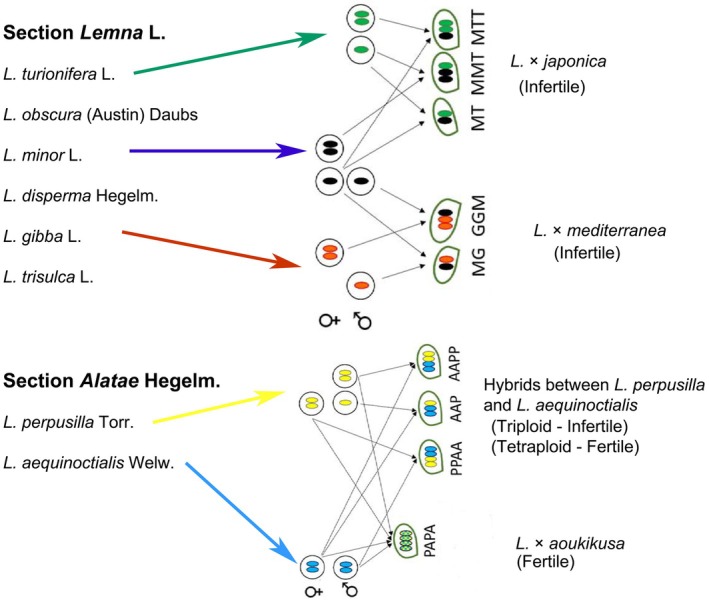 Figure 1
Peer Reviews
No public reviews on file for this paper yet. If you reviewed it on a platform where reviews are public (OpenReview, ICLR, NeurIPS, ICML), you can paste yours below so the community can read it here.
Videos
No videos yet. Explain this paper in a talk, walkthrough, or lecture? Add one.
Taxonomy
TopicsConstructed Wetlands for Wastewater Treatment · Peatlands and Wetlands Ecology · Coastal wetland ecosystem dynamics