Testing for Sufficient Follow‐Up in Survival Data With a Cure Fraction
Tsz Pang Yuen, Eni Musta

TL;DR
This paper introduces a new statistical test to determine if a study has followed subjects long enough to estimate the proportion of cured individuals in survival data.
Contribution
A novel nonparametric test is proposed for assessing practically sufficient follow-up in survival data with a cure fraction.
Findings
The proposed test is based on a relaxed definition of sufficient follow-up using quantiles and a nonincreasing density assumption.
The method uses shape-constrained density estimators and a bootstrap procedure for critical value computation.
Simulation studies and breast cancer data illustrate the test's performance and practical applicability.
Abstract
In order to estimate the proportion of “immune” or “cured” subjects who will never experience failure, a sufficiently long follow‐up period is required. Several statistical tests have been proposed in the literature for assessing the assumption of sufficient follow‐up, meaning that the study duration is longer than the support of the survival times for the uncured subjects. These tests do not perform satisfactorily, especially in terms of Type I error. In addition, they are constructed based on the assumption that the survival time for the uncured subjects has a compact support, that is, the existence of a “cure time.” However, for practical purposes, the assumption of “cure time” is not realistic and the follow‐up would be considered sufficiently long if the probability for the event to happen after the end of the study is very small. Based on this observation, we formulate a more…
Genes, proteins, chemicals, diseases, species, mutations and cell lines named across the full text — each resolved to its canonical identifier and authoritative record.
Click any figure to enlarge with its caption.
 Figure 1
 Figure 2
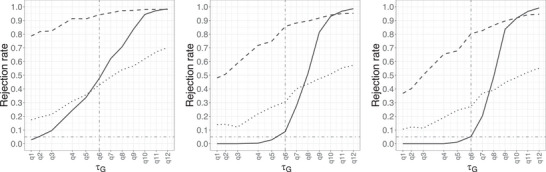 Figure 3
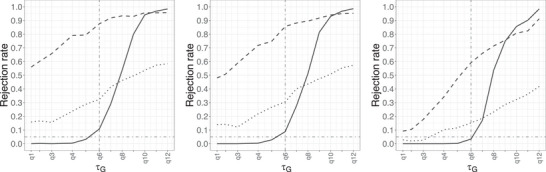 Figure 4
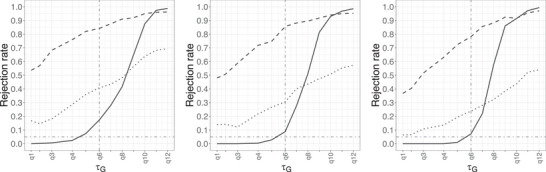 Figure 5
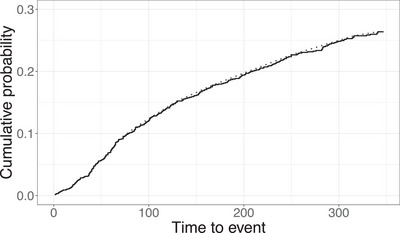 Figure 6
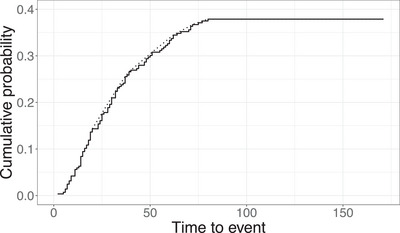 Figure 7
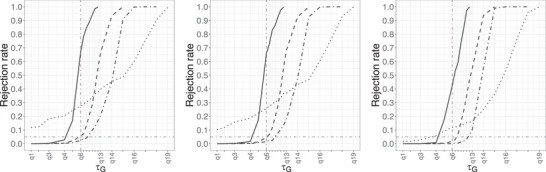 Figure 8
Peer Reviews
No public reviews on file for this paper yet. If you reviewed it on a platform where reviews are public (OpenReview, ICLR, NeurIPS, ICML), you can paste yours below so the community can read it here.
Videos
No videos yet. Explain this paper in a talk, walkthrough, or lecture? Add one.
Taxonomy
TopicsStatistical Methods and Inference · Bayesian Methods and Mixture Models · Statistical Methods and Bayesian Inference