Early Functional Recovery Is Improved in Patients Treated With Bioinductive Collagen Implant Augmentation Compared With Standard Arthroscopic Repair of High-grade Partial-Thickness Rotator Cuff Tears: A Prospective Randomized Trial
Allan Wang, William Breidahl, Eugene T. Ek, Travis Falconer, Peter D’Alessandro, Jay R. Ebert

TL;DR
A bioinductive collagen implant improved early recovery in patients with rotator cuff tears compared to standard repair, with similar healing rates after a year.
Contribution
Demonstrates that bioinductive collagen implant augmentation offers better early functional outcomes than standard rotator cuff repair for high-grade tears.
Findings
The REG group showed superior WORC and ASES scores at 6 weeks and 3 months post-surgery.
Patients in the REG group returned to daily activities and work faster than the RCR group.
MRI-based healing rates were equivalent between the two groups at 12 months.
Abstract
Arthroscopic surgical takedown and repair of symptomatic partial-thickness rotator cuff tears are commonly undertaken. An alternative approach is the use of a bioinductive collagen implant to augment the rotator cuff tear. To investigate early function and rotator cuff tendon integrity in patients undergoing arthroscopic bioinductive collagen implant augmentation (REG group) versus rotator cuff takedown and repair (RCR group) for high-grade partial-thickness rotator cuff tears. Randomized controlled clinical trial; Level of evidence, 2. Patients 35 to 75 years of age with symptoms >3 months and unresponsive to nonoperative treatment, with high-grade partial-thickness rotator cuff tears confirmed on 3-T magnetic resonance imaging (MRI), were randomly allocated to RCR or REG groups. Exclusion criteria included previous ipsilateral shoulder surgery, multitendon tears/pathology, and…
Genes, proteins, chemicals, diseases, species, mutations and cell lines named across the full text — each resolved to its canonical identifier and authoritative record.
Click any figure to enlarge with its caption.
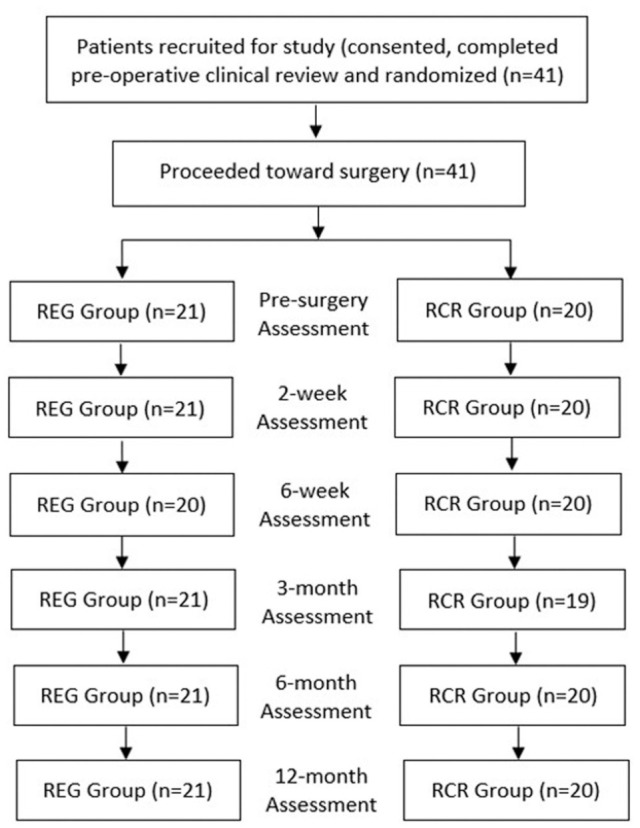 Figure 1
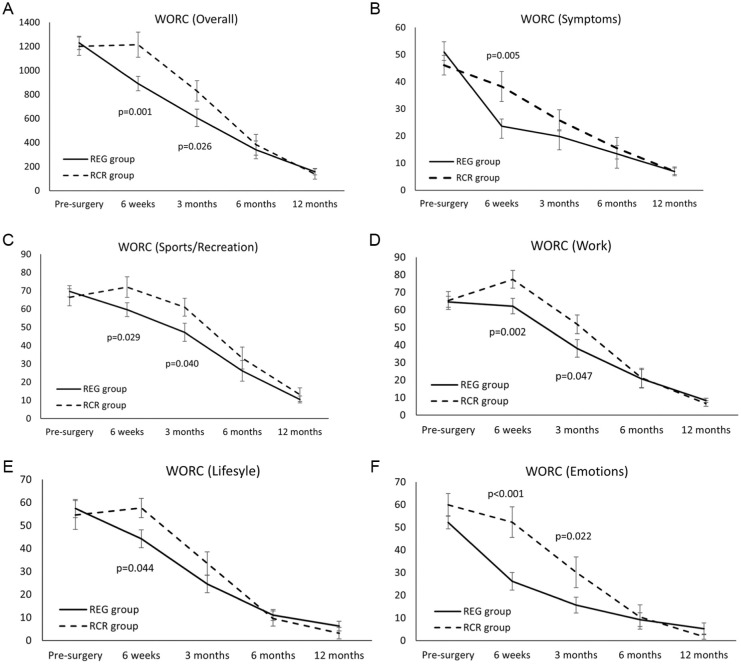 Figure 2
 Figure 3
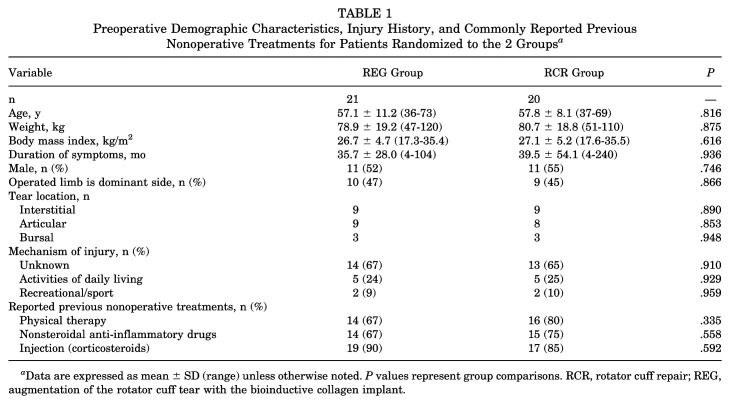 Figure 4
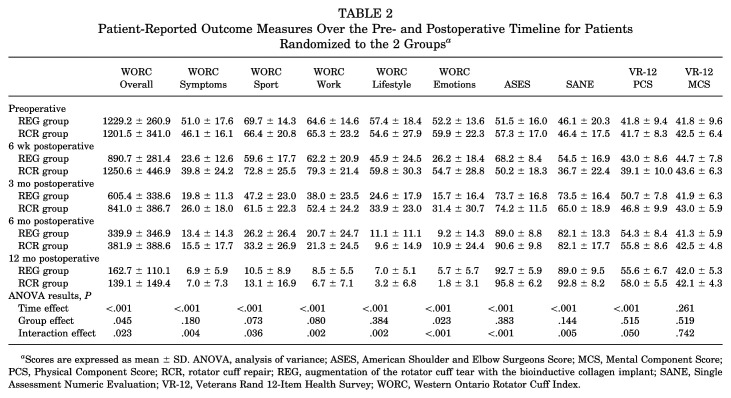 Figure 5
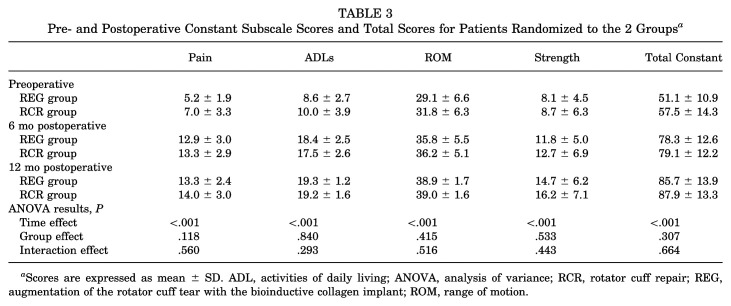 Figure 6
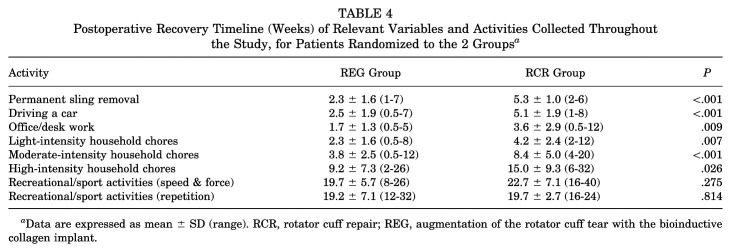 Figure 7
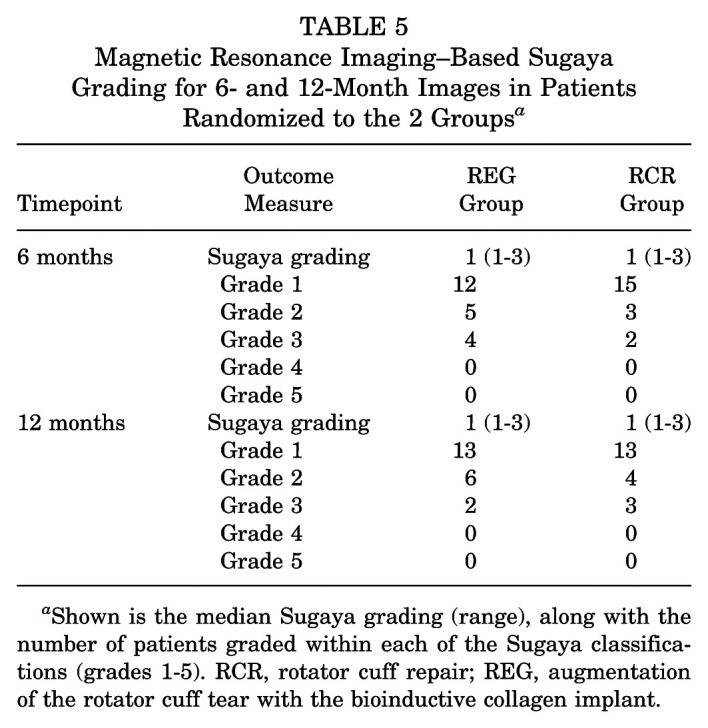 Figure 8
Peer Reviews
No public reviews on file for this paper yet. If you reviewed it on a platform where reviews are public (OpenReview, ICLR, NeurIPS, ICML), you can paste yours below so the community can read it here.
Videos
No videos yet. Explain this paper in a talk, walkthrough, or lecture? Add one.
Taxonomy
TopicsShoulder Injury and Treatment · Total Knee Arthroplasty Outcomes · Shoulder and Clavicle Injuries