Eco-Friendly, Multi-Mode Processable Highly Moldable Wood Enabled by the Reconstruction of Hydrogen-Bonding Domain
Rui Yang, Linghui Qi, Xiaoli Wu, Zhipeng Liu, Huiyang Bian, Changlei Xia, Changtong Mei, Shuaicheng Jiang, Meng Yao, Jianzhang Li

TL;DR
Scientists created a moldable wood with improved stability and water resistance, enabling precise 3D shaping for use in sustainable engineering.
Contribution
A hydrogen-bond reconstruction strategy enables highly moldable wood with exceptional dimensional stability and plasticity.
Findings
The moldable wood has ≈ 80% lower moisture absorption compared to traditional wood.
It allows for the creation of complex 3D structures like origami cranes and honeycombs.
The material offers an energy-efficient and eco-friendly alternative to synthetic composites in aviation.
Abstract
A hydrogen-bond reconstruction strategy creates a moldable wood with greatly improved dimensional stability (≈ 80% lower moisture absorption) and plasticity for precision 3D shaping.We develop a moldable wood that combines high plasticity with exceptional water resistance, enabling the creation of complex, precise 3D structures like mechanical metamaterials.This moldable wood bridges sustainable materials and precision engineering, offering an energy-efficient alternative to synthetic composites in demanding fields like aviation. A hydrogen-bond reconstruction strategy creates a moldable wood with greatly improved dimensional stability (≈ 80% lower moisture absorption) and plasticity for precision 3D shaping. We develop a moldable wood that combines high plasticity with exceptional water resistance, enabling the creation of complex, precise 3D structures like mechanical metamaterials.…
Genes, proteins, chemicals, diseases, species, mutations and cell lines named across the full text — each resolved to its canonical identifier and authoritative record.
Click any figure to enlarge with its caption.
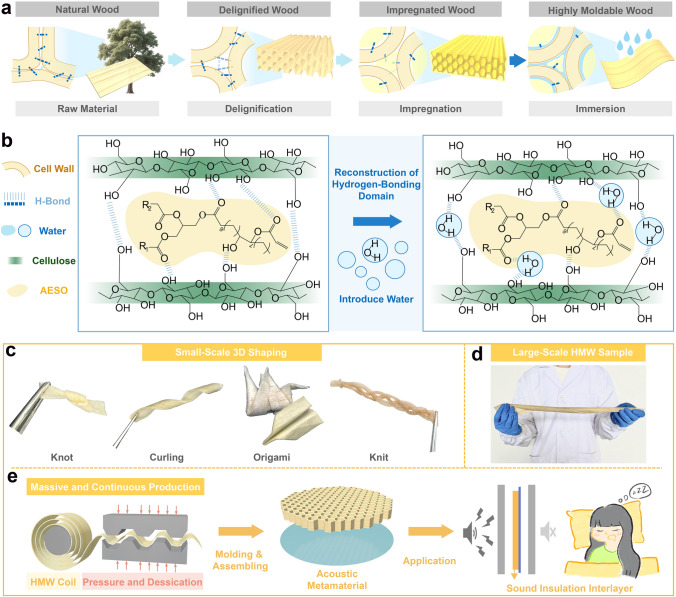 Figure 1
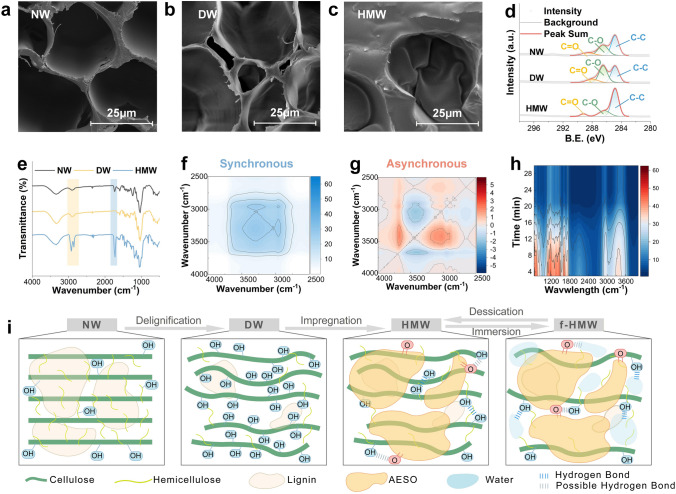 Figure 2
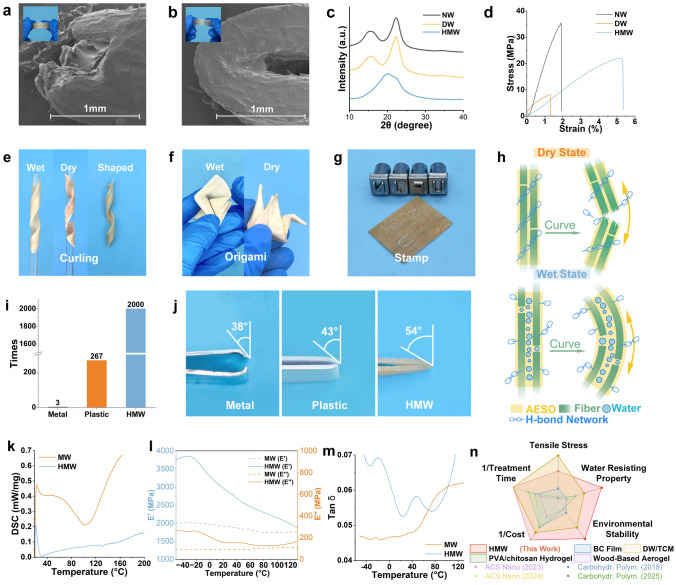 Figure 3
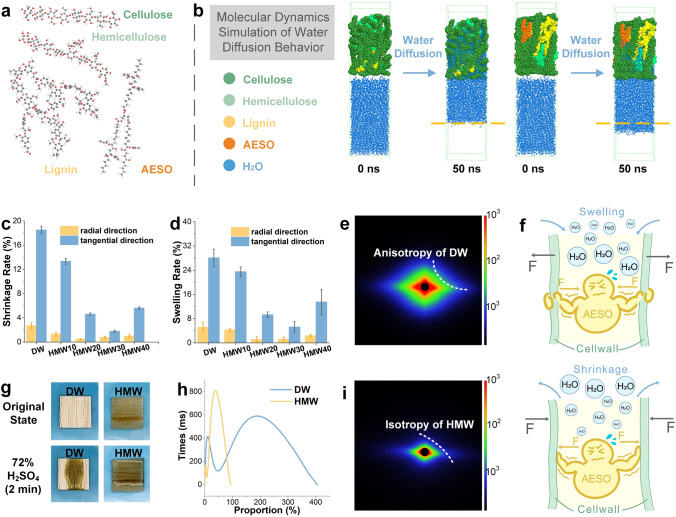 Figure 4
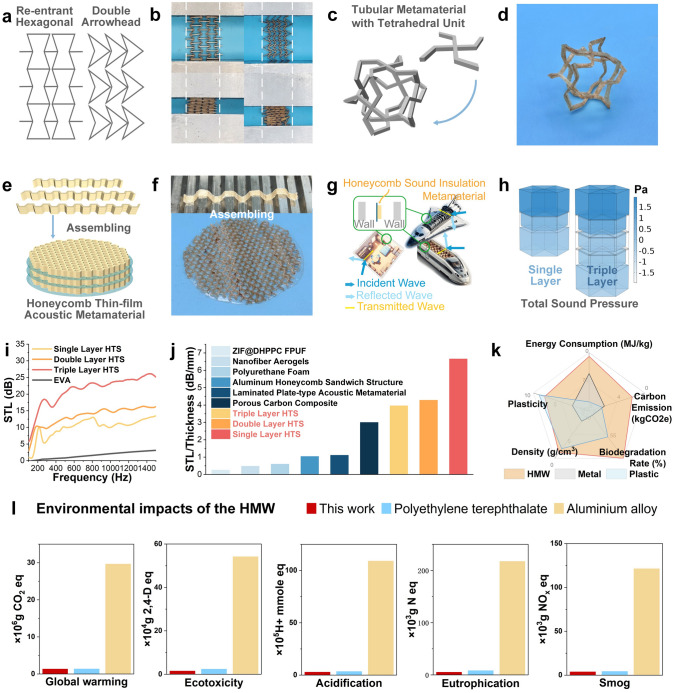 Figure 5
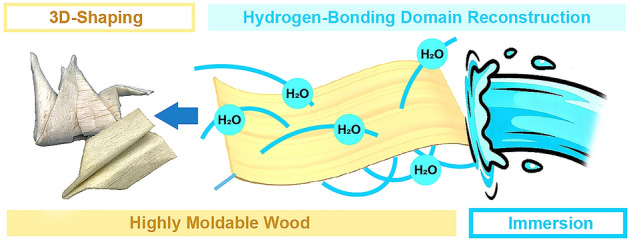 Figure 6
Peer Reviews
No public reviews on file for this paper yet. If you reviewed it on a platform where reviews are public (OpenReview, ICLR, NeurIPS, ICML), you can paste yours below so the community can read it here.
Videos
No videos yet. Explain this paper in a talk, walkthrough, or lecture? Add one.
Taxonomy
TopicsAdvanced Cellulose Research Studies · Polymer composites and self-healing · Natural Fiber Reinforced Composites