Automatic detection of single-electron regime and virtual gate definition in quantum dots using U-Net and clustering
Yui Muto, Michael R. Zielewski, Motoya Shinozaki, Kosuke Noro, Tomohiro Otsuka

TL;DR
This paper presents an automated method using U-Net and clustering to detect single-electron regimes and define virtual gates in quantum dots for scalable quantum computing.
Contribution
A novel automated approach combining U-Net and clustering for virtual gate definition and single-electron regime detection in quantum dots.
Findings
U-Net successfully identifies charge transition lines in charge stability diagrams.
Clustering Hough transform outputs enables automatic identification of the single-electron regime.
The method provides a transformation matrix to virtual gates and operates entirely automatically.
Abstract
To realize practical quantum computers, a large number of quantum bits (qubits) will be required. Semiconductor spin qubits offer advantages such as high scalability and compatibility with existing semiconductor technologies. However, as the number of qubits increases, manual qubit tuning becomes infeasible, motivating automated tuning approaches. In this study, we use U-Net, a neural network method for object detection, to identify charge transition lines in experimental charge stability diagrams. The extracted charge transition lines are analyzed using the Hough transform to determine their positions and angles. Based on this analysis, we obtain the transformation matrix to virtual gates. Furthermore, we identify the single-electron regime by clustering the Hough transform outputs. We also show the single-electron regime within the virtual gate space. These sequential processes are…
Genes, proteins, chemicals, diseases, species, mutations and cell lines named across the full text — each resolved to its canonical identifier and authoritative record.
Click any figure to enlarge with its caption.
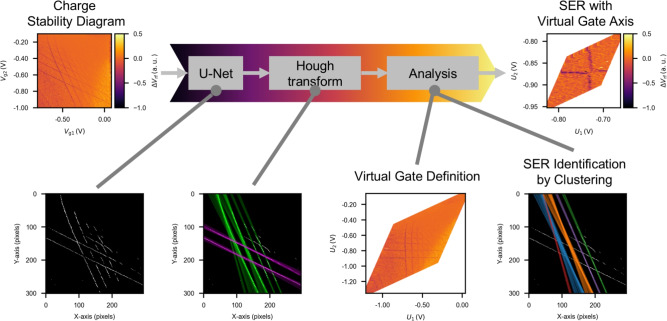 Figure 1
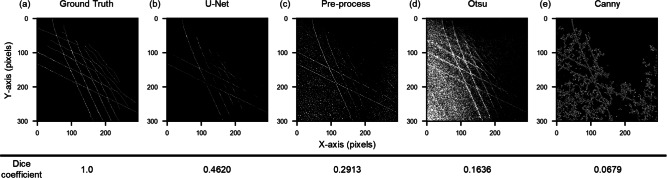 Figure 2
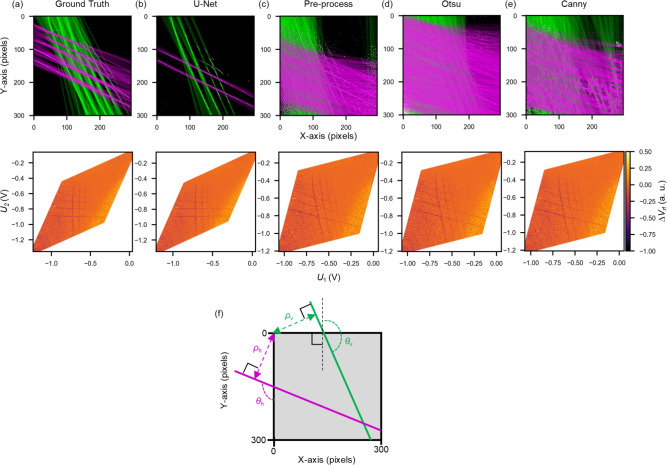 Figure 3
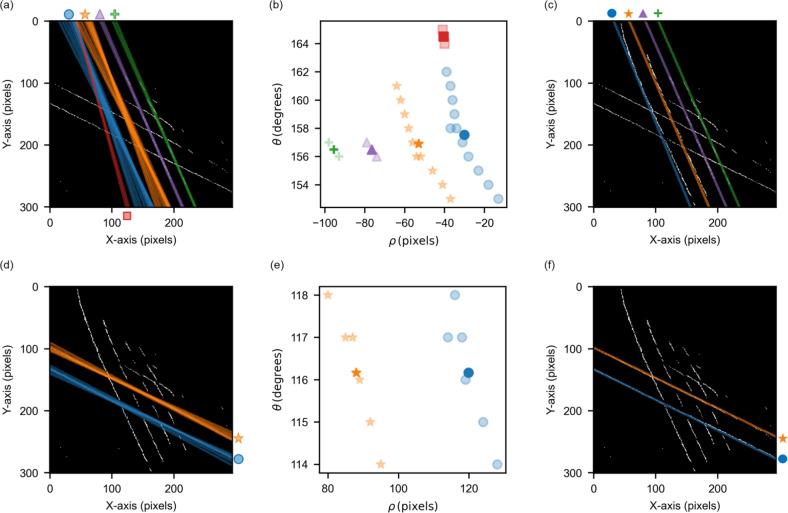 Figure 4
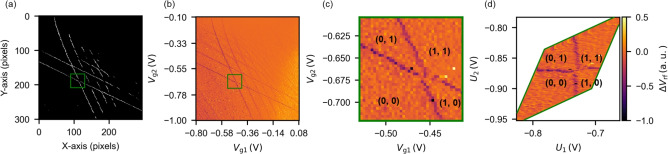 Figure 5
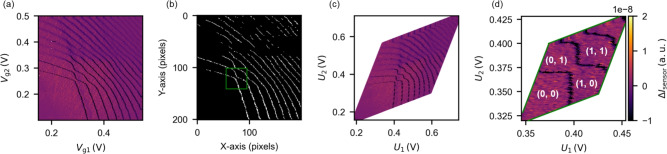 Figure 6
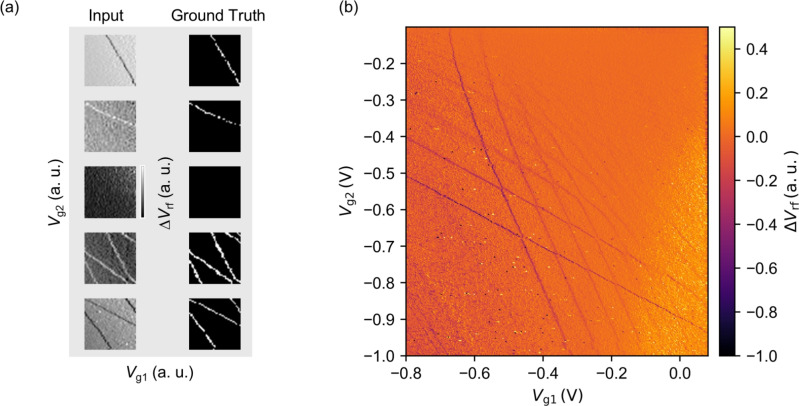 Figure 7
Peer Reviews
No public reviews on file for this paper yet. If you reviewed it on a platform where reviews are public (OpenReview, ICLR, NeurIPS, ICML), you can paste yours below so the community can read it here.
Videos
No videos yet. Explain this paper in a talk, walkthrough, or lecture? Add one.
Taxonomy
TopicsElectron and X-Ray Spectroscopy Techniques · Integrated Circuits and Semiconductor Failure Analysis · Advanced Electron Microscopy Techniques and Applications