Rallying and Amplifying Faculty Voice During Periods of Curriculum Reform
Adarsh Shidhaye, Kirby Allen, Shanna Williams, Kelly Quesnelle

TL;DR
This study introduces a new approach to curricular reform in medical science education that reduces faculty stress and increases participation through motivation and structured support.
Contribution
The novel contribution is an evidence-based model for curricular reform using Kotter’s change model and self-determination theory.
Findings
High participation rates were observed in faculty working groups during curricular reform.
Measurable goal achievements were linked to motivation and structured support.
The approach fostered a positive culture and improved curricular outcomes.
Abstract
Faculty face numerous demands, leading to stress and burnout, which can be exacerbated during curricular reform. This study presents a new approach to curricular reform which takes advantage of people’s motivational propensities for learning and growth. Based on a self-determination framework, one medical science education department employed Kotter’s change model to implement a curricular reform through faculty working groups. High participation rates and measurable goal achievements were observed, highlighting the importance of motivation and structured support in driving curricular improvements and fostering a positive culture. This study presents an evidence-based model for curriculum reform tailored to medical science educational faculty.
Genes, proteins, chemicals, diseases, species, mutations and cell lines named across the full text — each resolved to its canonical identifier and authoritative record.
Click any figure to enlarge with its caption.
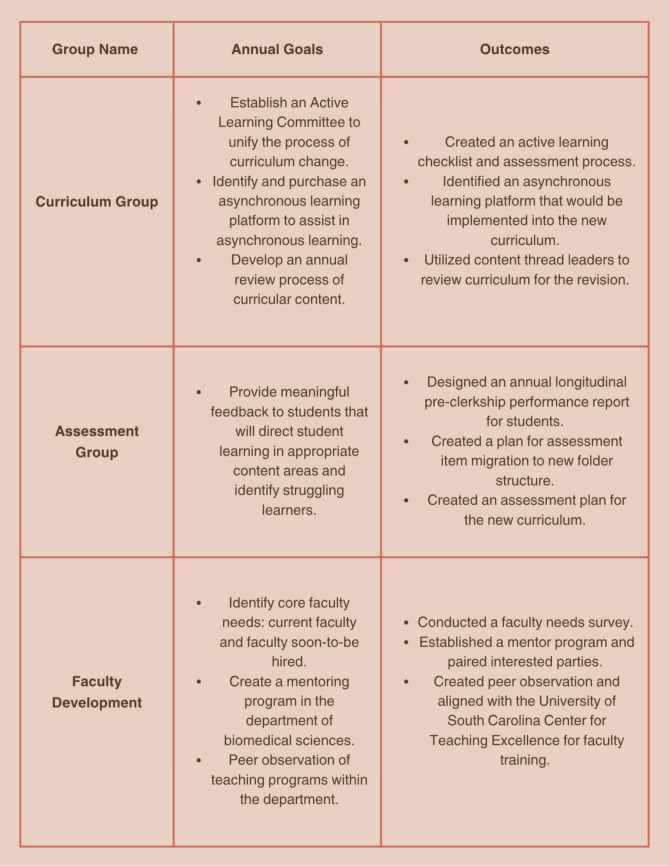 Figure 1
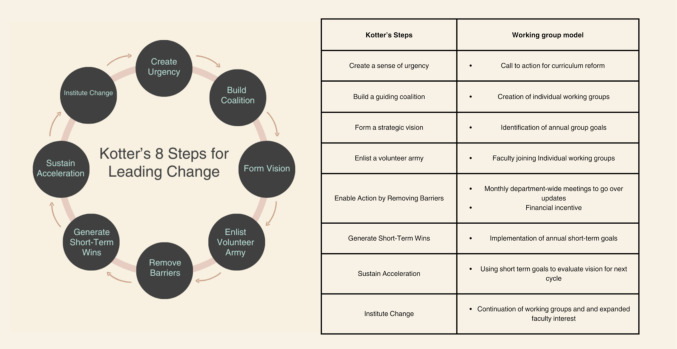 Figure 2
Peer Reviews
No public reviews on file for this paper yet. If you reviewed it on a platform where reviews are public (OpenReview, ICLR, NeurIPS, ICML), you can paste yours below so the community can read it here.
Videos
No videos yet. Explain this paper in a talk, walkthrough, or lecture? Add one.
Taxonomy
TopicsTeacher Education and Leadership Studies · Motivation and Self-Concept in Sports · Evaluation of Teaching Practices