Chemo-Strain Valence Engineering for Boosting Photovoltaic Response in Double Perovskite Epitaxial Films
Yonghui Wu, Jie Tu, Jing Xia, Xudong Liu, Longyuan Shi, Hangren Li, Menglin Li, Peng Chen, Qianqian Yang, Siyuan Du, Pengfei Song, Haiying Li, Qian Zhan, Xiaolong Li, Jianjun Tian, Linxing Zhang

TL;DR
Researchers improved the photovoltaic performance of double perovskite films by using a substitution strategy that alters lattice and valence states, achieving record current density under white light.
Contribution
A novel aliovalent substitution strategy synergizes chemical strain and defect engineering to enhance ferroelectric photovoltaic performance in double perovskite films.
Findings
Pb substitution in Bi2FeMnO6 boosts short-circuit current density to 320 μA cm−2 under white light.
The method increases JSC by 109-fold and VOC by fourfold compared to pure BFMO.
Chemical strain and valence modulation are confirmed to enhance bandgap engineering and photovoltaic response.
Abstract
A simple inequivalent substitution strategy modulates lattice distortion and element valence states, realizing a remarkable boost in ferroelectric photovoltaic performance under white light (|JSC| = 320 μA cm−2 after negative poling).Synergistic integration of chemical strain and defect engineering yields high performance ferroelectric photovoltaic in double perovskite thin films.Oxygen vacancies enable electric-field modulation of photovoltaic response in ferroelectric thin films by tuning the band gap and engineering the Schottky barrier. A simple inequivalent substitution strategy modulates lattice distortion and element valence states, realizing a remarkable boost in ferroelectric photovoltaic performance under white light (|JSC| = 320 μA cm−2 after negative poling). Synergistic integration of chemical strain and defect engineering yields high performance ferroelectric…
Genes, proteins, chemicals, diseases, species, mutations and cell lines named across the full text — each resolved to its canonical identifier and authoritative record.
Click any figure to enlarge with its caption.
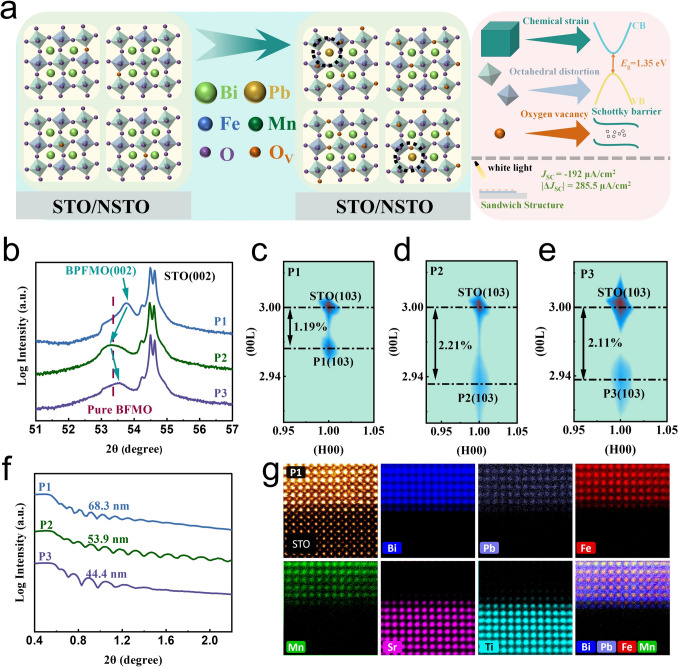 Figure 1
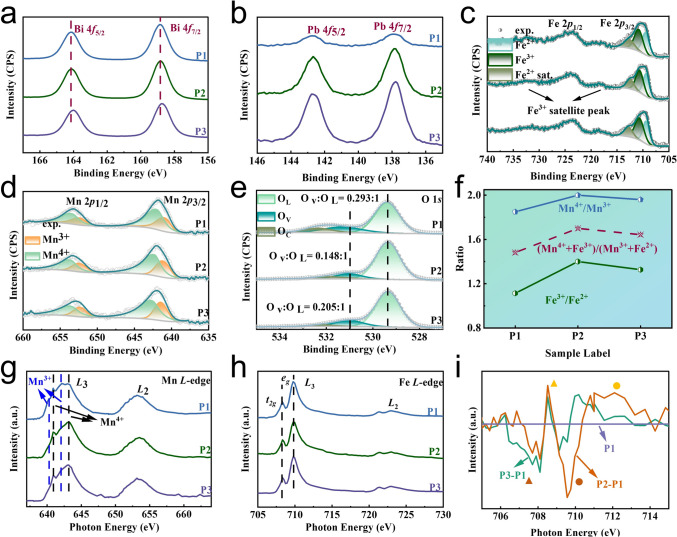 Figure 2
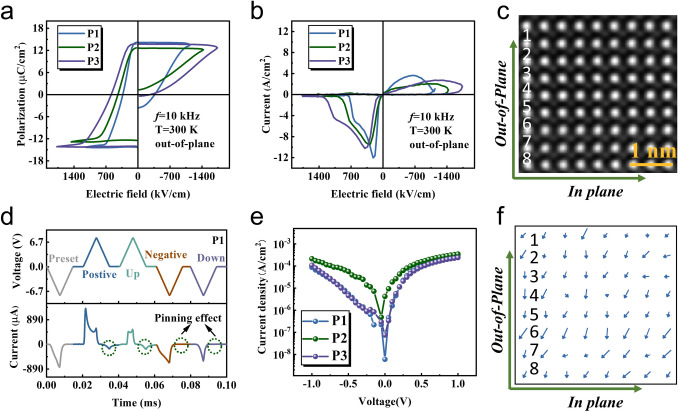 Figure 3
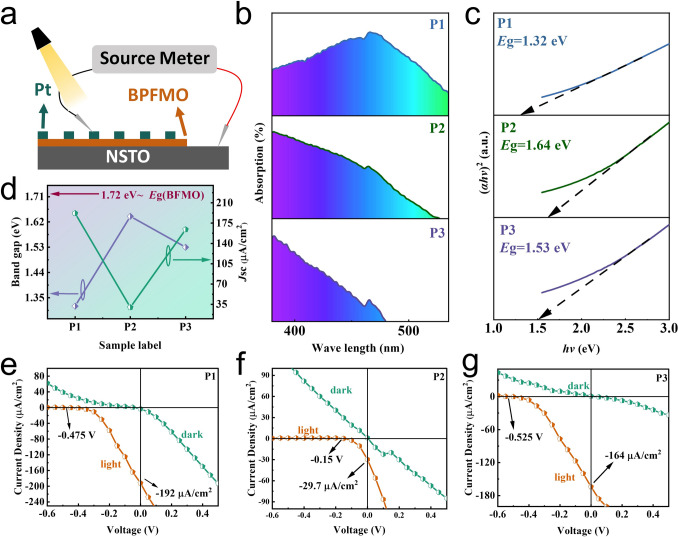 Figure 4
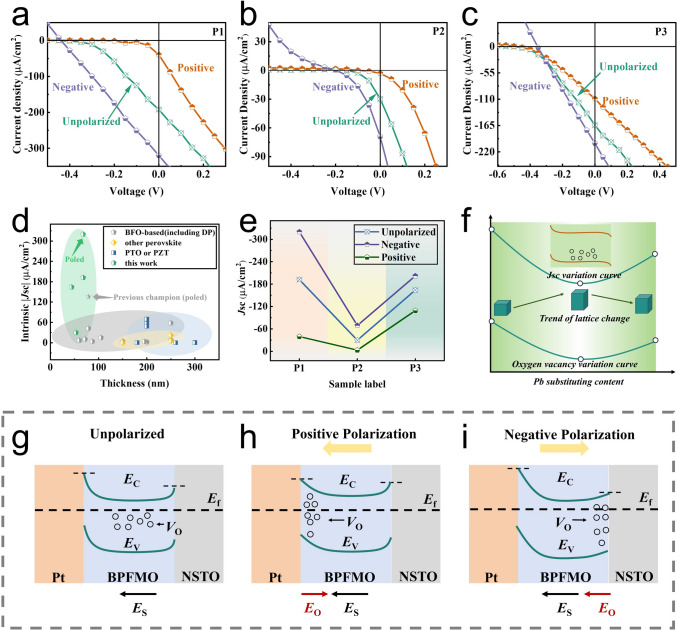 Figure 5
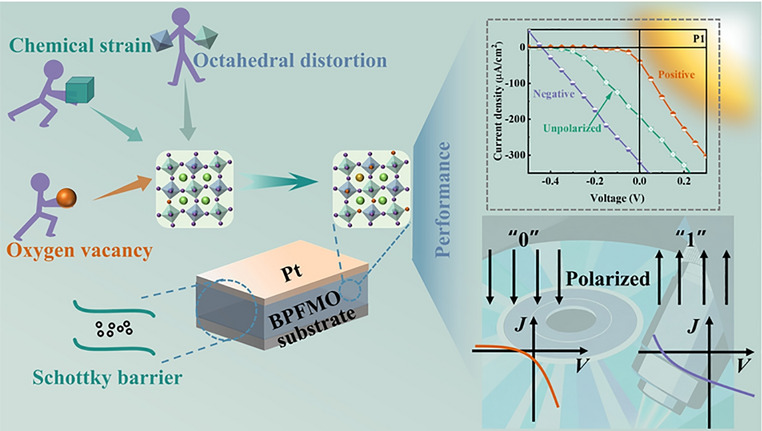 Figure 6
Peer Reviews
No public reviews on file for this paper yet. If you reviewed it on a platform where reviews are public (OpenReview, ICLR, NeurIPS, ICML), you can paste yours below so the community can read it here.
Videos
No videos yet. Explain this paper in a talk, walkthrough, or lecture? Add one.
Taxonomy
TopicsMultiferroics and related materials · Perovskite Materials and Applications · 2D Materials and Applications