Near-care assay of plasma glial fibrillary acid protein and ubiquitin carboxyl-terminal hydrolase isozyme L1 with shorter and prolonged duration exercise
Michael John Stacey, Amanda Barden, Daniel Snape, Barney Wainwright, Iain Parsons, Todd Leckie, Daniel Fitzpatrick, Gerasimos Grivas, Yannis Pitsiladis, Tom Palin, John O’Hara, David Woods

TL;DR
This study examines how exercise and heat stress affect blood levels of two brain injury biomarkers, GFAP and UCHL1, to determine if they might interfere with TBI diagnosis.
Contribution
The study reveals that UCHL1 levels can rise significantly during prolonged exercise, potentially leading to false positives in TBI diagnosis.
Findings
UCHL1 levels more than doubled during a marathon, exceeding the decision threshold for neuroimaging in 18 out of 25 runners.
GFAP levels remained stable during both laboratory and field exercise conditions.
Exercise-heat stress may confound UCHL1 interpretation in traumatic brain injury management.
Abstract
Neurobiomarkers measured in peripheral blood can supplement management strategies following traumatic brain injury (TBI). Dual-assay of glial fibrillary acid protein (GFAP) and ubiquitin carboxyl-terminal hydrolase isozyme L1 (UCHL1) is FDA-approved to inform a decision threshold approach (GFAP > 30 µg.L− 1 and/or UCHL1 > 360 µg.L− 1) for post-TBI neuroimaging. As physical activity and thermal strain often accompany TBI-prone activities, we investigated whether each molecule’s quantification - and, by extension, clinical decisions - could be influenced by exercise-heat stress. In healthy volunteers monitored continuously for body core temperature (Tc), we used the i-STAT Alinity to assess plasma GFAP and UCHL1 responses to exercise in the laboratory (four female, eighteen male trained participants, cycling for 45 min in 32 °C) and field (three female and 22 male recreational marathon…
Genes, proteins, chemicals, diseases, species, mutations and cell lines named across the full text — each resolved to its canonical identifier and authoritative record.
Click any figure to enlarge with its caption.
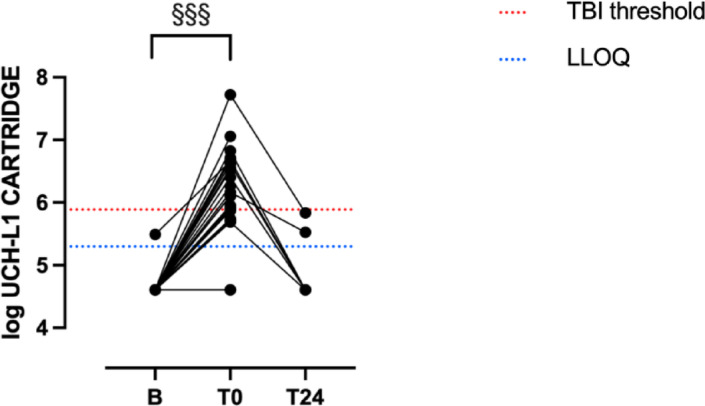 Figure 1
Peer Reviews
No public reviews on file for this paper yet. If you reviewed it on a platform where reviews are public (OpenReview, ICLR, NeurIPS, ICML), you can paste yours below so the community can read it here.
Videos
No videos yet. Explain this paper in a talk, walkthrough, or lecture? Add one.
Taxonomy
TopicsThermal Regulation in Medicine · S100 Proteins and Annexins · Thermoregulation and physiological responses